

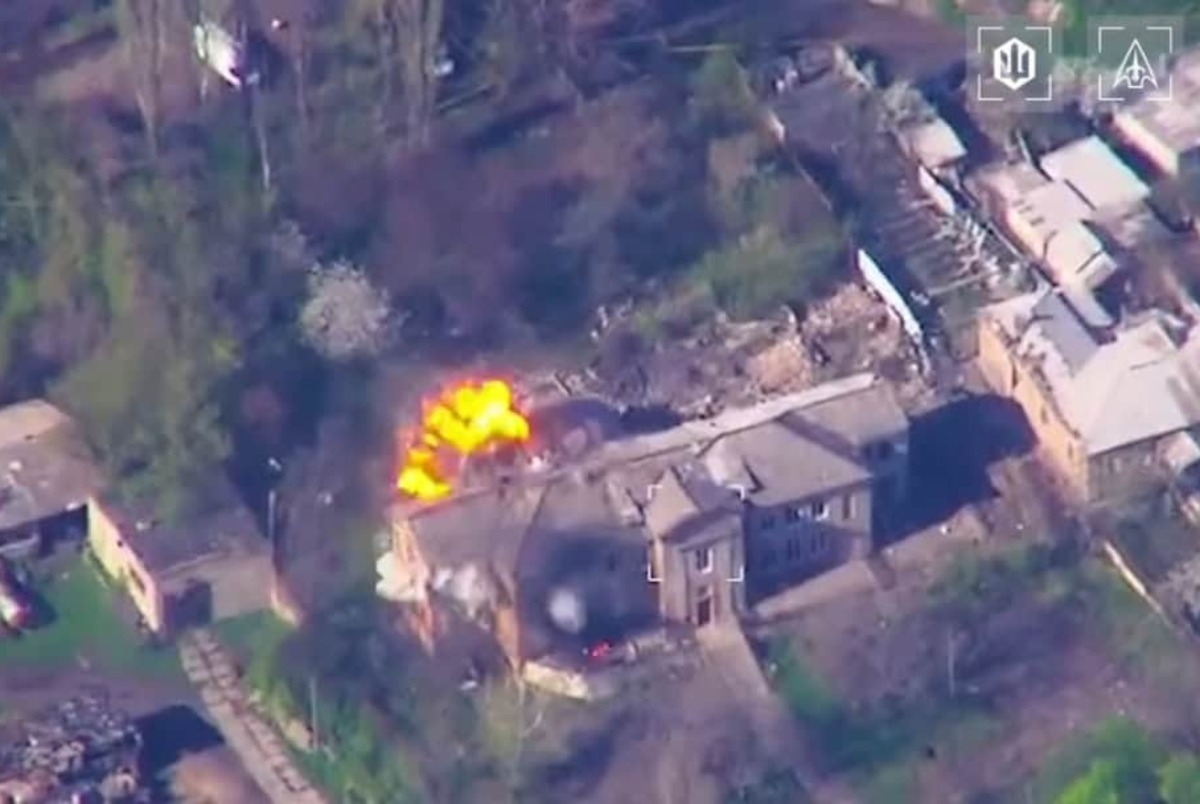
- Ukraine's Unmanned Systems Forces commander Robert Brovdi publicly accused warhead manufacturers of systemic quality failures, citing a strike on a Russian command post in Kadiivka.
- Six FP-2 drones with 100-kilogram warheads were used to destroy a single building that Brovdi said should have required only two aircraft.
The commander of Ukraine’s Unmanned Systems Forces publicly accused domestic warhead manufacturers of delivering substandard products that are forcing frontline units to expend far more drones than necessary to destroy a single target — and he used a real combat operation to prove it.
Robert Brovdi, call sign “Madyar,” commander of the Unmanned Systems Forces of the Armed Forces of Ukraine, made the accusation public in a statement reported by Ukrainian defense outlet Militarny.
His criticism was pointed and specific: low-quality warheads fitted to Ukrainian strike drones are failing to deliver the destructive effect their specifications promise, and the problem is systemic, not incidental.
Brovdi shared video evidence from an actual strike to support his case. The target was a command post of Russia’s 58th Army, located in the temporarily occupied city of Kadiivka in the Luhansk region — approximately 55 kilometers from the front line. Ukrainian forces attacked the building using FP-2 drones manufactured by the Ukrainian company Fire Point, each fitted with a 100-kilogram warhead. Six aircraft were used to completely destroy the structure. According to Brovdi, two should have been sufficient if the warheads had performed to their declared specifications.
Four additional drones consumed against a single target means four fewer aircraft available for strikes on other Russian command posts, logistics nodes, or military infrastructure in temporarily occupied territory. Multiplied across dozens or hundreds of similar strike missions, underperforming warheads translate directly into reduced battlefield effectiveness for Ukraine’s drone campaign.
“This is a constant problem, otherwise I would not have allowed myself to highlight it publicly,” he wrote. “Take your eyes off counting super-profits and solve the problem immediately.” The statement was a direct rebuke to manufacturers he accused of prioritizing financial returns over combat performance, and of lobbying their own interests rather than engaging directly with the frontline units that use their products. He called on warhead producers to focus on quality and establish direct communication channels with combat units.
Fire Point, the manufacturer of the FP-2 drone used in the Kadiivka strike, responded through its co-founder and chief designer Denis Shtilerman, who had previously explained the company’s production process. Shtilerman stated that Fire Point does not manufacture warheads itself — the company sources them from third-party suppliers. He said quality control is rigorous: every twentieth munition is deliberately cut open to verify that the entire batch is free of defects. He also described the military’s stated requirement for the warhead: penetration of 15 centimeters of concrete without destruction of the warhead casing. Whether the warheads delivered against the Kadiivka target met that specification is precisely what Brovdi’s public statement calls into question.
The FP-2 is a Ukrainian-developed strike drone produced by Fire Point, a domestic defense manufacturer operating within Ukraine’s rapidly expanding unmanned systems industrial base. Strike drones of this class — typically carrying substantial explosive payloads and designed for one-way attack missions against fixed targets — have become one of Ukraine’s primary tools for striking Russian military infrastructure deep behind the front line. The ability to reach targets 55 kilometers from the contact line, as demonstrated in the Kadiivka strike, illustrates the operational reach these systems provide. Their effectiveness, however, depends entirely on the lethality of the warhead on arrival.
Ukraine’s Unmanned Systems Forces, established as a distinct branch of the Armed Forces of Ukraine, were created specifically to centralize command, doctrine, and procurement for what has become one of the most drone-intensive conflicts in military history. The war against Russia’s full-scale invasion has turned Ukraine into both a testing ground and a proving ground for unmanned systems at scale — strike drones, reconnaissance drones, maritime drones, and first-person-view attack platforms have all become integral to daily operations across the front. That scale means quality failures in any component of the drone supply chain have consequences that ripple across the entire campaign.
Brovdi’s public intervention is unusual in its directness. Military commanders rarely criticize domestic defense suppliers by name and on the record, particularly during active conflict when maintaining industrial relationships is operationally necessary. The fact that he chose to do so — and backed the accusation with combat footage — suggests the problem has persisted long enough and at sufficient scale to warrant the reputational risk of a public confrontation.