

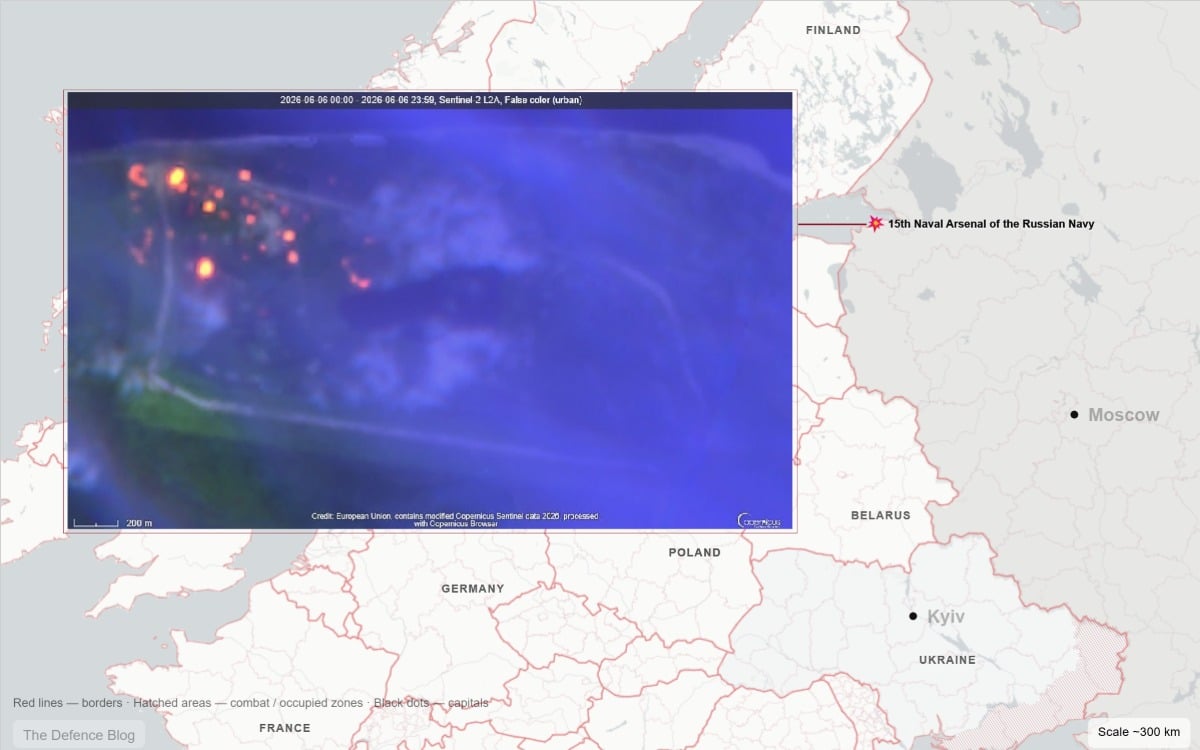
Fresh Sentinel-2 satellite imagery has confirmed what local Russian officials initially denied: Ukrainian long-range attack drones struck the 15th Naval Arsenal of the Russian Navy at Bolshaya Izhora in the Leningrad region, triggering a massive fire and secondary detonations powerful enough that more than 600 residents of nearby settlements had to be evacuated while Russian military and emergency personnel spent hours trying to bring the blaze under control.
The satellite imagery, reviewed and published by open-source analysts in the days following the June 6 attack, shows unmistakable thermal signatures and fire damage at the arsenal’s ammunition storage areas, providing visual confirmation that the strike penetrated the facility’s storage zones rather than merely impacting perimeter areas. Ukrainian drones covered approximately 1,000 km (620 miles) to reach the target, as confirmed by Ukrainian President Volodymyr Zelenskyy, who described the operation as part of Ukraine’s “long-range sanctions” strategy targeting Russian military and economic infrastructure deep inside Russian territory.
The General Staff of the Armed Forces of Ukraine formally confirmed a strike on the missile and munitions storage arsenal of the 1060th Logistics Support Center at Bolshaya Izhora, with explosions, secondary detonations, and fire recorded at the site.
The 15th Naval Arsenal, designated Military Unit 81263 and located in the Lomonosovsky District of the Leningrad region approximately 35 km (22 miles) south of Saint Petersburg, is one of the Russian Baltic Fleet’s most strategically important logistics installations. The facility stores, repairs, maintains, and disposes of naval mines, torpedoes, and missile systems for Baltic Fleet vessels, making it a central node in the ammunition supply chain that keeps Russian naval forces operational in the Baltic Sea. Available satellite imagery revealed that Russian forces had not even constructed protective earth berms around buildings within the arsenal, according to analysis published by Defence Express, a Ukrainian defense outlet that reviewed the overhead imagery. That absence of basic ammunition storage protection reflects a decades-old Soviet-era facility design that assumed deep strategic depth would protect the site from air attack, an assumption that Ukrainian long-range drone capability has now invalidated twice in less than a week.
The secondary detonations recorded after the initial drone impacts are the detail that most clearly indicates the scale of the damage. When munitions storage areas are struck by an incoming warhead, the stored explosive material can cook off in a cascading series of sympathetic detonations that are far more destructive than the initial impact, sending fragments and blast overpressure across a wide area and making firefighting operations extremely dangerous. After the attack on the 15th arsenal’s warehouses, local chat groups reported a possible evacuation of residents from nearby settlements, and Leningrad Oblast Governor Alexander Drozdenko confirmed that more than 600 people had been evacuated from Bolshaya Izhora while military and emergency personnel worked to extinguish the fire, as reported by CNN, which geolocated video of thick smoke plumes rising from the area.
The governor’s initial response had been to minimize the attack, with Drozdenko claiming that Russian air defenses had shot down 141 drones over Leningrad Oblast and that only debris had fallen in three districts of the region. That framing, consistent with Russia’s standard pattern of attributing damage to intercepted drone debris rather than direct hits, was directly contradicted by the satellite imagery that subsequently emerged, by the evacuation of 600 civilians, by Ukraine’s General Staff confirmation, and by the secondary detonations visible in video footage from the area. The gap between the governor’s initial public statement and what the satellite record shows is a familiar feature of information management around Ukrainian strikes on Russian territory, where local officials routinely minimize or deny successful attacks before physical evidence makes denial untenable.
The Exilenova+ channel, which has documented Russian military facilities throughout the war, described the 15th Arsenal as a strategic facility responsible for storing, repairing, maintaining, and disposing of naval munitions, torpedoes, and missile systems for the Russian Baltic Fleet, framing the strike as part of what it called “the planned demilitarization of Leningrad and Russia.” The strike on Bolshaya Izhora was part of a broader June 6 drone campaign that Zelenskyy confirmed also targeted the Kronstadt naval base and shipyard, also near Saint Petersburg, as well as an oil depot in Krasnodar Krai in southern Russia approximately 500 km (310 miles) from Ukrainian territory. The coordinated assault was executed by the Special Operations Forces’ “Deep Strike” units alongside the Unmanned Systems Forces and the Security Service of Ukraine, bypassing regional air defenses to ignite fires within the naval hub and navy ammunition arsenals near St. Petersburg, according to Kyiv Post’s reporting on Ukrainian official confirmations.
The 15th Arsenal strike follows a pattern of Ukrainian targeting of Russian Baltic Fleet logistics that has accelerated significantly in recent months. The facility’s role in maintaining torpedo and mine stocks for Baltic Fleet surface combatants and submarines makes its degradation operationally consequential beyond the immediate destruction of stored munitions, since replacing complex naval weapons systems requires industrial capacity and supply chain access that Russian sanctions pressure has already strained. Munitions that are destroyed on the ground at a storage depot are munitions that cannot be loaded onto ships, fired at Ukrainian coastal targets, or used to lay mine barriers in the Baltic approaches.
The satellite imagery that confirmed the damage to Bolshaya Izhora is a reminder that the information environment around this conflict has permanently changed. Russia cannot credibly claim that its most protected strategic facilities are untouched when commercial and government satellite operators can produce overhead imagery within hours of an attack, and open-source analysts can match those images to ground truth provided by social media video from the vicinity.