

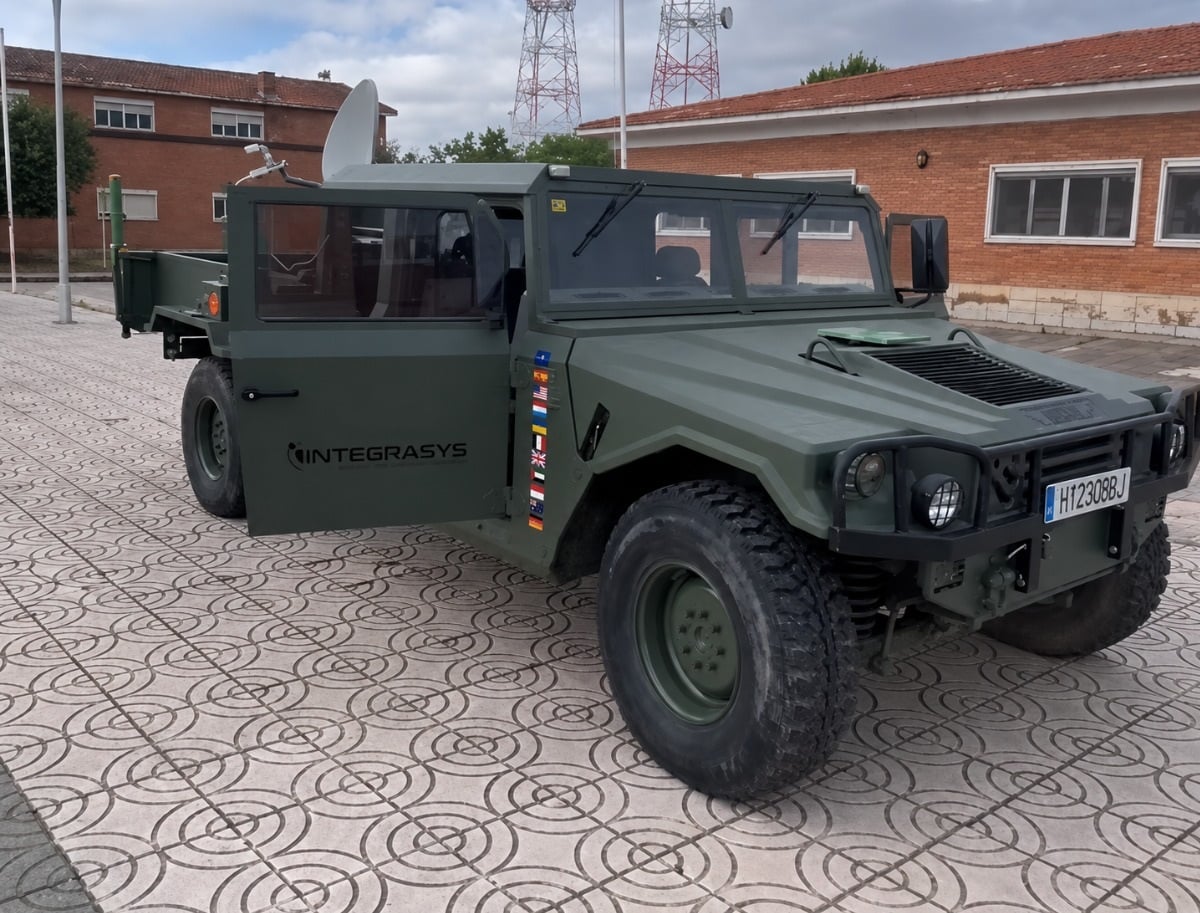
- Integrasys invested €400,000 converting a retired Spanish Air Force URO VAMTAC into a mobile electronic warfare demonstrator presented publicly on June 4, 2026.
- The vehicle integrates Starlink connectivity via LEONNMS, real-time anti-jamming, AI-powered cognitive jamming, INTERGEO signal geolocation, and tactical communications in a single deployable platform.
A Spanish defense technology company has transformed a decommissioned military truck into one of the more unusual vehicles currently making the rounds in European defense circles: a fully operational mobile electronic warfare platform packed with jamming systems, satellite connectivity management, signal geolocation hardware, and real-time anti-drone capability, all integrated into a single deployable unit, El Periódico reported.
The vehicle, unveiled by Integrasys CEO Álvaro Sánchez at a public demonstration, represents the company’s bet that the future of electronic warfare is not a fixed installation or a purpose-built military platform but a capability that can be loaded onto any suitable vehicle and driven to wherever the threat is.
Integrasys, a Spanish technology company with approximately 100 employees across 11 global offices and annual revenues of around €9 million, has spent years supplying spectrum monitoring and interference detection systems to satellite operators, space agencies, and military customers across multiple continents, including NASA, the European Space Agency, the Saudi Arabian Ministry of Defense, French and British special operations forces, Taiwan, and the U.S. Space Force. The company’s decision to invest €400,000 ($460,000) converting a retired military vehicle into a mobile demonstrator reflects a deliberate choice to show potential customers what integrated electronic warfare looks like in practice rather than in a product brochure.
The vehicle at the center of the demonstration is a URO VAMTAC, the High Mobility Tactical Vehicle developed by Spanish manufacturer URO Vehículos Especiales and widely used across the Spanish Armed Forces and by numerous NATO allies as a tactical four-wheel-drive platform. The specific truck Integrasys acquired had previously served the Spanish Air Force in operational deployments in Bosnia and Afghanistan before being retired from active service. Rather than a purpose-built military electronic warfare vehicle designed from the ground up, the URO demonstrator is a proof of concept showing that commercial and government-off-the-shelf electronic warfare technology can be integrated into an existing tactical vehicle with enough capability to conduct real operations.
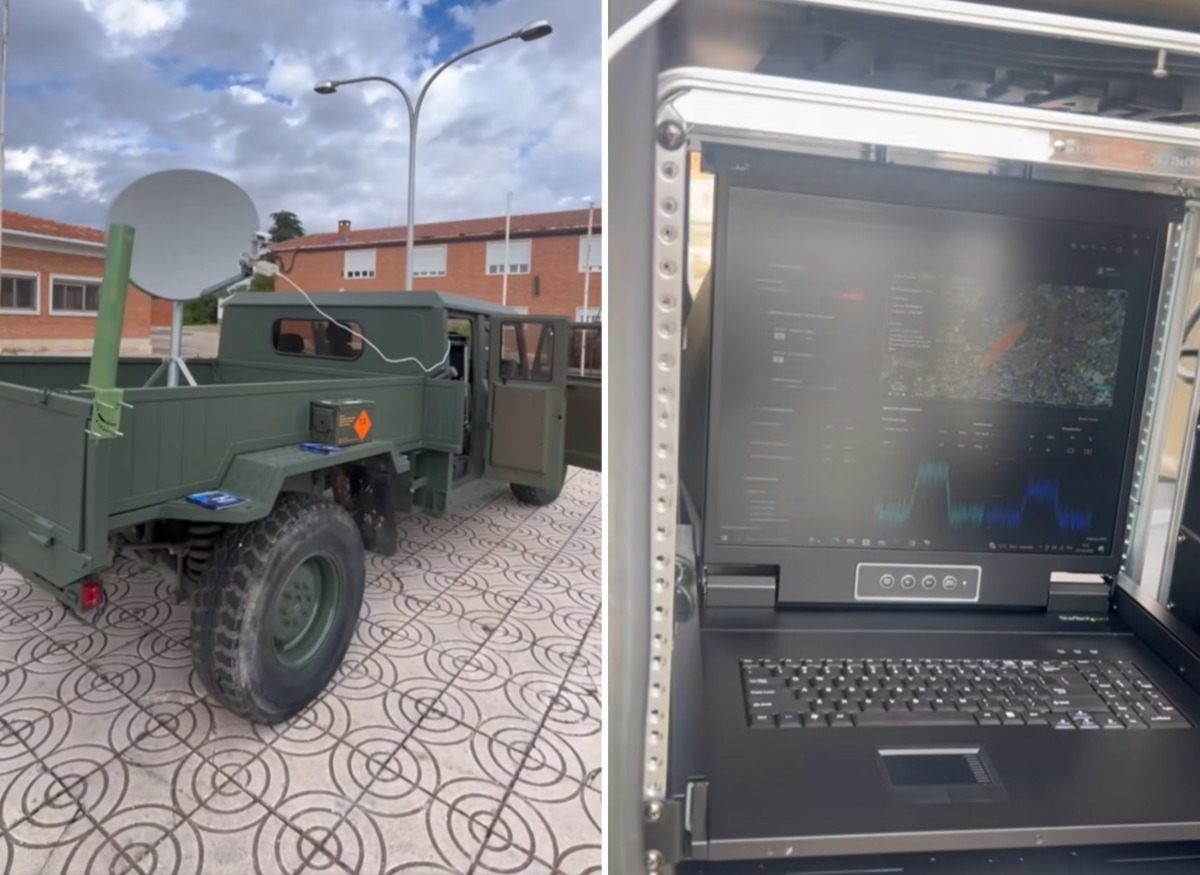
The capability suite the converted URO carries covers the full spectrum of electronic warfare tasks a tactical unit might need in a drone-intensive combat environment. The vehicle integrates Starlink satellite connectivity managed through Integrasys’s LEONNMS network management system, allowing the platform to maintain broadband communications links even in areas where terrestrial communications infrastructure has been degraded or destroyed, a scenario that has become routine in the Ukrainian war where Russian strikes have systematically targeted communications towers, fiber routes, and relay stations. Real-time anti-jamming technology protects the vehicle’s own communications and navigation systems from hostile electronic attack while the platform is operating, ensuring that the equipment protecting others does not become a liability when adversaries attempt to blind it.
The offensive electronic warfare layer built into the URO platform centers on the company’s Jam CCS system, an AI-powered cognitive jamming tool that Sánchez described as a fundamental upgrade from earlier broadband jammers that disrupted friendly and enemy signals with equal indiscrimination. Cognitive jamming uses artificial intelligence to identify the specific signals used by hostile drones or communications systems and target those signals selectively, leaving allied communications and navigation functional while denying the same to adversaries operating in the same frequency bands. The company describes the detection-to-jamming cycle as approximately two seconds from initial spectrum scan to active signal denial, a response speed calibrated to the operational reality that FPV drone attacks can close the distance between detection and impact in a matter of seconds.
Signal geolocation is provided through Integrasys’s INTERGEO system, which allows the vehicle to precisely locate the source of radio frequency emissions in its operational area. That capability has direct applications both for counter-drone operations, where identifying the location of a drone operator enables a lethal or non-lethal response, and for broader electronic intelligence collection, where mapping the electromagnetic signatures of opposing forces provides actionable targeting data for artillery, aviation, or other assets. The INTERGEO system can geolocate the vehicle’s own transmissions from an external telepresence facility as well, providing an independent verification capability that allows operators to confirm their own electromagnetic signature and adjust accordingly to reduce detectability.
The tactical communications solutions integrated into the platform round out a capability package designed to function as a self-contained electronic warfare node that can be deployed forward with maneuvering units rather than remaining tethered to fixed support infrastructure. That forward deployment model is directly relevant to the operational environment that Ukraine has demonstrated, where electronic warfare capability concentrated at headquarters or fixed positions has proven far less effective than distributed, mobile systems that can respond to threats as they develop across a fluid front line.
According to El Periódico’s reporting, approximately 70 percent of Integrasys’s technologies have already been tested in real combat conditions in Ukraine, where the company has personnel operating equipment to help mitigate the mass drone attacks that define the conflict. That operational validation record gives the URO demonstrator’s capabilities a credibility that a laboratory-only system cannot claim, and it provides Integrasys with direct feedback from the most demanding electronic warfare environment currently operating anywhere in the world. The lessons from Ukraine have shaped every element of the integrated platform: the speed of the jamming response, the selectivity of the cognitive system, the emphasis on satellite connectivity resilience, and the mobile deployment model all reflect problems that fixed or slow electronic warfare systems have failed to solve on the Ukrainian front.