

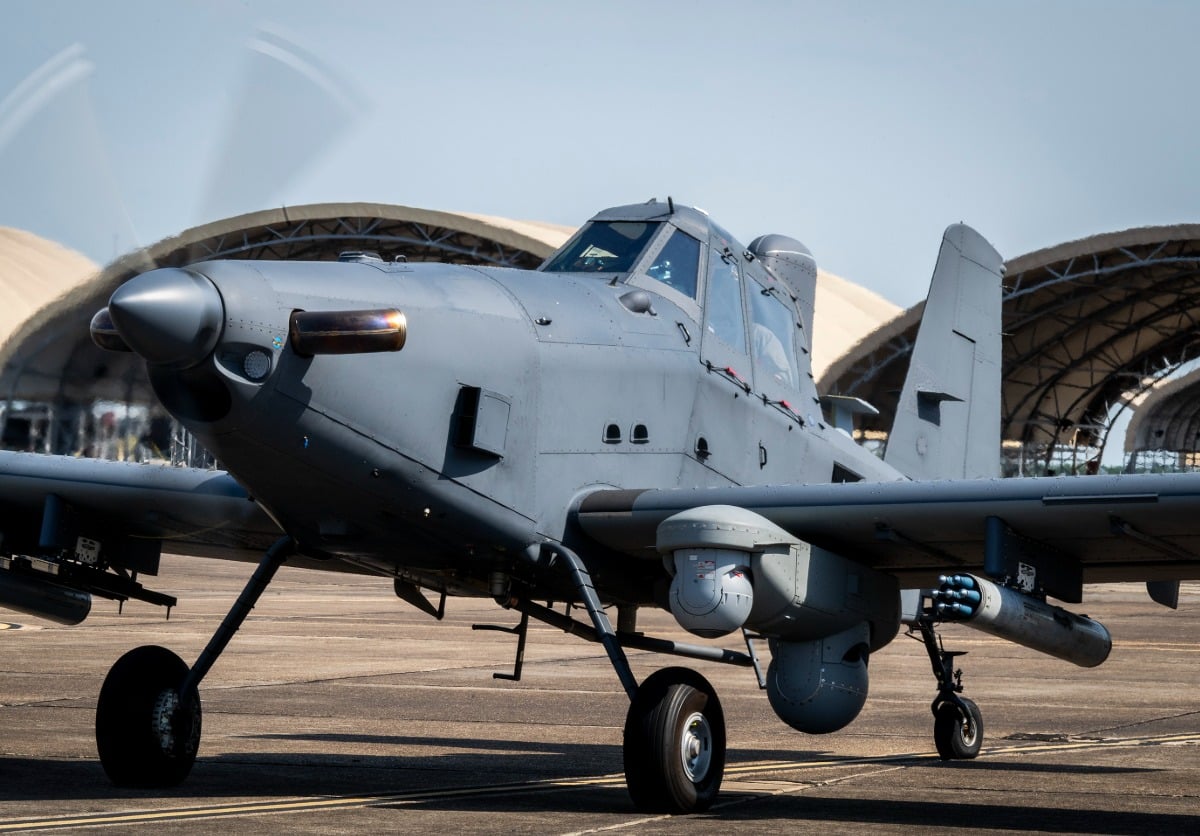
- The 17th Special Operations Squadron published a sources sought notice on June 4, 2026, seeking three external carriage mobility pods for the OA-1K Skyraider II.
- The pod must fit BRU-71/A pylons with 14-inch lug spacing, provide at least 0.25 cubic meters of storage, and be delivered within 60 days of contract award.
The United States Air Force’s newest special operations aircraft is a lean, rugged turboprop built for long loiter times, precision strikes, and operations from remote airstrips in some of the world’s most austere environments.
There is just one problem: it has nowhere to put anything and the 17th Special Operations Squadron, the only OA-1K flying unit in the Air Force, has published a draft statement of work seeking external storage pods that attach to the aircraft’s wings, because right now the aircrew cannot bring mission equipment or personal gear on cross-country training trips without trucking it separately.
The sources sought notice by the Oklahoma Air National Guard’s 137th Special Operations Wing on behalf of the 17th Special Operations Squadron, describes a straightforward but operationally significant gap. The OA-1K Skyraider II, the Air Force’s new light attack and armed intelligence, surveillance, and reconnaissance aircraft, has limited to no internal storage capability, and the squadron is tasked with supporting missions and temporary duty assignments throughout the continental United States on a constant monthly basis. Without a way to carry equipment on the aircraft itself, every deployment requires logistics support that the aircraft’s low-overhead operating model was specifically designed to avoid.
The OA-1K Skyraider II, formally designated in February 2025 by Air Force Special Operations Command, is built on the Air Tractor AT-802 agricultural aircraft platform and militarized by L3Harris Technologies, a defense electronics company headquartered in Melbourne, Florida. The two-seat turboprop can carry up to 6,000 pounds of munitions and other stores on up to eight underwing pylons, fly out to an area up to 200 miles away, and loiter there for up to six hours with a typical combat load, making it well suited to the kind of persistent overhead support that special operations ground forces require. The first missionized OA-1K was delivered to AFSOC on April 3, 2025, with the 17th Special Operations Squadron at Will Rogers Air National Guard Base in Oklahoma conducting formal training for the aircraft.
The pod the squadron needs must meet a specific and demanding set of technical requirements derived from the OA-1K’s pylon configuration and flight envelope. According to the draft statement of work, the external carriage mobility pod must be compatible with BRU-71/A aircraft ejector release units, the standard hardware that holds stores to military aircraft pylons, with 14-inch (35.6 cm) lug spacing, and must attach without requiring any modification to the aircraft or its existing pylon. The pod must fit within maximum dimensions of 330 cm (130 inches) in length, 57 cm (22.5 inches) in width, and 73 cm (28.8 inches) in depth, provide a minimum usable internal volume of 0.25 cubic meters (9.0 cubic feet), and achieve a cargo capacity to empty weight ratio of at least 1.9, meaning it must carry nearly twice its own weight in useful load. A stowable internal length of at least 190 cm (75 inches) must accommodate mission equipment of meaningful size, and the pod must include adjustable strap tie-downs to keep contents secured during flight maneuvers.
The structural and materials requirements reflect the realities of military aviation use. The primary structure must be corrosion-resistant, built from composite materials, aluminum, or a hybrid of both, a requirement driven by the exposure to rain, humidity, sun, and temperature extremes that any externally mounted aircraft component experiences across the range of environments where the OA-1K operates. External handles are required to allow aircrew to move the pod safely on the ground, and a keyed locking mechanism must secure the contents against unauthorized access. Center of gravity markings on the internal floor will help crews load the pod correctly, keeping the weight distribution within the limits needed for safe flight.
The notice references two existing commercial products as benchmarks for the kind of solution the Air Force has in mind: the MXU-648, a widely used cargo pod that has been carried by American military aircraft for decades, and the Kihomac ACE pod, a more recently developed option that has attracted interest across multiple platforms. Both represent the mature end of the external carriage pod market, and their mention in the sources sought notice signals that the Air Force is looking for proven commercial solutions rather than a new development program.
The contractor selected will be required to deliver three pods within 60 days of contract award and provide maintenance and support for 12 months, a timeline and scope consistent with a relatively small initial procurement intended to evaluate the solution in operational use before any larger commitment. The technical data package required under the contract covers store drawings, weight and center of gravity data, structural and aerodynamic analysis including ground vibration test results and computational fluid dynamics or wind tunnel data, qualification test results, and maintenance instructions, requirements that reflect the airworthiness certification burden that comes with any new store carried on a military aircraft.
The OA-1K is expected to achieve initial operational capability in 2026, with full fleet delivery expected by 2029, and the program has been cut from an original order of 75 aircraft to 53 in the latest budget projections, a reduction driven by budget pressure and a Pentagon pivot toward high-end conflict preparation. Despite those cuts, AFSOC commander Lieutenant General Michael Conley has continued to support buying the full contingent of 75 aircraft, and the squadron’s active pursuit of logistical improvements like the mobility pod reflects an institution committed to making the platform as operationally capable as possible within the constraints it faces.
The OA-1K was designed to operate from austere airstrips in remote locations with a minimal support footprint, a concept that only works if the aircraft can carry what its crew needs without a separate logistics train. A pod that fits on a weapons pylon, locks with a key, and delivers nearly twice its own weight in useful cargo is not a glamorous piece of military hardware. But for a two-person crew deploying across the country on a training mission, it is exactly the kind of unglamorous capability that makes the difference between an aircraft that can truly go anywhere and one that still needs a truck following it around.