

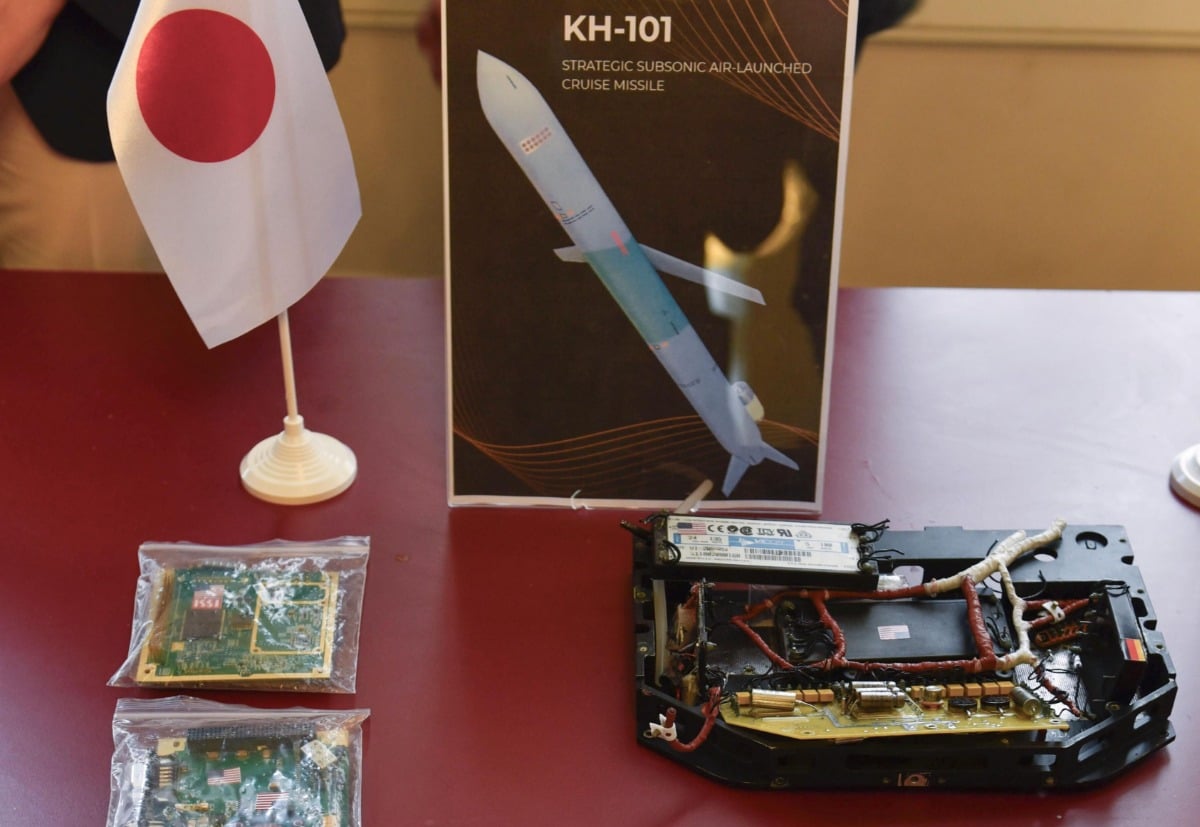
- Ukrainian Presidential Adviser Denys Brasheuk told Kyodo News on June 28, 2026, that Japanese components appear in approximately 90 percent of Russia's cruise missile and drone types.
- Internal Ukrainian government documents named 13 Japanese companies and specifically identified Japanese parts in the Kh-101 cruise missile used extensively against Ukrainian cities.
Ukrainian Presidential Adviser Denys Brasheuk told Kyodo News in an exclusive interview that Japanese-manufactured components have been identified in approximately 90 percent of the cruise missile and drone types Russia has used in its invasion of Ukraine, Kyodo News reported on June 28, 2026.
Brasheuk presented internal Ukrainian government documents during the interview, including materials identifying Japanese semiconductor and electronics manufacturers’ components in the Kh-101, Russia’s primary air-launched cruise missile, and called on Japan to tighten its export control regime to prevent commercial electronics from being diverted to Russian weapons production through third-country intermediaries.
The claim is the most specific accusation Japan has faced since the war began, and it arrives from the most senior Ukrainian official to go on the record with Tokyo-dateline media on the component traceability issue. Brasheuk named 13 Japanese companies in the internal documents he shared with Kyodo News. Of those 13, five told Kyodo News they could not confirm whether the parts were their own products due to limited information. One company said products from one of its group subsidiaries were likely diverted. Another company said the parts were from a different manufacturer. Six companies did not respond to Kyodo News’s inquiries.
The Kh-101 that Brasheuk’s documents implicate is Russia’s most widely used strategic cruise missile, an air-launched weapon designed in the 1990s that entered service in the 2010s and has been fired at Ukrainian cities hundreds of times since February 2022. The missile is 7.45 m (24.4 ft) long, weighs approximately 2,300 kg (5,070 lb), and carries a conventional warhead that Russia increased from 450 kg (992 lb) to approximately 800 kg (1,764 lb) in early 2024 by reducing its fuel capacity. It is launched from Tu-95MS and Tu-160 strategic bombers and travels at up to Mach 0.8, guided by terrain-contour matching, an optical terminal guidance system, and satellite navigation. Since the start of 2026, Ukrainian air defense has shot down approximately 88 percent of Kh-101, Kh-55, and Kh-555 cruise missiles, according to Ukraine’s Ministry of Defense, though Russia has responded by upgrading the missile with electronic countermeasures and decoy dispensers to make interception harder.
The presence of Western electronics in Russian weapons is not a new discovery, but Brasheuk’s framing of Japanese components as pervasive across 90 percent of Russia’s missile and drone inventory, if the internal Ukrainian data supports it, represents a significant escalation in the specificity and breadth of the accusation. The Royal United Services Institute in London examined 27 Russian weapon systems in a 2022 study and identified 450 unique foreign-made components, with at least 318 originating from American companies. A 2024 Financial Times analysis, citing Ukraine’s presidential office, reported that a single Kh-101 that struck the Okhmatdyt children’s hospital in Kyiv in July 2024 likely contained more than 50 parts of Western origin. Ukraine’s defense intelligence directorate has published interactive 3D models of recovered Russian missiles including the Kh-101 and the newer Izdeliye-30, identifying components and the procurement networks used to acquire them, consistently finding chips, navigation receivers, processor modules, and memory components produced by American, Taiwanese, Dutch, Swiss, and German manufacturers.
Japan’s specific exposure to this issue is rooted in the nature of its electronics industry. Japanese manufacturers produce significant volumes of the dual-use components, meaning components with both commercial and military applications, that Russian procurement networks have systematically targeted since sanctions cut off direct access after the 2022 invasion. These include capacitors, resistors, microcontrollers, inertial measurement units, and specialized semiconductors that are not subject to the same stringent export controls as purpose-built military electronics, because they were designed and sold for civilian applications: automotive, consumer electronics, industrial machinery. Brasheuk told Kyodo News that the majority of the Japanese-made components found in Russian weapons were civilian electronics of this type, commercially available in Japan and rerouted to Russia through third countries that do not have equivalent export control regimes.
Japan has progressively tightened its export controls since 2022, joining coordinated Western sanction packages and adding categories of goods to its restricted list. As of mid-2026, however, the Kyodo News reporting suggests those controls have not eliminated the flow of Japanese commercial components into Russian weapons production. The diversion route the Brasheuk documents describe, commercial parts exported to a third country and then re-exported to Russia without Japan’s knowledge or consent, is structurally difficult to close through export licensing alone, because Japan’s control ends at the border of the first destination. Policing the subsequent movement requires either secondary sanctions against the intermediary countries and companies involved, or verification requirements that the end user of Japanese components is not involved in Russian weapons procurement, an administrative burden that scales poorly across the millions of commercial electronics shipments Japan processes annually.
By choosing a Japanese wire service as the venue for disclosing internal Ukrainian government documents naming specific Japanese companies, the Ukrainian presidential adviser has placed the story directly in front of the Japanese media and political establishment in a format that demands a response. Japan is one of Ukraine’s most significant financial supporters in the Group of Seven, having contributed billions of dollars in economic assistance since 2022, and the suggestion that Japanese commercial electronics are killing Ukrainian civilians through a diversion chain Tokyo has not adequately closed creates an uncomfortable domestic political question about whether Japan’s export compliance is consistent with its stated policy of support for Ukraine.
None of the companies named in Brasheuk’s documents have accepted responsibility for the diversion. The structural reality of dual-use component proliferation means responsibility is genuinely diffuse: a Japanese manufacturer that lawfully sells capacitors to a trading company in a third country has not violated any law, and may have no practical way of knowing its products will be re-exported to a Russian missile factory. What Brasheuk’s data claims to establish is not that Japanese companies broke rules but that the rules as currently written, and enforced, are insufficient to keep Japanese technology out of the weapons killing Ukrainian civilians. That is a harder problem than sanctioning a company, and a more uncomfortable one to hand a trusted G7 partner.