

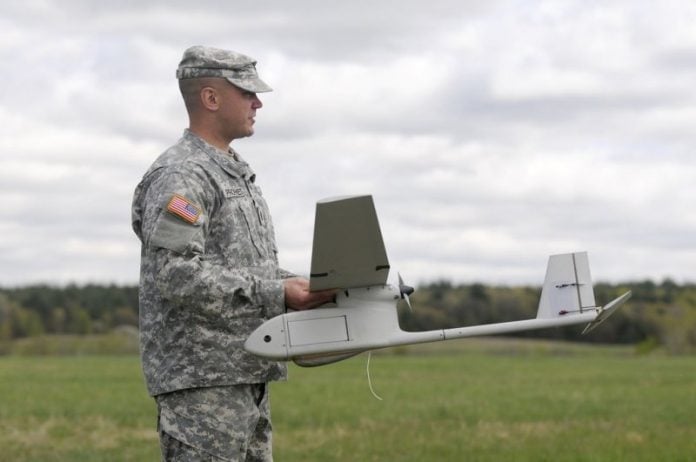
On July 27, the Ukrainian army received a first batch of US-made RQ-11B «Raven» hand-launched remote-controlled unmanned aerial vehicle.
24 RQ-11B Raven Unmanned Aircraft Systems (comprised of 72 aircraft and associated equipment) arrived at Boryspil International Airport July 27. The Raven Unmanned Aircraft System is a hand-launched reconnaissance and surveillance tool. The system transmits live airborne video images and location information to a ground control stations. This capability can provide day or night aerial intelligence and enables operators to navigate, recognize terrain, and record information for analysis.
Raven system is part of the European Reassurance Initiative package and on-going security assistance efforts in Ukraine. Several dozen Ukrainian soldiers already have completed training on Raven Unmanned Aircraft System in Huntsville, Alabama. The United States has committed more than $600 million in training and equipment to help Ukraine better defend its sovereignty and territorial integrity.
On September 14 2014 US Department of Defense posted a list of contracts at www.defense.gov. According to that information $9,049,306 contract was approved for Aerovironment Inc. The company will manufacture 30 RQ-11B Raven unmanned aircraft systems for Ukraine by May 11, 2016.
“Aerovironment Inc.,* Monrovia, California, was awarded a $9,049,306 firm-fixed-price foreign military sales contract (Ukraine) for the small UAV RQ-11B Raven analogy system. Work will be performed in Monrovia, California, with an estimated completion date of May 11, 2016. One bid was solicited with one received. Fiscal 2010 other procurement funds in the amount of $9,049,306 were obligated at the time of the award. Army Contracting Command, Natick, Massachusetts, is the contracting activity (W911QY-15-C-0102).” – US Department of Defense, Contracts.

It was reported earlier that the United States had approved a $335 million aid package to Ukraine that includes providing Kiev with new military technologies. The US has also trained Ukrainian troops since 2014 and provided the country’s army with defensive equipment.
In March 2015 Ukraine has received batch of U.S. military vehicles HMMWV and in July 2015 USA submitted radar complexes AN/TPQ-36 and AN/TPQ-49 to Ukraine
The Raven is the most widely used unmanned aircraft system in the world today. The Raven B DDL® system, an enhanced version of the battle proven Raven B system, is a lightweight solution designed for rapid deployment and high mobility for military applications requiring low-altitude surveillance and reconnaissance intelligence.
RQ-11 UAVs are manufactured in two variants – RQ-11A and RQ-11B – designed and manufactured by AeroVironment
More than 3,000 RQ-11As were produced before 2006. The RQ-11A Raven UAV weighs about 1.9kg (4.2lb). It has a flight endurance of 80 minutes and an effective operational radius of about 10km (6.2 miles). Raven has a flying speed of 32km/h to 81km/h at typical operating altitude between 30m and 152m.
RQ-11A Raven provides flexibility, with remote control or control through ground station. It allows completely autonomous missions using GPS waypoint navigation. CCD colour video and an infra-red camera constitute the standard mission payloads.
The Raven B system is an enhanced version of the battle-proven Raven A. It is a lightweight system designed for rapid deployment and high mobility for both military and commercial applications. The Raven B is the most advanced small unmanned aircraft systems (SUAS) deployed with the US armed forces.
RQ-11B has a wingspan of 1.4m (4.5ft) and a weight of 4.2lb. Launched by hand, Raven provides aerial observation, day or night, at line-of-sight ranges of 10km or more.
It can deliver real-time colour or infra-red imagery to ground control unit (GCU) and remote viewing stations, as well as IR laser illumination of ground targets.