

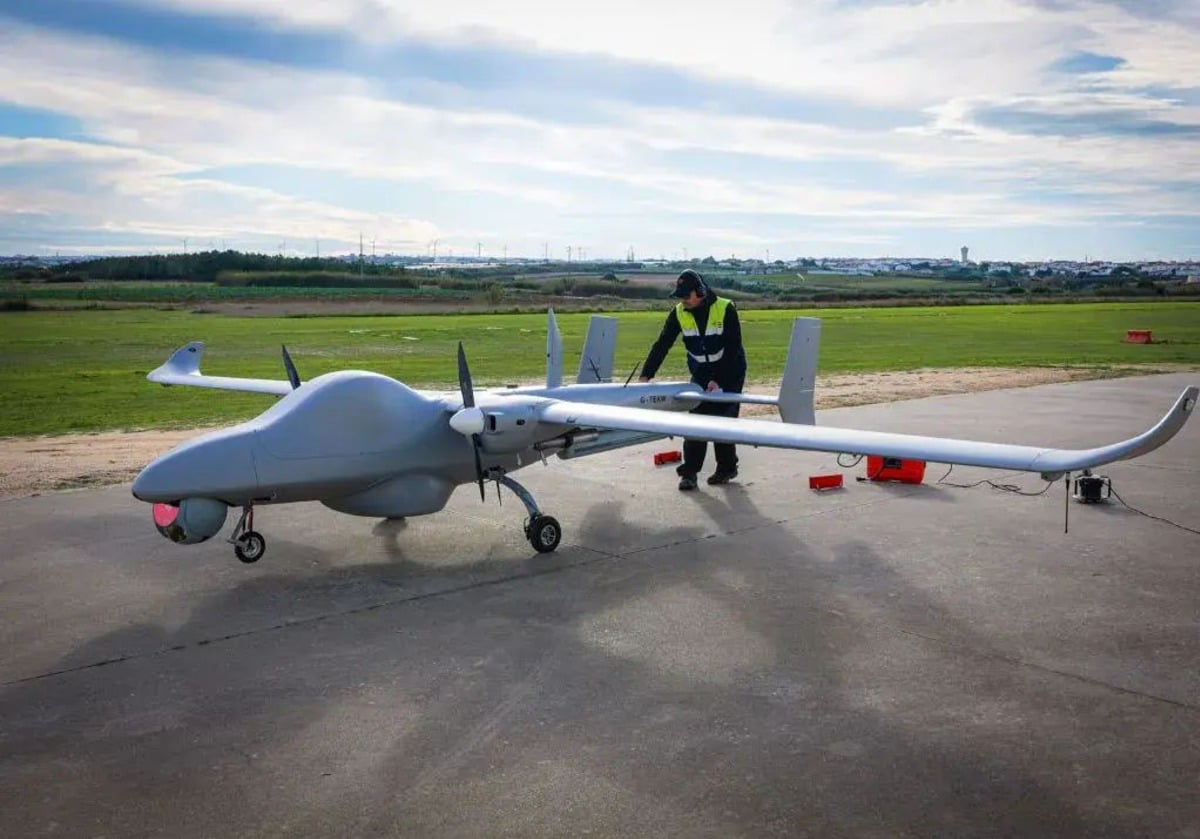
- The UK Ministry of Defence selected Tekever's AR5 drone to replace the British Army's Watchkeeper fleet in a deal worth up to £400 million.
- The initial order covers six AR5 aircraft, potentially rising to 24 by 2029, with first deliveries expected later in 2026.
The UK Ministry of Defence announced this week that it has chosen the Tekever AR5, a surveillance drone built by the UK-based company Tekever, to replace the British Army’s aging Watchkeeper fleet under a deal worth up to $533 million over the next ten years.
The program, called Project CORVUS, will see the Army field a new generation of surveillance aircraft capable of carrying up to 50 kilograms (110 pounds) of cameras and sensors, staying airborne far longer than the Watchkeeper drones it replaces, and feeding commanders real-time intelligence they can use to protect troops and make faster decisions on the battlefield. Watchkeeper has served the British Army since 2014, and with the aircraft now reaching the end of its operational life, the Ministry of Defence says the AR5 offers a significant jump in endurance, sensor capability and reliability, keeping the Army ahead in surveillance and reconnaissance as threats continue to evolve.
The AR5 already carries genuine combat credibility into this new role, since Ukraine’s armed forces have used the same drone on the battlefield in their ongoing defense against Russia’s invasion, giving British commanders a system proven under real fire rather than one tested only in peacetime conditions. That track record featured directly in how Defence Secretary Wes Streeting framed the decision to select Tekever.
“Proven in Ukraine and designed to protect British soldiers globally, we’ve chosen the UK-based Tekever AR5 drone to supply our personnel with kit that will keep them ahead of emerging threats. This investment will support our troops on deployment, while driving re-industrialisation and backing British innovation,” said Defence Secretary Wes Streeting.
The initial order covers six AR5 drones, with deliveries expected to rise to as many as 24 aircraft by 2029, and subject to contract signature and final approvals, the new capability is expected to begin entering service later this year. Tekever will build the AR5 at a new manufacturing facility opening in Swindon, in South West England, a site that will anchor both the drone program itself and a broader push to strengthen Britain’s defense manufacturing base. The full contract is expected to sustain and create hundreds of highly skilled jobs across Tekever’s UK sites, reinforcing the defense sector’s role in the country’s wider technology and manufacturing growth, and reflecting the government’s stated commitment to using defense investment as an engine for economic growth and industrial renewal across Britain.
For Tekever, the contract represents something bigger than a single hardware sale, according to Karl Brew, Managing Director of Tekever UK, who framed CORVUS as the foundation for a much longer-term relationship between the company and the British Army.
“CORVUS represents a major step change in delivering cutting-edge autonomy to the British Army. This isn’t about a platform; it’s about building and sustaining sovereign capability that stays one step ahead of our adversaries,” said Karl Brew, Managing Director of Tekever UK.
“Through CORVUS, TEKEVER aims to create a new type of partnership between government and industry where we will ensure a constant cycle of capability evolution that delivers decisive advantage to our end users,” said Brew.
For a British Army that has spent more than a decade flying the same aging surveillance fleet, the shift to the AR5 marks the start of what the Ministry of Defence is positioning as a genuinely different kind of program, one measured less by a single delivery date and more by how well it keeps pace with a battlefield that keeps changing faster than any static piece of hardware ever could.