

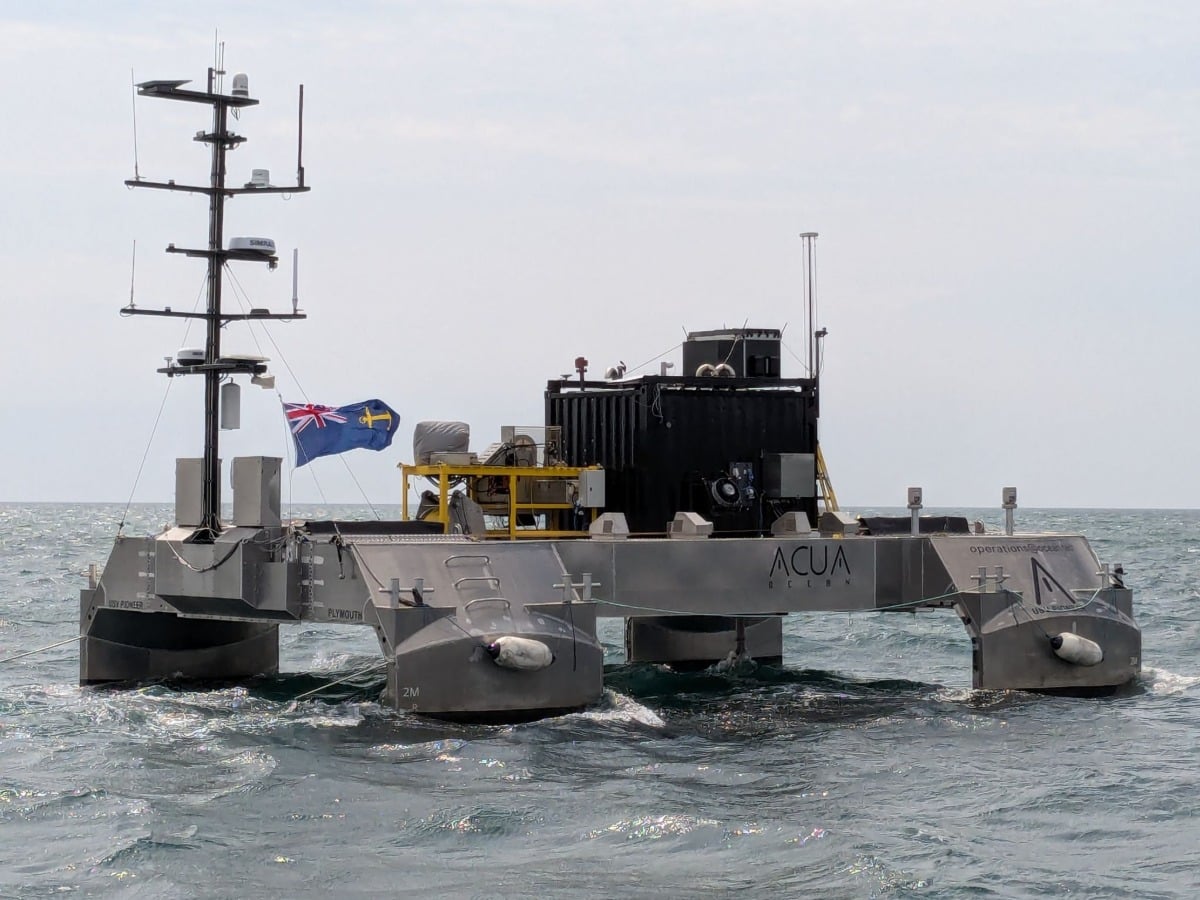
- ACUA Ocean and Teledyne FLIR Defense completed a UKDI-funded demonstration pairing the SkyCarrier drone launch system with the USV Pioneer for the UK MOD.
- In January 2026, USV Pioneer maintained stability in 4.25-meter (13.9-foot) waves, cutting roll by 60 percent compared to monohull vessels.
An unmanned boat has launched a drone into the air over open ocean, all without a single person on board either vehicle, and the demonstration could change how the Royal Navy watches its own waters.
British maritime robotics company ACUA Ocean and American sensor and drone manufacturer Teledyne FLIR Defense confirmed they completed two days of demonstrations for the UK Ministry of Defence and offshore industry partners, showing off a combined system that pairs an uncrewed surface vessel with a drone launched and recovered entirely on its own.
The project received funding from UK Defence Innovation (UKDI), a Ministry of Defence program that backs early-stage technologies with military potential before they reach full-scale procurement, often supporting smaller companies and demonstrators that larger, established defense contractors might overlook. That funding supported a joint demonstration of what the companies call a tethered uncrewed aerial system, or T-UAS, working together with an uncrewed surface vessel, or USV, essentially a robotic boat that operates without a crew and can run remotely or autonomously depending on the mission.
The demonstration centered on two named pieces of hardware working in tandem. Teledyne FLIR’s SkyCarrier is a ruggedized, autonomous drone launch and recovery platform housed in a protective container that unfolds into an articulating landing pad, allowing a drone to take off and return on its own, even while the vessel carrying it is moving or sitting on uneven terrain. During the trial, SkyCarrier autonomously launched a SkyRanger R70, a small drone built by Teledyne FLIR, from the deck of ACUA Ocean’s USV Pioneer, which the company says is the United Kingdom’s first uncrewed vessel certified by Lloyd’s Register, the maritime classification society that sets safety and engineering standards for ships, to be remotely operated.
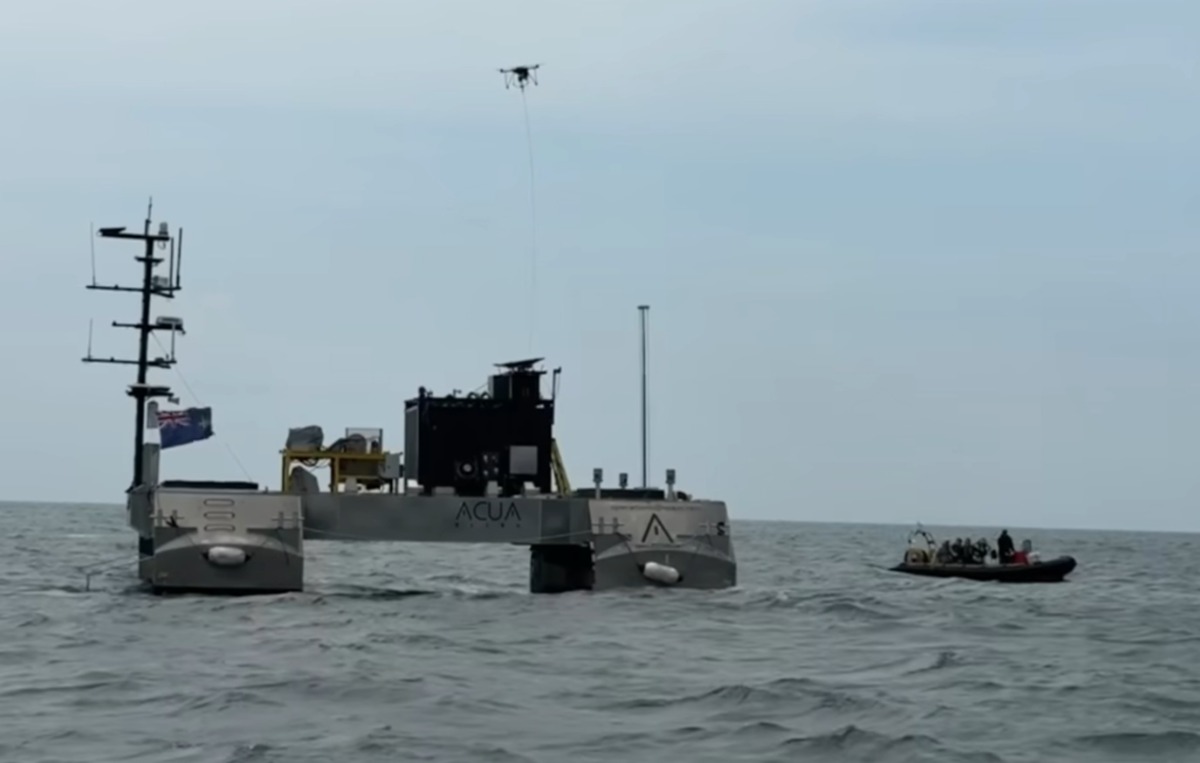
Once airborne, the SkyRanger R70 stayed connected to the Pioneer through a managed power and data tether rather than flying freely on battery power alone. That tether removes the drone’s dependence on onboard battery endurance, since the boat below feeds it continuous power, and keeps the aircraft’s position slaved directly to the vessel, meaning it stays anchored above the boat rather than drifting off on an independent flight path. The result is persistent, continuous aerial surveillance that does not need to pause for the drone to land and recharge, a limitation that has constrained tethered and untethered drones alike for years.
The SkyRanger R70 itself carries genuine technical sophistication built for demanding environments. It runs multiple embedded NVIDIA processors that provide real-time artificial intelligence at the edge, including object detection and classification performed onboard rather than relayed back to a distant operator, while four dedicated computer vision cameras support autonomous operation. Its long-range, high-resolution stabilized electro-optical and infrared sensor suite delivers what the companies describe as Group 2 ISR performance, a higher-capability tier of intelligence, surveillance and reconnaissance sensing, on a Group 1 airframe, the smallest and lightest classification of military drone, according to the U.S. Department of War’s unmanned aircraft grouping system.
Underpinning the entire demonstration was the Pioneer’s ability to hold steady in genuinely rough water. ACUA Ocean said that in January 2026, the USV Pioneer demonstrated superior seakeeping, the term for how well a vessel manages its motion in heavy seas, in wave heights of 4.25 meters (13.9 feet), achieving a 60 percent reduction in roll and a fourfold reduction in peak roll rates compared to traditional monohull vessels, the standard single-hull boat design used across much of the maritime industry. That stability is not a side detail. It is the mechanical foundation that makes flying a tethered drone off a small robotic boat possible at all in open-ocean conditions, since a violently rocking platform would make sustained flight operations for the SkyRanger R70 nearly impossible.
ACUA Ocean said the vessel has already completed multiple Royal Navy demonstration contracts covering intelligence, surveillance and reconnaissance as well as anti-submarine warfare, missions focused on detecting and tracking hostile submarines, giving this latest demonstration a track record of prior operational testing behind it rather than treating it as a one-off proof of concept.
According to ACUA Ocean, the combined T-UAS and USV system addresses a gap that the Royal Navy and wider UK defense establishment have identified: the need for persistent, long-endurance surveillance across multiple domains, meaning both sea surface and air, without putting personnel at risk in what the industry commonly calls dull, dirty or dangerous environments, missions that are repetitive, hazardous, or both. Operating together, the two systems extend surveillance coverage from the waterline up to altitude, creating what the companies describe as a coordinated air-surface package capable of multi-week ocean endurance, a duration that would be extremely difficult and costly to sustain using crewed ships or aircraft alone.
That endurance has direct relevance to a specific set of Royal Navy priorities, including anti-submarine warfare support, mine countermeasures, intelligence gathering, and protecting critical maritime infrastructure such as undersea cables and offshore energy installations, targets that have drawn increasing concern across NATO navies amid reports of suspected sabotage and surveillance activity near undersea infrastructure in European waters in recent years.
“Securing UKDI funding for this demonstrator is a significant milestone for ACUA Ocean and for UK maritime autonomy more broadly.”
“Integrating the SkyRanger R70 with the Pioneer creates something genuinely new: a persistent, deployable multi-domain ISR capability that the Royal Navy can put to sea today,” said Neil Tinmouth, CEO of ACUA Ocean.
“Teledyne FLIR Defense bring a battle-proven, operator-trusted UAS to a platform that is built, certified and ready. We look forward to demonstrating what this system can do,” said Tinmouth.
“The SkyRanger R70 has earned its reputation in the most demanding operating environments in the world,” said Richard Cunha, Principal Product Director for Unmanned Aerial Systems at Teledyne FLIR Defense.
“Pairing it with the Pioneer Mk2’s exceptional sea-keeping capability and endurance opens up a new class of persistent maritime ISR mission that simply wasn’t possible before,” said Cunha.