

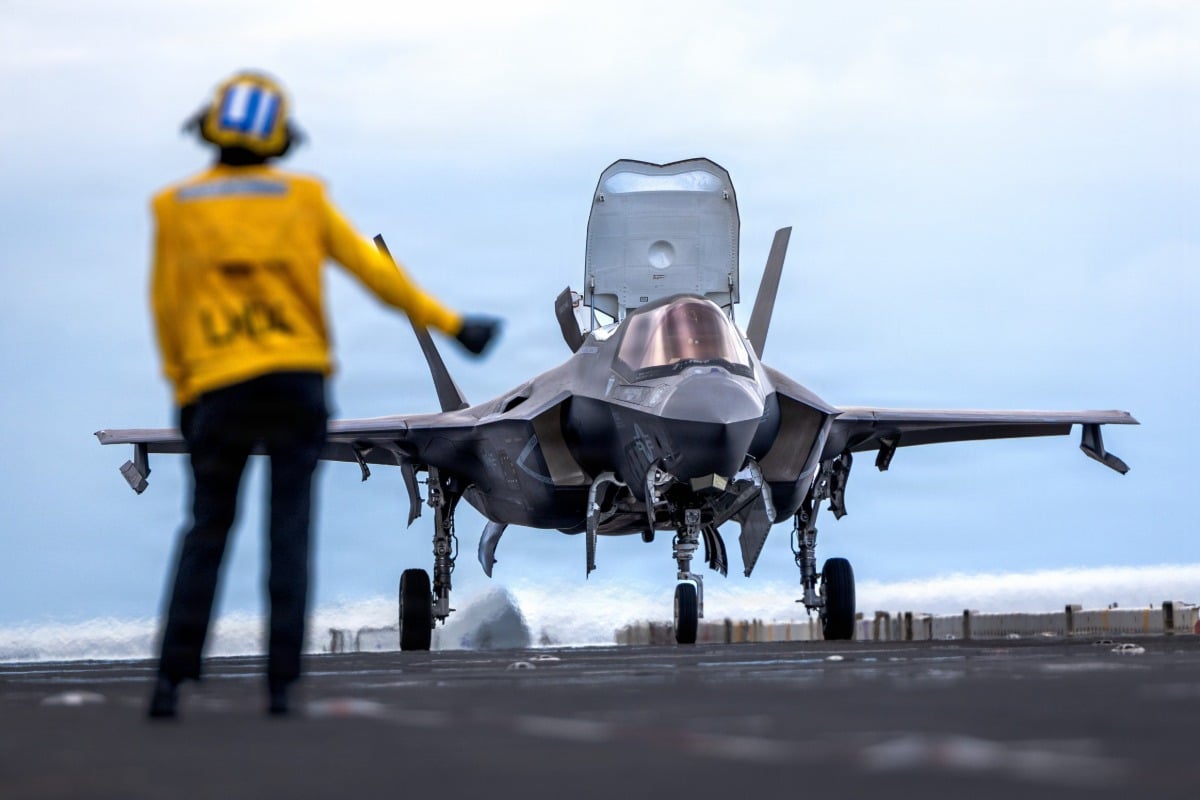
- The U.S. Navy posted a sources sought notice on July 9, 2026, seeking a deployable cleaning system for F-35B lift fan clutch cooling systems.
- Companies must respond within seven business days, by July 16, to be considered for the F-35 Joint Program Office's priority requirement.
The U.S. Naval Air Warfare Center Aircraft Division posted a sources sought notice on July 9 seeking companies capable of building a deployable cleaning system to remove what officials call “clutch sludge” from the F-35B’s short takeoff and vertical landing lift fan clutch cooling system, with responses due within just seven business days, by July 16.
The F-35B is the Marine Corps’ version of the F-35 Lightning II, purpose-built to take off from short runways or amphibious assault ships and land vertically like a helicopter, a capability no other fifth-generation stealth fighter in the world currently matches. That trick depends on a system called the Rolls-Royce LiftSystem, which uses a massive vertically oriented fan mounted behind the cockpit, called the LiftFan, to generate roughly 20,000 pounds of upward thrust by pulling in cool air and blasting it straight down, working alongside the engine’s rear exhaust nozzle to lift the aircraft without needing forward airspeed.
A clutch connects that LiftFan to the engine’s driveshaft, engaging only during vertical or short takeoff operations, and it is precisely that clutch, sitting at the mechanical heart of the jet’s signature capability, that has developed a contamination problem serious enough to warrant this week’s call for industry help.
According to the Navy’s own description of the issue, a mixture of carbon fiber dust and synthetic oil builds up inside the clutch cooling exhaust ductwork and vent panel screens over time, hardening into the substance officials are calling clutch sludge. That accumulation is not a brand-new discovery for the F-35B program, whose STOVL propulsion system has drawn scrutiny over clutch-related heating issues since early flight testing more than a decade ago. Pratt & Whitney, which builds the F135 engine powering the aircraft, disclosed in 2011 that clutch plates inside the lift fan system were making unexpected contact during normal, non-vertical flight, generating more heat than the clutch was originally designed to tolerate, a finding serious enough at the time that industry analysts questioned whether the entire F-35B design might need reworking.
Lockheed Martin responded by adding new heat sensors and requiring pilots to descend below 10,000 feet if clutch temperatures ran too high, buying the clutch cooler air until it could dissipate excess heat safely, an operational workaround that has apparently coexisted with this week’s newly identified sludge buildup problem in the years since.
The F-35 Joint Program Office’s propulsion support team is treating this specific cleaning capability gap with genuine urgency, describing the effort in the notice as priority action needed to secure expeditious support for evaluating clutch cooling system cleaning processes and equipment. Rather than developing an entirely new cleaning technology from scratch, the Navy wants companies with an existing commercial off-the-shelf cleaning system that can be modified specifically to fit the F-35B’s unique clutch hardware, a faster path to fielding a working solution than commissioning custom engineering work from zero. The specifications the Navy laid out are demanding but specific: the system must control water temperature, pressure, and quality precisely enough to strip away hardened sludge without damaging surrounding aircraft components, capture and recover all wastewater and removed contaminants to meet environmental compliance requirements, and include a specially designed apparatus that can safely mate to the F-35B’s distinctive clutch hardware.
The Navy explicitly wants a system that ground crews can transport and set up on-site at various Marine Corps air stations rather than one that requires shipping the aircraft or its components back to a centralized depot facility for cleaning, a distinction that matters enormously for aircraft availability. Every F-35B pulled offline for depot-level maintenance represents a jet unavailable for training, deployment readiness, or actual combat operations, and a field-deployable cleaning solution would let maintainers address clutch sludge contamination directly at the squadron level, potentially in a matter of hours or days rather than the weeks a depot trip might otherwise require.
That readiness math carries real weight given how central the F-35B has become to Marine Corps aviation planning. The aircraft represents the Marine Corps’ primary strike fighter platform for both conventional land-based operations and expeditionary missions from amphibious assault ships, a role that depends entirely on the STOVL capability the LiftFan and clutch system make possible in the first place. Any recurring maintenance issue affecting that specific propulsion hardware touches directly on how many F-35Bs the Marine Corps can actually keep flying at any given time, a concern that becomes more pressing as the broader F-35 fleet has continued expanding and aging simultaneously across U.S. and allied militaries worldwide.