

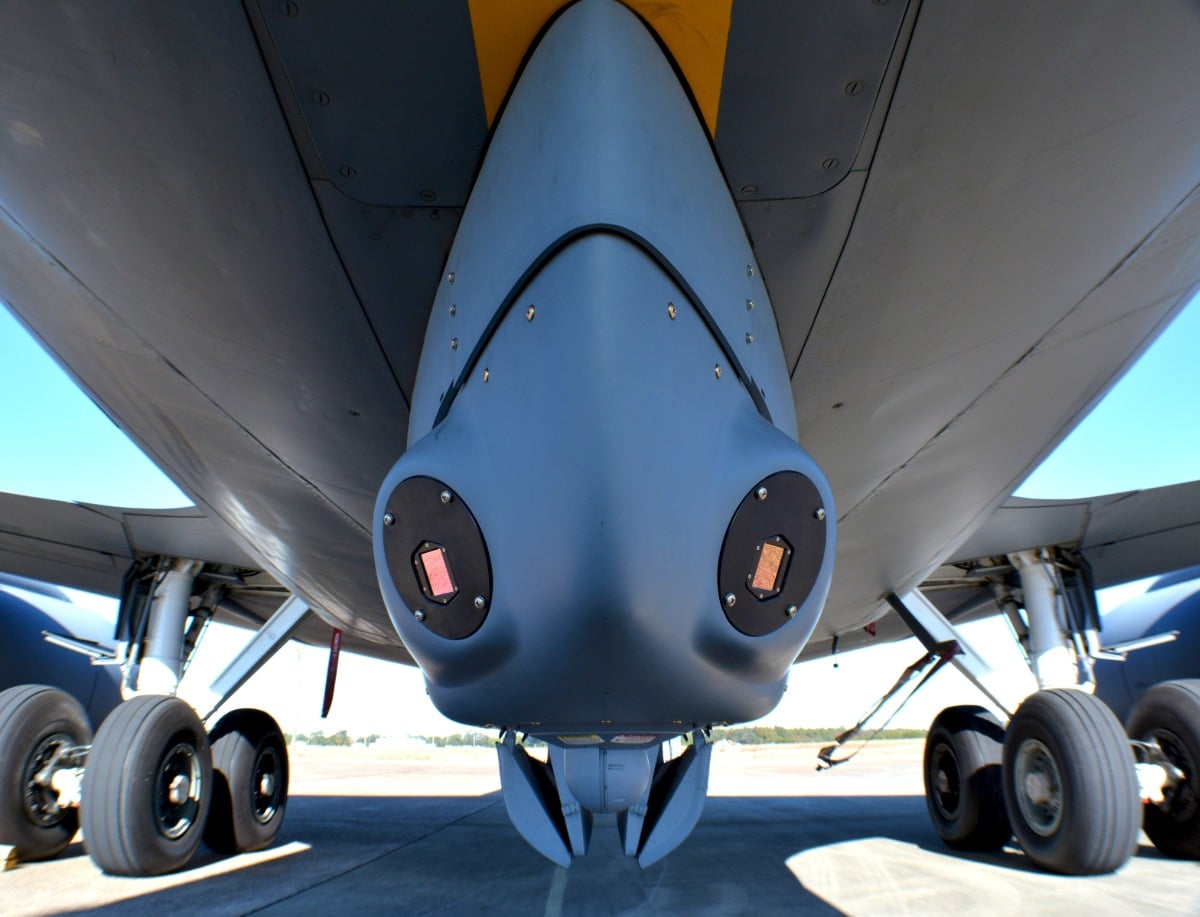
- The U.S. Air Force awarded Northrop Grumman a $60,438,241 contract on July 8, 2026, to develop an enhanced sensor for the LAIRCM system.
- The sole-source contract runs through April 30, 2029, with work performed at Northrop Grumman's Rolling Meadows, Illinois facility.
A shoulder-fired missile streaking toward a military cargo plane has mere seconds to find its target, and the U.S. Air Force has paid $60.4 million to make sure the aircraft sees it coming even faster. Northrop Grumman won a $60,438,241 contract to develop an enhanced sensor called the Optical Detection and Identification Node, or ODIN, as part of the Large Aircraft Infrared Countermeasures system, the defensive technology that has protected American cargo planes, tankers, and special mission aircraft from heat-seeking missiles for more than two decades.
Large Aircraft Infrared Countermeasures, known throughout the Air Force by its acronym LAIRCM, exists to solve a specific and persistent threat: man-portable air defense systems, commonly called MANPADS, the shoulder-fired missiles that insurgent groups and hostile forces around the world have used to shoot down aircraft during takeoff and landing, when planes fly low and slow enough to make an easy target. These missiles home in on an aircraft’s heat signature rather than relying on radar, meaning traditional countermeasures like chaff, which works against radar-guided threats, do nothing to stop them. LAIRCM instead uses passive infrared sensors to detect a missile’s exhaust plume the instant it launches, then fires a high-intensity laser directly at the missile’s guidance seeker, essentially blinding it and causing the weapon to lose track of the aircraft entirely rather than physically destroying the incoming missile.
The system Northrop Grumman built to deliver that capability, officially designated the AN/AAQ-24(V), has become one of the most widely fielded defensive technologies in American military aviation history, currently installed on more than 1,500 aircraft across more than 80 different platform types worldwide, including the C-17 Globemaster III, C-5 Galaxy, C-130J Hercules variants, KC-46 Pegasus refueling tanker, and CV-22 Osprey tiltrotor. Each LAIRCM installation combines several distinct pieces of hardware working together, including the AN/AAR-54 missile warning sensors that detect incoming threats using ultraviolet wavelengths specifically because that portion of the spectrum makes a missile’s rocket exhaust extremely difficult to confuse with background clutter, alongside laser transmitter assemblies mounted in rotating turrets that physically aim the jamming beam at the threat once detected.
This week’s contract funds development work specifically on the sensor half of that equation rather than the laser jamming components, and the Air Force’s own contract announcement describes ODIN as an enhanced sensor meant to improve how the broader LAIRCM system detects and identifies incoming threats before deciding how to respond. That distinction matters because faster, more accurate threat detection directly compresses the narrow window LAIRCM has to react, since every additional fraction of a second a sensor takes to confirm a genuine missile launch, rather than a false alarm triggered by sunlight glinting off water or another aircraft’s engine exhaust, eats directly into the limited time available to aim and fire the jamming laser before a real missile reaches its target.
Northrop Grumman will perform the development work at its Rolling Meadows, Illinois facility, with the Air Force expecting the project to run through April 30, 2029, a nearly three-year development window funded through fiscal year 2026 research, development, test, and evaluation money.
That continuity of contractor relationship traces back to LAIRCM’s origins in the 1990s, when the Air Force first identified a critical gap in aircraft self-protection after watching older infrared countermeasure systems struggle to keep pace with increasingly sophisticated heat-seeking missile technology proliferating among hostile groups worldwide. Northrop Grumman has steadily expanded and upgraded the system in the decades since, winning a $146 million Air Force contract in 2021 to install LAIRCM on additional fixed-wing and rotary aircraft, followed by a $16.5 million follow-on contract in 2024 for further installations, and a separate $96.1 million Navy contract in 2023 covering LAIRCM hardware and installation support for Navy and other military aircraft. That steady cadence of incremental contracts, rather than a single massive procurement, reflects how the Air Force and Navy have chosen to fund LAIRCM’s evolution, continuously refining and expanding the system across new aircraft and improved components rather than treating any single contract as a final, complete solution.
MANPADS technology has proliferated significantly since the system’s original development, spreading through arms markets and conflict zones to the point where the Department of War now treats the threat as a persistent concern for any large, relatively slow-moving military aircraft operating anywhere near contested or unstable airspace, whether during a resupply mission, a medical evacuation flight, or simply routine transport into a forward operating location. A faster, more capable detection sensor addresses that evolving threat directly, since newer generations of infrared-guided missiles have themselves grown more sophisticated at avoiding detection and evading countermeasures, creating a continuous technical race between missile designers trying to defeat defensive systems and companies like Northrop Grumman trying to keep those defensive systems a step ahead.
What the Air Force’s contract announcement does not specify is exactly how much faster or more accurate the ODIN sensor will perform compared to LAIRCM’s existing AN/AAR-54 detection hardware, nor does it identify which specific aircraft platforms will receive the upgraded sensor first once development concludes in 2029.