

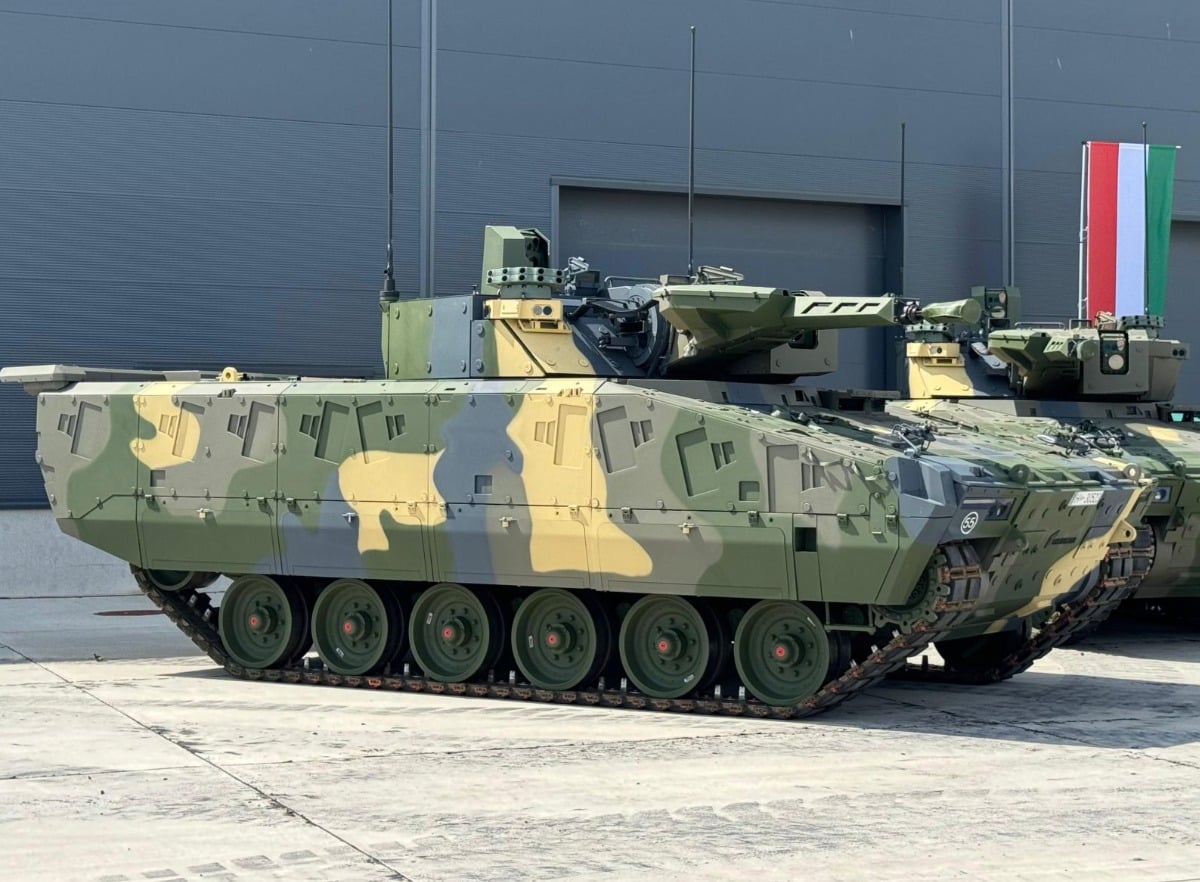
- RENK Group extended its framework agreement with Rheinmetall on July 9, 2026, to supply propulsion systems for additional KF41 Lynx vehicles.
- The extended agreement is worth more than $308, including options, covering HSWL 256C transmissions and final drives.
German engineering firm RENK just locked in more than $308 million in future business keeping one of Europe’s newest tracked infantry vehicles actually moving, extending its transmission supply agreement with Rheinmetall for the KF41 Lynx on July 9.
The expanded framework agreement, worth more than €270 million ($308.72 million) including options, covers the supply of RENK’s HSWL 256C transmissions and final drives, the mechanical components that translate engine power into the tracked movement letting a nearly 44-ton armored vehicle actually cross a battlefield.
The KF41 Lynx, developed by German defense manufacturer Rheinmetall, is built to carry a squad of up to eight infantry soldiers into contested territory while providing armored protection against small arms fire, artillery fragments, and mines, all while mounting a 30mm or 35mm autocannon capable of engaging both infantry and lightly armored vehicles. None of that protection or firepower matters if the vehicle cannot reliably move, accelerate, or reposition under fire, and RENK’s HSWL 256C transmission system serves as the mechanical backbone translating the Lynx’s engine output into the kind of responsive, cross-country mobility that keeps a 44-ton armored vehicle from becoming an easy, stationary target.
“With the extension of our framework agreement, we are consistently continuing our successful partnership with Rheinmetall,” said Michael Masur, CEO Vehicle Mobility Solutions at RENK GmbH. “The KF41 Lynx is one of the most state-of-the-art tracked vehicles worldwide and has already been introduced in Hungary as an infantry fighting vehicle. RENK provides the core transmission technology that powers the vehicle. For us, strengthening Europe’s defense capabilities is both a goal and a responsibility.”
Hungary’s experience with the Lynx explains why demand for RENK’s transmissions has grown enough to justify a nine-figure contract extension. Budapest signed the original deal with Rheinmetall back in August 2020, committing more than €2 billion to acquire 218 Lynx vehicles across seven variants, including standard infantry fighting vehicles, command posts, reconnaissance vehicles, mortar carriers, and medical evacuation configurations, as part of Hungary’s broader Zrínyi 2026 military modernization program. Rheinmetall delivered Hungary’s first German-built Lynx in October 2022, then opened a dedicated production facility in Zalaegerszeg in August 2023 specifically to manufacture the remaining vehicles domestically, a plant Rheinmetall Hungary’s own CEO has described as Europe’s most modern center for tracked armored vehicle production, capable of building more than 100 vehicles annually.
Hungary is no longer the Lynx’s only customer, and that expanding customer base is precisely what has driven this transmission agreement’s growth. Romania signed a contract in May 2026 worth €3.337 billion for 298 Lynx vehicles and related variants, with production split between Germany and Rheinmetall’s Romanian manufacturing arm, while Italy began testing and evaluating the KF41 in February 2025 and has already taken delivery of early vehicles configured with the Italian-made HITFIST 30 turret system. Ukraine became just the second country to field the Lynx after Hungary, receiving its first evaluation vehicle in late 2024, followed by a batch of five vehicles funded by the German government that Rheinmetall confirmed were headed to Ukraine’s front lines in January 2026, giving the vehicle type its combat debut in one of the most demanding operational environments any modern infantry fighting vehicle currently faces.
That widening customer list matters enormously for a component supplier like RENK, since every additional country that orders Lynx vehicles translates directly into more transmissions the company needs to manufacture and deliver on schedule. RENK’s own statement pointed to this dynamic directly, framing the contract extension as validation of production planning the company undertook specifically to keep pace with growing demand across multiple national customers rather than scrambling to expand capacity after orders had already outpaced supply.
“The extension of the framework agreement underscores the importance of efficient European supply chains for the defense industry,” RENK said in its announcement, adding that through the early expansion of its production capacity, the company had created the conditions to meet growing demand reliably over the long term.
That emphasis on supply chain reliability reflects a broader anxiety running through European defense manufacturing since Russia’s invasion of Ukraine exposed how thin and fragile the continent’s military production base had become after decades of shrinking defense budgets. A single component shortage, whether in transmissions, ammunition, or electronics, can stall an entire vehicle production line regardless of how much political will or funding exists to build more armored vehicles, which is exactly why RENK frames its early capacity investment as a responsibility rather than simply a business opportunity, given how directly component availability now shapes how quickly European militaries can actually rearm.
Rheinmetall partnered with Raytheon on an offer for the U.S. Army’s Next-Generation Combat Vehicle program aimed at eventually replacing the Bradley Fighting Vehicle, an effort that evolved into what is now called the XM30 Combat Vehicle program, with American Rheinmetall Vehicles winning contract phases for detailed design and prototype construction back in August 2023.