

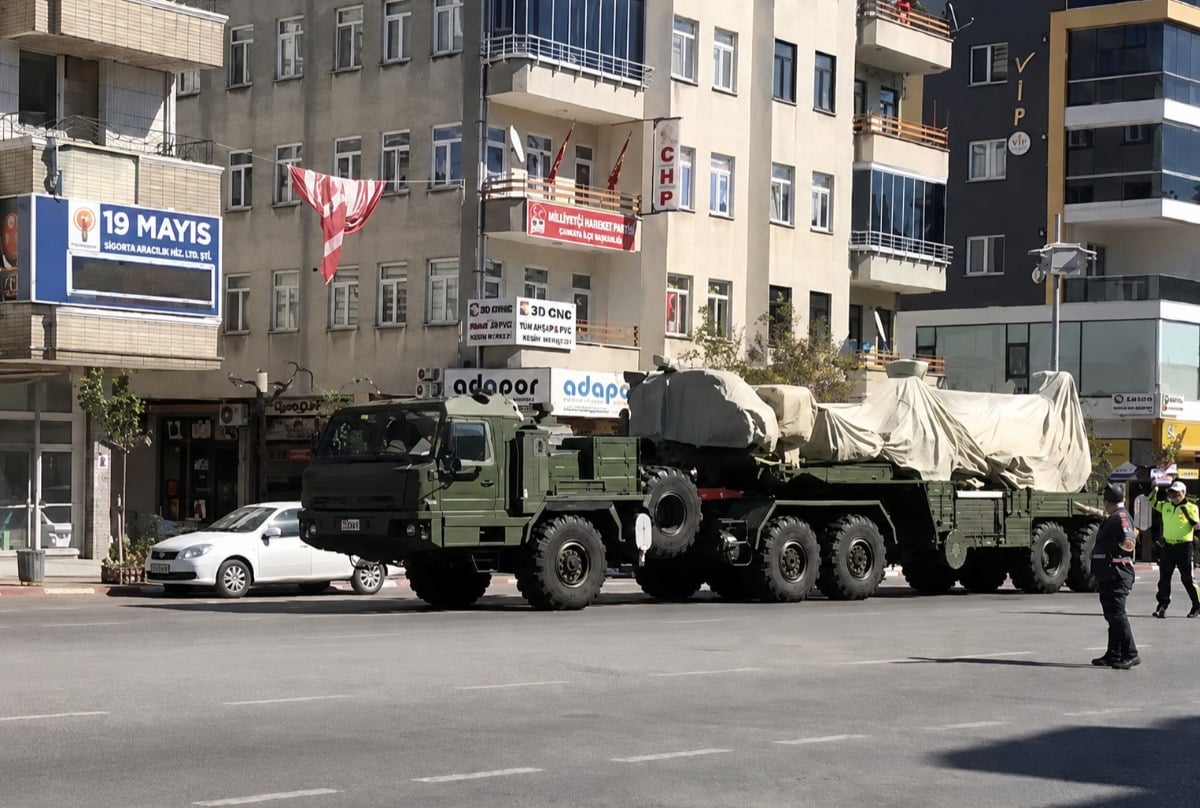
- Hürriyet columnist Abdülkadir Selvi reported that Türkiye sold its Russian S-400 air defense system to a Gulf country, with an official announcement expected Thursday.
- CAATSA sanctions were imposed on Türkiye in 2020 after its 2019 purchase of the S-400, leading to Türkiye's removal from the F-35 fighter jet program.
Türkiye has reportedly sold its Russian-made S-400 air defense system to a Gulf state, according to Hürriyet columnist Abdülkadir Selvi, whose report ties the transaction directly to Türkiye’s yearslong effort to escape American sanctions and potentially reopen the door to purchasing F-35 fighter jets.
Selvi wrote that the sale had been finalized after last-minute details were resolved overnight, with the systems headed to what he described only as “a country in the Gulf,” while separate Hürriyet reporting from columnist Hande Fırat indicated the United States and Türkiye have been actively discussing transferring the S-400s to a third country specifically to satisfy Washington’s legal requirements for lifting sanctions.
The S-400, formally known as the Triumf, is a long-range surface-to-air missile system built by Russian state defense conglomerate Almaz-Antey, capable of tracking and destroying aircraft, cruise missiles, and ballistic missiles at ranges exceeding 400 km (249 miles). Türkiye’s 2019 purchase of the system triggered sanctions under the Countering America’s Adversaries Through Sanctions Act, commonly known as CAATSA, a 2017 U.S. law that punishes countries conducting significant defense transactions with Russia, making Türkiye the first NATO ally ever sanctioned under the measure. Washington’s objection to the S-400 in Turkish hands centers on a specific technical concern: the system’s radar, if operated alongside NATO’s F-35 stealth fighter, could theoretically gather data on the jet’s low-observable characteristics and transmit that information back to Russia, a vulnerability that led the United States to expel Türkiye from the F-35 program entirely in 2019 rather than risk exposing the aircraft’s stealth profile to a system built by a strategic rival.
According to Selvi’s reporting, the path to lifting those sanctions runs through a written notification President Trump would send to Congress, a mechanism that Turkish journalist Yunus Paksoy said would need to answer three specific questions: confirming the S-400s are non-operational, that Türkiye will no longer claim ownership of the systems, and that Ankara commits to not developing similar defense relationships with Russia going forward. That notification process would trigger a congressional review period during which lawmakers could still object and force a vote if they conclude Türkiye has not met the law’s requirements, meaning even a completed sale would not guarantee immediate sanctions relief without Congress declining to challenge Trump’s certification.
Separate Hürriyet reporting cited by regional outlet Athens Times detailed why a straightforward sale to a third country became the preferred solution over alternatives Türkiye and the U.S. had previously explored. Options such as placing the S-400s in storage, dismantling their launch systems, or keeping them under joint U.S.-Turkish control had all reportedly been ruled out by Washington as legally insufficient to satisfy CAATSA’s requirements, since American officials maintain the systems must no longer be physically present in Türkiye’s military inventory at all rather than simply deactivated on Turkish soil. Any such transfer would also require Moscow’s consent under the original end-user agreement Türkiye signed when it purchased the system, and according to the same reporting, Russia has not signaled outright opposition to a resale, though the Kremlin has not publicly confirmed any position on the matter either.
Selvi’s reporting cited conflicting information on which Gulf nation is actually buying the system, noting that some of his sources pointed to the United Arab Emirates while others named Qatar, adding that both countries had begun actively searching for additional air defense capability following recent escalation between the United States, Israel, and Iran. That regional security anxiety is not abstract for either potential buyer. Iran’s Islamic Revolutionary Guard Corps struck a U.S. command facility and an air base in Jordan earlier this week amid the broader confrontation, and both Gulf states sit within range of Iranian missile and drone capabilities that have already targeted shipping and military assets across the region in recent days, giving either nation a concrete, immediate incentive to add a proven, long-range air defense system to their existing arsenals regardless of the system’s Russian origin or its complicated diplomatic history.
Selvi framed the potential deal as delivering Türkiye a double benefit beyond simply escaping sanctions.
“By getting rid of the S-400s, Türkiye will not only escape the CAATSA sanctions,” Selvi wrote, according to Hürriyet. “At the same time, it will make money by selling the S-400s.”
Turkish authorities had not issued any official statement confirming the transaction at the time of Hürriyet’s reporting, and President Erdoğan himself offered only a cryptic response when previously asked directly about the fate of the S-400s, telling reporters simply to “continue watching us,” according to Selvi’s column, a non-answer that has left Ankara’s own intentions publicly ambiguous even as journalists close to the story describe the deal as effectively finalized behind closed doors.
For a weapons system that spent years as the single biggest irritant in the U.S.-Türkiye relationship, costing Ankara its place in the world’s most advanced fighter jet program and years of formal American sanctions, the prospect of simply selling the S-400s to a Gulf buyer offers Türkiye an unusually clean resolution, provided the deal survives both congressional scrutiny in Washington and the diplomatic fallout already brewing in Jerusalem.