

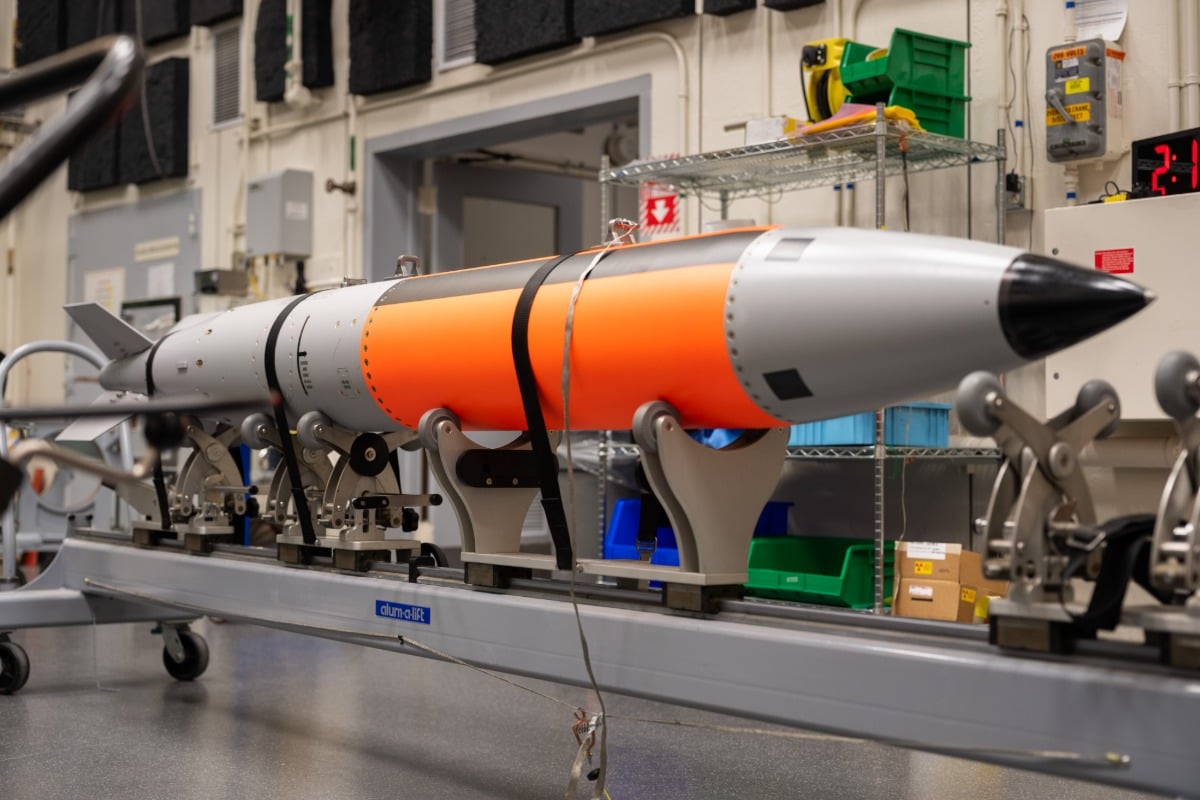
- NNSA completed diamond stamping of all canned subassemblies for the B61-13 nuclear gravity bomb three months ahead of schedule at Y-12 National Security Complex.
- NNSA completed the first B61-13 production unit in May 2025, nearly a year ahead of its original target date.
The scientists and technicians who build America’s newest nuclear bomb just finished a critical manufacturing step three months ahead of schedule, the U.S. Department of Energy’s National Nuclear Security Administration announced, marking another milestone in what officials describe as one of the fastest nuclear weapons development efforts since the Cold War.
NNSA said its Y-12 National Security Complex in Oak Ridge, Tennessee, completed what the agency calls “diamond stamping” of every canned subassembly planned for the B61-13 gravity bomb this fiscal year, a certification process that confirms a critical nuclear component has passed every required inspection and is approved for deployment as genuine “war reserve” quality hardware rather than a test article.
Understanding what actually got stamped requires understanding how a modern thermonuclear weapon is built. A two-stage nuclear weapon like the B61 family relies on a “primary” stage that triggers the explosive chain reaction and a “secondary” stage that dramatically amplifies the resulting explosive yield, and the canned subassembly, or CSA, is the sealed metal container, typically stainless steel or an aluminum alloy, that houses that secondary stage capsule along with other critical components. Diamond stamping represents the final quality checkpoint in that component’s production, the moment NNSA’s rigorous certification process confirms the hardware meets every safety and performance standard required before it can actually enter America’s nuclear stockpile rather than remaining a manufacturing sample.
NNSA Administrator Brandon Williams framed the milestone as proof the agency’s broader modernization effort is functioning exactly as intended.
“The progress on the B61-13 program demonstrates the Nuclear Security Enterprise’s ability to respond to evolving geopolitical requirements with speed and precision,” Williams said. “Completing the 2026 baseline deliverables ahead of schedule is a clear indicator of discipline and operational focus. This milestone directly supports our goals to modernize our nuclear deterrent and sends a message to our adversaries that our national defense remains agile, secure, and effective.”
The B61-13 belongs to a nuclear weapons family with a genuinely long history, tracing back to the original B61 design that entered service in 1968 and has since become the longest-serving and most versatile weapon in the American nuclear arsenal, carried at various points by aircraft ranging from the B-52 Stratofortress to the F-16 Fighting Falcon. The newest variant builds directly on the B61-12, a modernized version NNSA finished upgrading in January 2025 that consolidated several older B61 variants into a single weapon equipped with a guided tail kit assembly using inertial navigation for improved accuracy. The B61-13 shares that same modern safety, security, and guidance technology, but the Pentagon has said it carries a significantly higher maximum yield than the B61-12, oriented specifically toward defeating harder targets and targets spread across a larger physical area, giving military planners additional flexibility when selecting how much destructive force a given mission actually requires.
That yield difference reflects a specific gap the B61-13 was designed to fill rather than simply making an existing weapon more powerful for its own sake. The Pentagon first announced the B61-13 program in October 2023 explicitly as a planned replacement for the older B61-7 variant, a bomb reported to carry a maximum yield in the range of 340 to 360 kilotons, considerably higher than the B61-12’s reported 50-kiloton maximum. Because the B61-13 pairs that higher yield with the same precision guidance technology developed for the B61-12, independent nuclear policy analysts have noted that the weapon’s improved accuracy combined with its yield could make it more effective against buried or hardened targets than either the older B61-7 or the more precise but lower-yield B61-12 alone, since a nuclear detonation transmits its destructive force into the ground far more efficiently when it lands close to the intended target regardless of yield.
Unlike the B61-12, which the Pentagon has certified for delivery by fighter aircraft including the F-35A and F-16 alongside strategic bombers, the B61-13 will only be certified for delivery by U.S. strategic bomber aircraft operating from bases within the continental United States, according to NNSA’s announcement. That restriction points toward the B-21 Raider, the Air Force’s newest stealth bomber currently entering service, as the weapon’s primary intended delivery platform going forward, tying the B61-13’s development directly to the broader modernization of America’s long-range strike capability rather than expanding tactical nuclear options across the wider range of aircraft the B61-12 can already use.
NNSA completed the first production unit of the B61-13 in May 2025, nearly a full year ahead of its original target date and less than two years after the Pentagon first announced the program, a timeline officials have described as one of the fastest nuclear weapons development efforts completed since the Cold War ended. NNSA credited that speed partly to reusing proven production techniques and manufacturing infrastructure already established during the B61-12 program, along with what the agency described as streamlining or combining certain rigorous design review checkpoints that would typically occur sequentially on a standard development schedule, allowing engineers to begin building test hardware just three months after Congress authorized and funded the program.
Defense officials have previously indicated only a modest number, described as a few dozen units, are expected to be produced, with each B61-13 built to replace a B61-12 that would have otherwise been manufactured rather than adding to the overall size of the stockpile.