

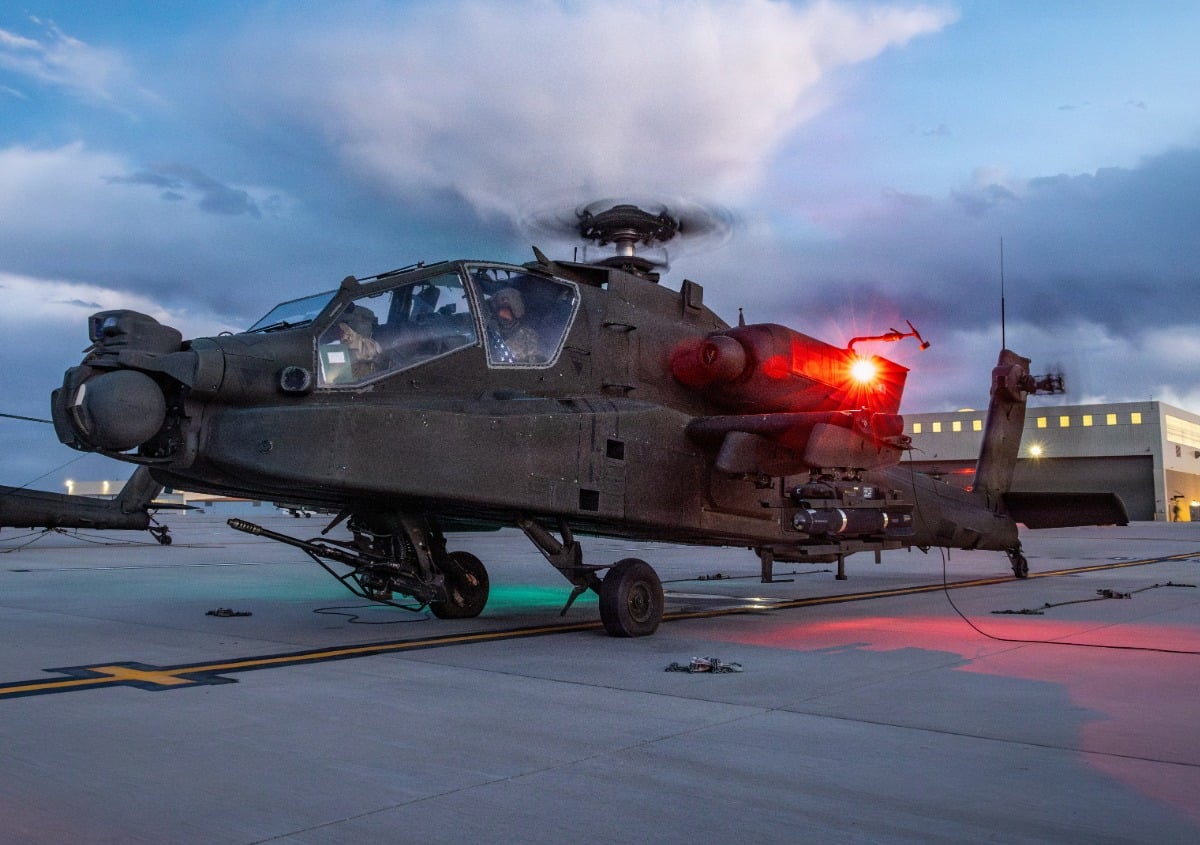
- The U.S. Army awarded Lockheed Martin a $502 million contract on July 7, 2026, for post-production support of the AH-64 Apache's M-TADS/PNVS targeting system.
- The contract, managed by Army Contracting Command at Redstone Arsenal, Alabama, has an estimated completion date of July 5, 2031.
The U.S. Army awarded Lockheed Martin a $502 million contract to provide ongoing support services for the Modernized Target Acquisition Designation Sight and Pilot Night Vision Sight system, known in Army circles by the shorthand M-TADS/PNVS, the combined sensor and targeting package mounted on every AH-64 Apache helicopter in the U.S. fleet.
The M-TADS/PNVS, also nicknamed Arrowhead, functions as the helicopter’s eyes, combining a targeting sensor package mounted in a turret below the nose with a separate pilot night vision system mounted above it, together giving the aircraft’s two-person crew the ability to spot, track, and engage targets in complete darkness, through smoke, or in bad weather using forward-looking infrared cameras that detect heat signatures rather than relying on visible light. The pilot’s half of the system slaves an infrared camera directly to the pilot’s head movements, letting them look around the battlefield in the dark exactly as they would in daylight, while the targeting half in the lower turret carries a laser rangefinder and laser designator that lets the crew mark targets precisely enough for the Apache’s own weapons or other aircraft to strike with confidence.
Lockheed Martin developed the system as the modernized second generation of an original targeting and night vision package first fielded on Apaches back in 1983, with the Army fully embracing the upgraded Arrowhead version by 2011, when the service celebrated delivery of its 1,000th unit and had equipped roughly 704 Apaches across the fleet with the improved system. The modernization brought quick-access, remove-and-replace components specifically designed to cut maintenance time and expense, a design choice the Army projected would save nearly $1 billion in operations and support costs over the system’s 20-year service life, savings that depend entirely on sustained contractor support like the deal announced this week to keep those maintenance-friendly components actually functioning as designed.
That maintenance relationship has continued evolving well past Arrowhead’s initial rollout. Lockheed Martin has periodically won additional contracts over the years to refurbish the system’s electro-optical components, upgrade its cockpit displays from black-and-white to color imagery for better target identification at longer distances, and replace older mechanical components like spinning-mass gyroscopes with modern inertial measurement units, changes that have progressively extended both the system’s capability and its expected service life well beyond what the original 1980s-era TADS/PNVS could offer. This new $502 million award falls under what the Army calls post-production support services, a category covering the unglamorous but essential work of keeping fielded equipment maintained, repaired, and updated after the initial manufacturing run has ended, rather than funding new production of additional units.
The Army structured this contract as a sole source acquisition solicited to a single bidder, Lockheed Martin, which received the only bid submitted, a pattern that makes practical sense given the company both designed the original Arrowhead system and has handled essentially every major support and upgrade contract for it since. Work locations and specific funding levels will be determined through individual task orders issued over the life of the agreement rather than being fixed at the outset, according to the Army’s contract announcement, with the overall arrangement running through an estimated completion date of July 5, 2031, giving Lockheed Martin roughly five years of guaranteed sustainment work on a system the Army has now relied on for more than four decades in one form or another. The Army Contracting Command at Redstone Arsenal in Alabama, the service’s primary hub for aviation acquisition programs, is overseeing the deal.
The AH-64 Apache remains the U.S. Army’s primary attack helicopter, a role it has filled in every major American ground conflict since the 1991 Gulf War, and its effectiveness in that role depends almost entirely on crews being able to identify and engage targets accurately before an adversary can react, a capability gap that becomes especially dangerous during nighttime operations or in degraded visual environments like dust, smoke, or heavy weather where the human eye alone offers little useful information. A targeting system that goes offline or degrades in the field does not simply inconvenience a maintenance crew back at base, it can leave an Apache crew flying blind into exactly the kind of high-threat environment the aircraft was built to survive.