

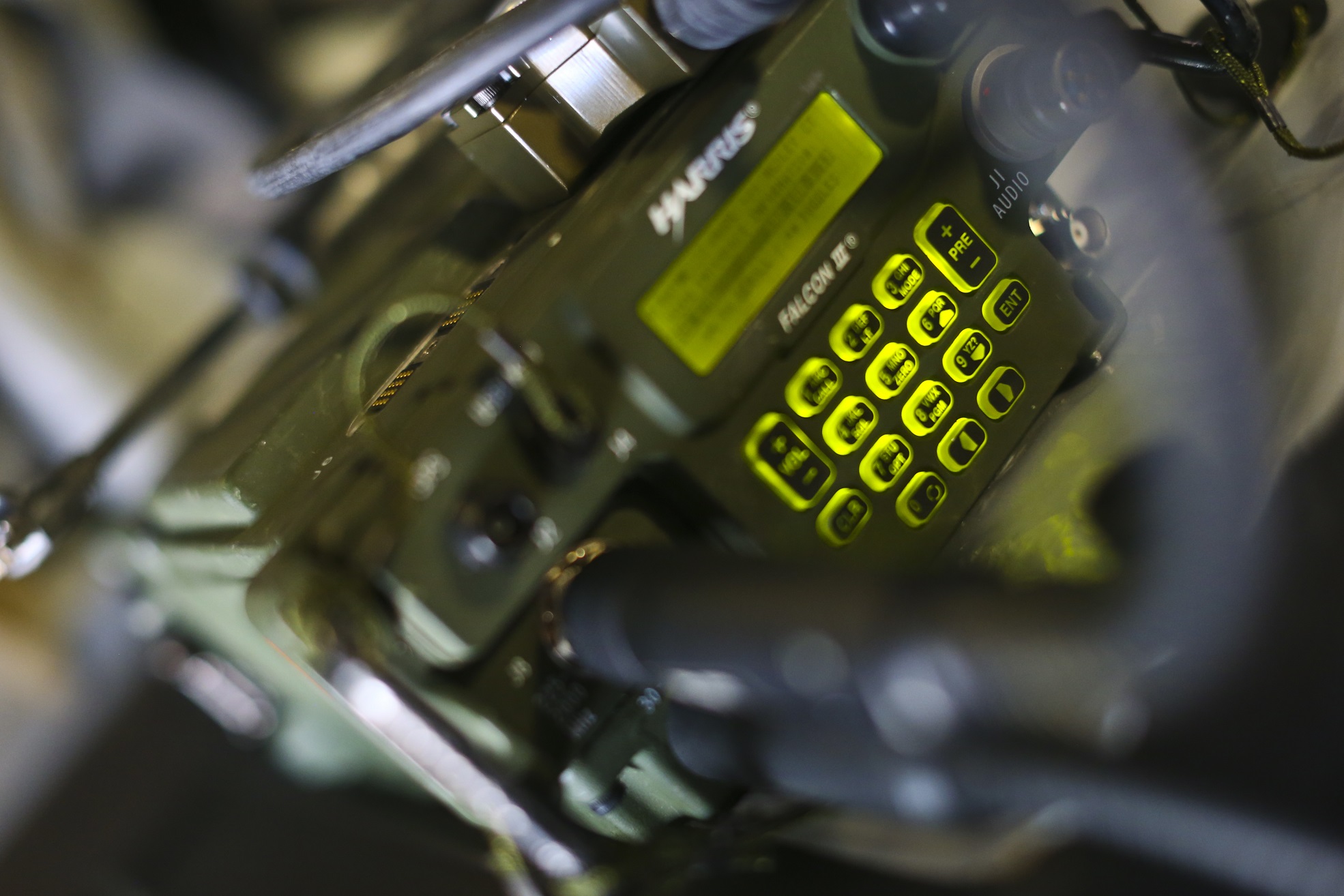
The Marine Corps Systems Command has announced that service is updating its tactical satellite system that provides increased communication on the battlefield.
Based on field user evaluations, the upgraded technology is performing beyond expectations.
The Mobile User Objective System is a next-generation, narrowband satellite communication capability that enables Marines to connect to SATCOM networks. It encompasses updated firmware to the AN/PRC-117G radio system and one of three antenna kits that help users simultaneously access these networks.
Initially fielded in March 2019, the system enables mobile or stationary Marines to leverage cellular technology to increase access to voice and data communication. It also improves overall reliability in urban environments.
“MUOS gives us a 3G capability using satellite constellations,” said Lt. Col. Jeff Decker, MCSC’s Ground Radios product manager. “It is similar to a cell phone capability in the sky that covers the entire globe.”
“We try to figure out anything that could be a possible issue for the warfighter. This helps to validate the concept of operations, and it allows us to provide lessons learned to other MEFs,” Lt. Col. Jeff Decker, MCSC’s Ground Radios product manager said.
The 3G networks used with MUOS remain far superior to the Marine Corps’ legacy SATCOM channels, said Decker. He noted that the Ground Radios program office continues to monitor the latest technologies and looks toward working with other services for future incremental improvements to the capability.
“We’re looking to support the warfighter with a lethal and sustainable capability, which is the command’s focus,” said Decker. “The more robust and resilient the capability, the more we can start adding on back-end systems to help Marines. MUOS is changing the way we look at a tactical satellite architecture.”
The importance of evaluations
From March to May 2020, MCSC conducted various field user evaluations with I Marine Expeditionary Force at Twentynine Palms, California, to assess an updated version of MUOS that increases network stability while executing missions.
During the testing, Marines participated in fire support simulation exercises where they employed MUOS for coordinated air strikes and mortar support. They also used the technology during scenario-based exercises that involved rehearsing command and control operations.
“We tested the system through user evaluation exercises to understand not only what the capability can do on paper, but how we can use it to increase lethality and provide redundancy across the [Fleet Marine Forces],” said Decker.
The testing enabled users to grow familiar with the system, ask questions and provide feedback. It allowed MCSC to learn more about MUOS, including the system’s strengths and limitations. Leveraging Marine feedback, the program office can make additional updates to MUOS as needed.
“We try to figure out anything that could be a possible issue for the warfighter,” said Decker. “This helps to validate the concept of operations, and it allows us to provide lessons learned to other MEFs.”
Eddie Young, project officer of Multiband Radio II Family of Systems at MCSC, said the testing helped the Ground Radios Team assess MUOS in combat-operational environments, which will better prepare them to employ the system during real missions.
“We wanted to bring in these units and make sure the system is working as it should,” said Young. “We want to ensure the warfighter’s needs are met.”
‘Exciting’ assessment results
Both Decker and Young said the feedback on the updated MUOS from Marines has been overwhelmingly positive, and that the system has exceeded performance expectations. Decker noted how Marines commended the new waveform for its lack of performance gaps, its adaptability and the absence of any technical difficulties while testing.
“Marines showed no frustration while trying to execute point-to-point calls while employing MUOS in an operational environment,” said Decker. “The system is doing what we expect it to do, and that is exciting.”
Sgt. Mason J. Roy, video chief for Communication Strategy and Operations at I MEF, participated in the communication exercises. He raved about the benefits of the exercises in training Marines for future missions that involve MUOS employment.
“I believe the exercises went really well,” said Roy. “The idea that we can send a video or photo from the field to a command post [using MUOS] shows we can rapidly inform commanders with visual information so that commands could potentially adjust battlespaces to promote mission accomplishment and protect our troops.”
The program office will begin fielding the updated version of MUOS this summer.