


- The United States has increased operations of its tethered aerostat radar system in Lajas, Puerto Rico, to enhance Caribbean air and maritime surveillance.
- The Lockheed Martin TARS platform provides continuous low-altitude radar coverage to support drug interdiction and security monitoring.
The United States has intensified the use of its tethered aerostat radar system operating out of Lajas, Puerto Rico, expanding persistent airborne surveillance across the Caribbean amid growing regional security concerns.
The long-standing system, equipped with the Lockheed Martin–built Tethered Aerostat Radar System (TARS), has been flying more frequently in recent weeks, according to defense monitoring sources.
The aerostat, anchored near the southern coast of Puerto Rico, carries the L-88 radar for low-altitude detection of aircraft and surface vessels. Its data are fed to the Caribbean Air and Marine Operations Center (CAMOC) and other command hubs for real-time situational awareness.
TARS provides low-level radar coverage along U.S. borders and maritime approaches, offering a high-endurance and cost-effective alternative to traditional airborne patrols. The system operates at altitudes between 10,000 and 15,000 feet, extending radar visibility across hundreds of miles. When weather conditions permit, it remains aloft for long durations, maintaining nearly continuous coverage over critical shipping lanes and air corridors in the region.
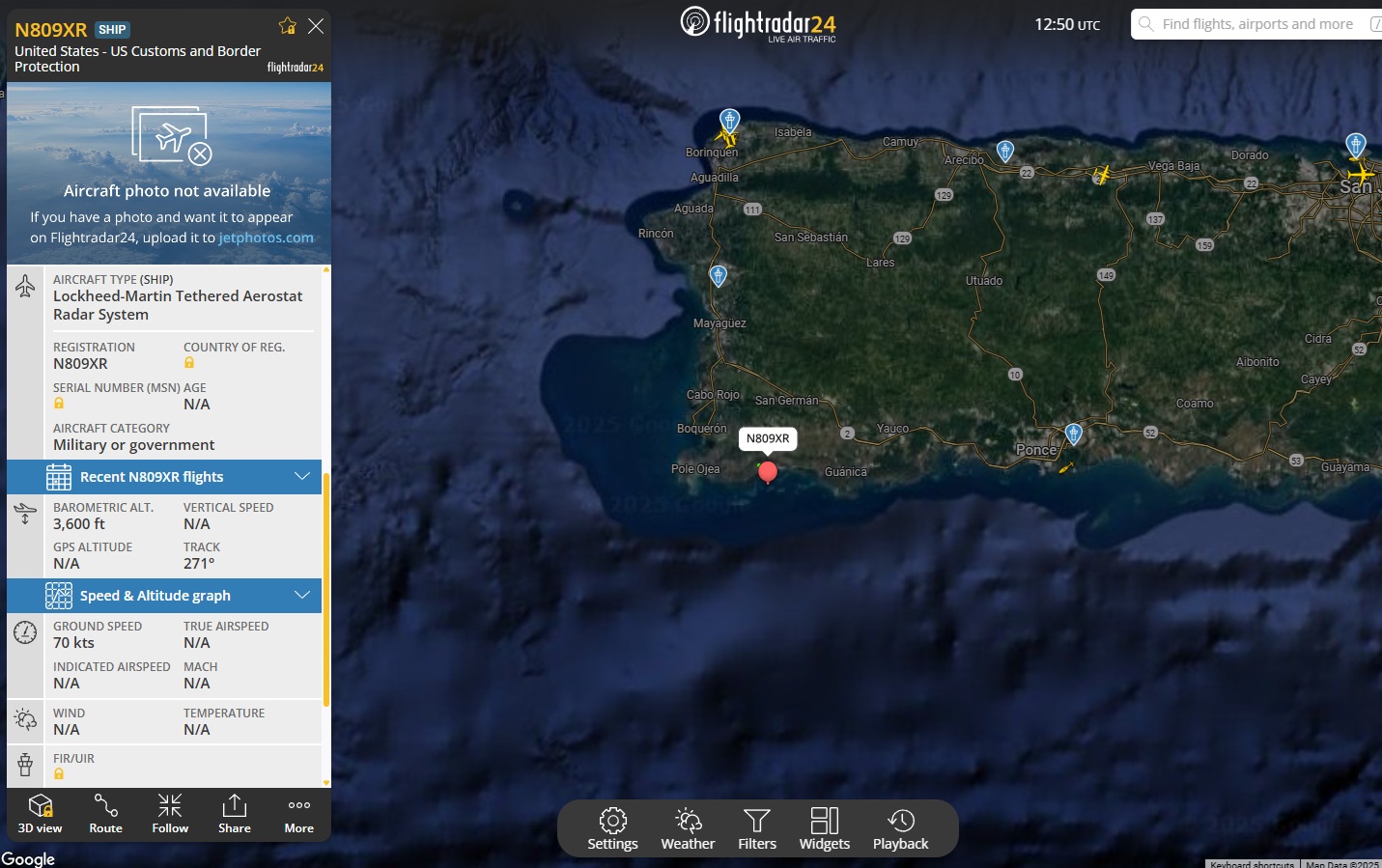
The TARS network was originally designed to support airspace security and counter-narcotics missions along the southern U.S. border. The Puerto Rico site—one of the key nodes—serves as a forward radar platform for tracking low-flying aircraft, monitoring maritime smuggling routes, and providing early warning data to U.S. agencies.

In recent months, defense observers have noted a rise in operational tempo from the Lajas aerostat site. The increase comes as the Department of War and U.S. Southern Command heighten monitoring of the Caribbean airspace following concerns about potential threats from Venezuela. Officials fear that the Maduro regime, under growing internal and external pressure, could attempt to project military power or conduct drone and air operations near U.S. or allied assets in the region.
The aerostat’s radar feed integrates into a larger surveillance network that supports U.S. military and Homeland Security operations, including drug interdiction and counter-smuggling efforts. These persistent airborne sensors provide near-continuous situational awareness, helping to detect both illicit air traffic and possible unconventional threats such as small, low-observable drones.