

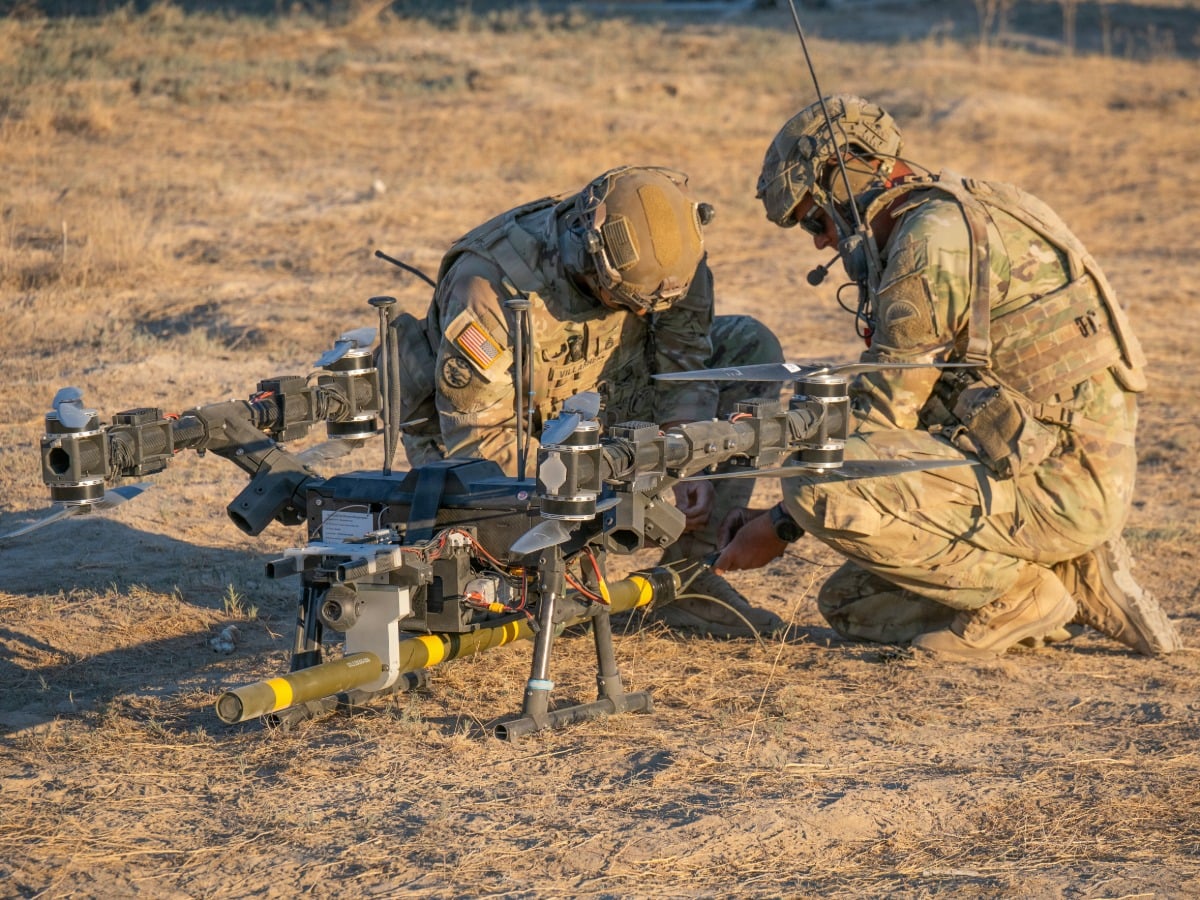
- Soldiers from the 741st Brigade Engineer Battalion, 41st IBCT, Oregon Army National Guard, successfully detonated a drone-delivered live Bangalore torpedo on a wire obstacle on June 22, 2026.
- The Lorica Technologies Mule 28 drone, built in approximately six weeks, weighs 20.4 kg and carries a payload of up to 90.7 kg.
A drone climbed into 40 km/h (25 mph) gusts above a high desert training range in Oregon on June 22, 2026, carrying a live Bangalore torpedo, a metal tube packed with Composition B4 explosive, and dropped it directly onto a wire obstacle before soldiers detonated the charge from cover. Army doctrine normally assumes half the soldiers ordered to breach a wire obstacle on foot will become casualties in the attempt, and the engineers of the 741st Brigade Engineer Battalion, 41st Infantry Brigade Combat Team, Oregon Army National Guard, just demonstrated a potential way around that calculation using a $40,000 drone and a weapon that has been in U.S. Army inventory since World War II.
The Bangalore torpedo, formally designated the M1A3 Bangalore Torpedo Demolition Kit, is one of the oldest breaching tools in the American military inventory, a concept developed by the British Army in 1912 in Bangalore, India, and widely used in both World Wars to clear barbed wire obstacles and anti-personnel mines. Each demolition kit consists of ten tube sections, each 0.76 m (2.5 ft) long and containing 2.27 kg (5 lb) of Composition B4 high explosive, a mixture of RDX and TNT that delivers a powerful linear blast effect when detonated along its length. Doctrine permits joining up to four sections for a single shot. The soldiers on Range 22 used a two-section assembly, extended shock tube behind the drone to serve as the detonation link, and detonated from cover after the drone released the charge onto the wire.
The tactical problem the 741st BEB’s drone working group set out to solve is not a new one, but the threat environment sharpening its urgency absolutely is. Breaching enemy obstacles under fire has always been the most dangerous mission in the combat engineer’s repertoire, but the proliferation of first-person view drones on the modern battlefield, where a cheap quadcopter carrying a rocket-propelled grenade warhead can track a sprinting soldier across open ground and detonate on contact, has elevated the lethality of that open-ground sprint to a degree that existing doctrine did not fully anticipate. The 50 percent casualty planning factor Army doctrine assigns to the deliberate breach was established before FPV drones rewrote the cost structure of lethal observation and precision fires at the squad level.
“The most casualty-producing thing that Army engineers do is the breach,” said 1st Lt. Andrew Lucas, who co-led the working group from the battalion S-3 section. “Expect 50 percent casualties. If you can deliver something to clear the breach with a $40,000 drone, instead of putting soldiers in harm’s way, that’s worth experimenting with.”
The working group was established by battalion commander Lt. Col. Eric Zimmerman with a directive to defeat a wire obstacle using a commercial or similar drone during annual training. When the team researched existing approaches, they found no precedent anywhere in the U.S. Army. What they did find was a constant stream of Ukrainian combat footage demonstrating exactly the kind of improvised drone-enabled engineer solutions that years of attritional warfare against a well-equipped adversary tend to produce.
“Mostly Ukraine,” Zimmerman said when asked what drove the concept. “Watching what was going on in Ukraine, and how innovative they are, it inspires you to get better and think bigger.”
Funding for a commercial drone purchase never materialized, and the Oregon Army National Guard’s 249th Regional Training Institute could not build an airframe with sufficient lift capacity within the available timeline. The battalion’s operations section kept searching, working from specifications the drone working group had developed, and eventually identified Lorica Technologies, a company based in Ashland, Oregon, as the only available partner capable of meeting the requirement. Working group co-lead Capt. Samuel Cushing, the battalion’s plans officer, noted that choosing a domestic manufacturer rather than a commercially available drone with Chinese components was a deliberate decision driven by electronic warfare and supply chain concerns.
“It’s been helpful to have contractors that can meet every specification we’re asking for and produce a drone that also meets the Army’s intent for any sort of technology that we integrate,” Cushing said.
Lorica built the drone that flew on June 22 in approximately six weeks. The aircraft, designated the Mule 28, weighs roughly 20.4 kg (45 lb), generates a payload lift capacity of approximately 90.7 kg (200 lb), and is powered by eight motors turning eight 0.71 m (28 inch) bi-bladed propellers. Its onboard computing architecture processes 128 trillion operations per second, giving it sufficient processing power for real-time sensor fusion, and its software-defined radio suite covers the 0-to-11 GHz spectrum for listening and radio direction-finding. The drone carries a sensor package capable of facial recognition, vehicle recognition, and weapons recognition, and it can derive map coordinates from its camera feed using trigonometric calculations based on focal length, allowing it to mark precise drop points on identified objects. Lorica currently fields three Mule 28 prototypes. The company had produced the airframe specifically for this project.
The working group built the safety architecture for live explosive employment in methodical stages, walking up the risk ladder one step at a time rather than attempting the full live-Bangalore drop on the first try. The drone first proved it could deliver an inert training aid identical in weight and dimensions to the M1A3 Bangalore. Once that was reliable, the team flew an inert body fitted with only a blasting cap, then a blasting cap with a short section of detonating cord, and finally the full two-section live charge. Every iteration involving energetics used shock tube spooled from the drone to the obstacle as the initiating system, a deliberate rejection of electronic triggers that could be jammed or prematurely activated in the dense electromagnetic environment of a large-scale combat operation.
“Ideally, you would love to be able to remote-detonate this without having to have a spool of shock tube,” Lucas said. “But in the LSCO environment, we’ve seen so many other systems jammed that if you have the ability to, it’s not a detriment that we’re doing it this way.”
Lorica founder and CEO Christopher Dye described the software architecture behind the Mule 28’s swarm control system, called Hive, as the capability that makes the platform more than a large quadcopter.
“It doesn’t matter what the vehicle is, as long as we understand the capabilities and the parameters of the vehicle,” Dye said. “We can task the swarm based on what the job needs to get done. Right now, we’re working on natural language control, so that you can just talk to the bird and tell it, ‘Hey, I want a reconnaissance around this building. I need to know how big that ditch is before we get there, how many steps, how high the windows are.'”
Both Lucas and Cushing identified the broader significance of the experiment as belonging to the specific mission set of combat engineers rather than the infantry-centric drone applications that have dominated the conversation so far. The engineer’s primary warfighting functions are mobility, helping friendly forces move, and counter-mobility, denying the enemy the ability to do the same. Every drone concept that has attracted significant Army attention over the past three years has been oriented toward direct fire, reconnaissance, or logistics. The Bangalore drop represents a different category of application: using drone lift to extend the engineer’s organic breaching capability into the space beyond direct enemy observation and fire.
“Mobility, counter-mobility is the bread and butter of the engineers, so we should focus on leaning into that versus infantry tasks,” Lucas said.
The next conceptual step Lucas described is full autonomy: a drone carrying an onboard AI processor that can identify concertina wire from its camera feed, calculate a release point, and fly the approach and drop sequence without requiring a human controller in the loop, removing even the radio link as a potential point of failure or vulnerability.
The 741st BEB will capture the June 22 demonstration in a battalion white paper and forward the concept to the broader Army Engineer community for evaluation. Whether that community adopts, funds, and scales the tactic into doctrine is a question the white paper will begin to answer. What the soldiers at Range 22 already answered is the foundational one: the drone-delivered Bangalore breach works.