

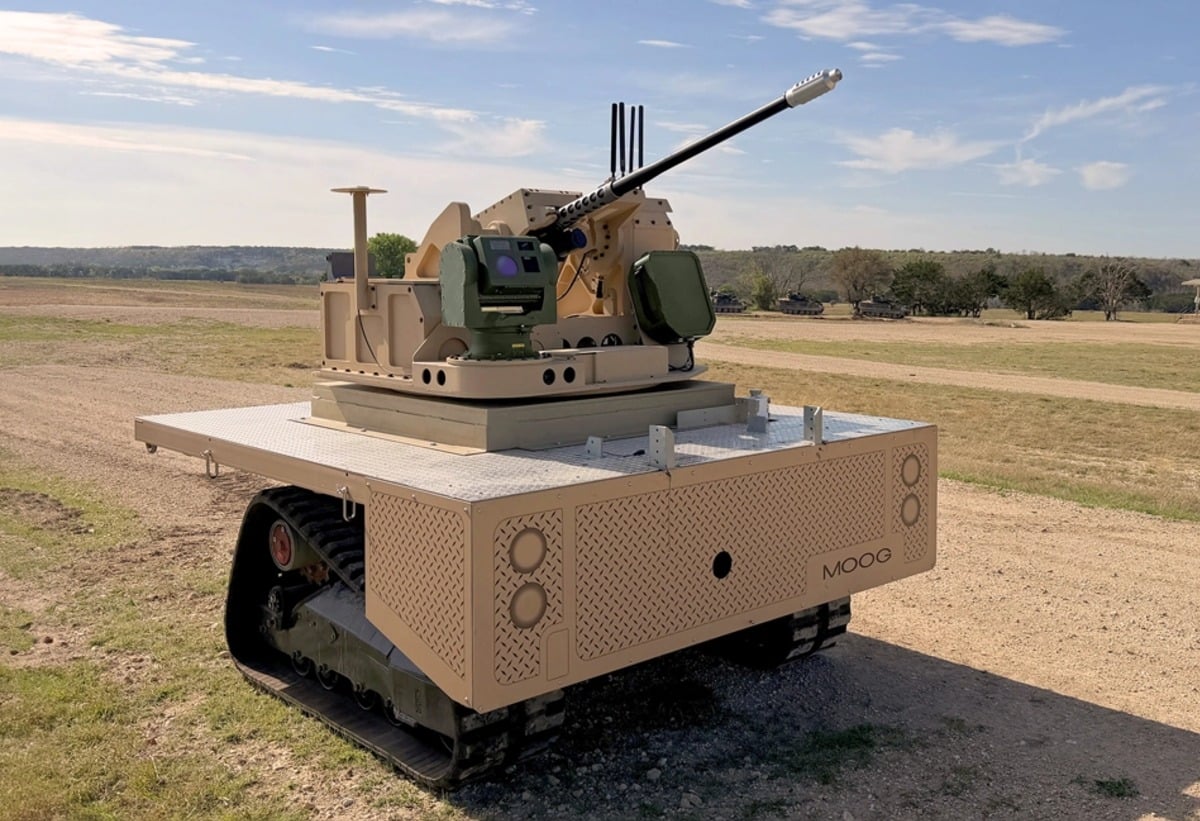
- Moog, Echodyne, and Picogrid demonstrated a retrofit C-UAS system at Fort Hood, Texas in late March, engaging drone threats in under three seconds.
- The RIwP platform combines Echodyne's EchoShield radar and AI targeting to upgrade existing Army turreted weapon stations against Group 1-3 UAS threats.
At Fort Hood, Texas, in late March, engineers and soldiers ran live fire at drones and watched a retrofitted U.S. Army weapon station kill them in under three seconds. The exercise, called Operation Condor Rebirth, brought together Moog, Echodyne, and data platform company Picogrid to demonstrate that existing turreted weapon stations, the kind already mounted on vehicles across the U.S. Army’s fleet, can be transformed into capable counter-drone systems by bolting on a radar, an edge computer, and an AI targeting module rather than buying entirely new hardware.
Small unmanned aircraft systems, ranging from commercial quadcopters modified to carry grenades to purpose-built first-person-view kamikaze drones, have become a defining feature of modern land combat. Ukraine has seen thousands of such strikes against armored vehicles, logistics convoys, and infantry positions, and adversaries including Iran, Russia, and various non-state actors have invested heavily in scaling cheap drone production precisely because the cost asymmetry is so favorable. A $500 drone destroying a $4 million armored vehicle is a trade any attacker will accept repeatedly. Defending against that exchange requires systems that can engage threats quickly and at a cost that doesn’t bankrupt the defender.
The Moog Reconfigurable Integrated-weapon Platform, known as RIwP, addresses that problem not by replacing what soldiers already have but by upgrading it. The platform packages an edge computer and Echodyne’s EchoShield radar with cabling designed to connect with any existing U.S. Army turreted weapon station, meaning the retrofit can be applied across a wide range of vehicles without requiring a new vehicle purchase or a lengthy integration program. Echodyne describes EchoShield as a medium-range radar built on a commercial off-the-shelf design with industry-standard interfaces, which in practice means it can feed targeting data directly to other systems without bespoke software bridges. The radar uses machine learning models for classification, distinguishing between drone types and configurations, and generates precise location data that the AI targeting system then converts into a firing solution.
What the Fort Hood exercise demonstrated was how well that chain functions under pressure. The team tested Group 1 through Group 3 UAS threats, a classification covering drones from under five pounds up to roughly 1,300 pounds and from treetop altitude to 18,000 feet, representing the full spectrum of small to medium unmanned systems that infantry and vehicle crews are most likely to encounter in contested airspace. Detecting, locking on with precision tracking, and engaging a target in that threat class in less than three seconds is a reaction time that matters enormously when the incoming system is traveling at speed and carrying a warhead. The AI targeting capability also demonstrated passive detection, meaning it can identify threats without emitting signals that would betray its position, along with autonomous targeting, track re-acquisition after signal interruption, and multi-object targeting, handling more than one threat simultaneously.
Eben Frankenberg, Echodyne’s CEO, captured the core argument for this approach: “By combining high quality radar sensors and rapid integration of data it is possible to deliver impressive C-UAS capabilities from existing battlefield systems, affordably and more quickly than using purpose-built systems.”
Purpose-built counter-drone systems can cost millions of dollars per unit and take years to procure and field through conventional acquisition channels. A retrofit kit that achieves comparable engagement timelines on hardware the Army already owns compresses both the cost and the timeline considerably.
Mike Gruver, Moog’s senior vice president for defense, framed the urgency plainly: “This is a critical moment to rapidly strengthen C-UAS defenses and protect warfighters against evolving threats. Working with teammates like Echodyne ensures the best forms of C-UAS capabilities are available to the U.S. and its Allies.”
The Picogrid Legion data platform connected the exercise’s mission systems into a secure Army network, addressing a gap that has tripped up other counter-drone integration efforts. Disparate sensors and effectors that cannot share data in real time, or that require manual intervention to hand off targeting information between systems, introduce latency that negates whatever speed advantage the individual components provide. Demonstrating that the radar, AI targeting, and weapon station could operate as a networked system rather than a collection of separately operated boxes was as important to the exercise’s conclusions as the three-second kill chain.