

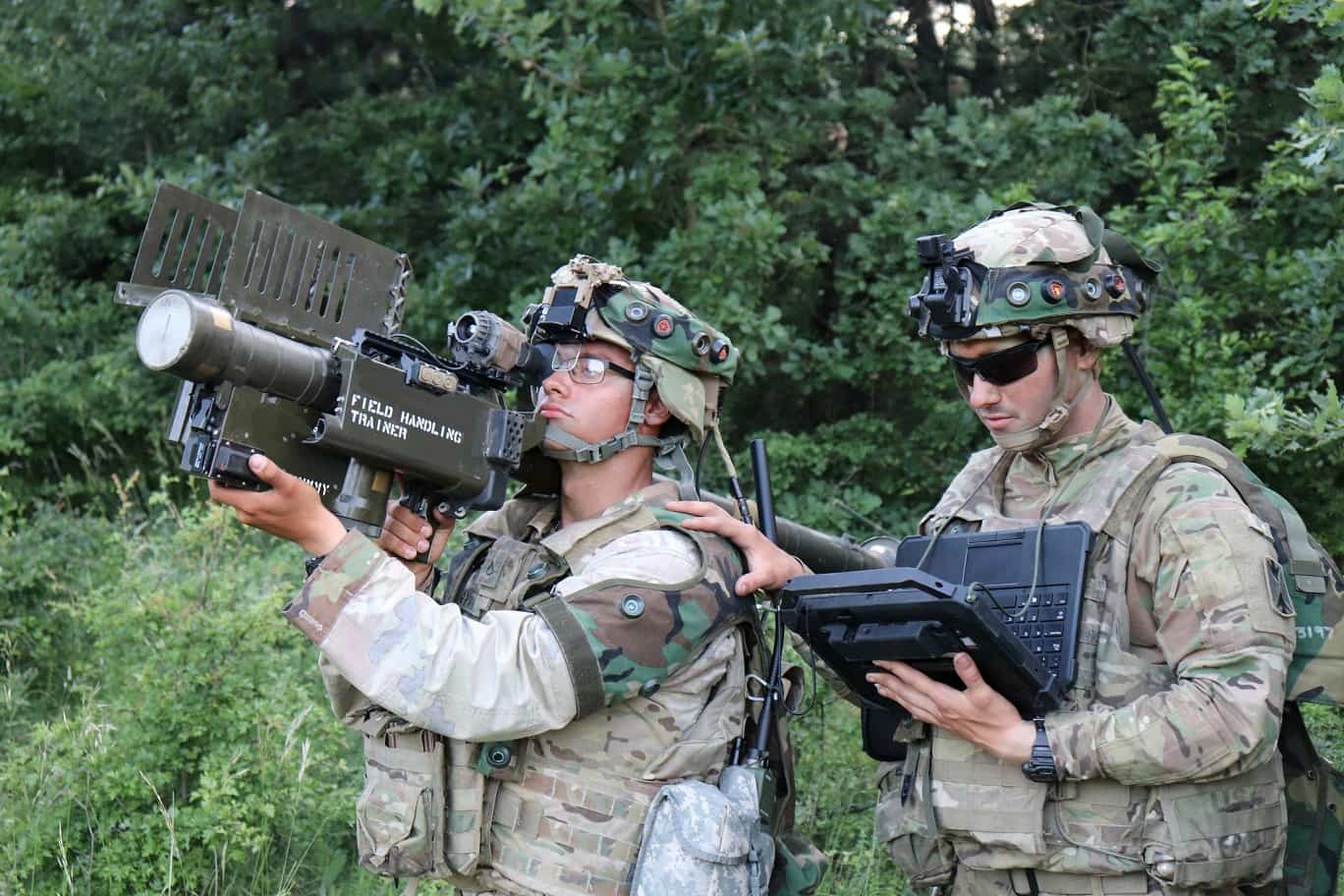
The U.S. Army has demonstrated cutting-edge Enhanced Target Acquisition Kit, or ETAK, that is designed to provide day, night and degraded visual environment target acquisition and tracking for man-portable systems for Warfighters.
According to a statement issued by U.S. Army Space and Missile Defense Command, Soldiers in Europe demonstrated the ETAK during the Sabre Guardian exercise earlier this year.
Members of SMDC have developed the Enhanced Target Acquisition Kit, or ETAK, to provide day, night and degraded visual environment target acquisition and tracking for man-portable systems.
“ETAK augments the Soldiers’ existing equipment so they are able to see at night and receive sensor tracks to cue the Soldier to the location of the threat,” said Justin Novak, SMDC Future Warfare Center computer engineer.
ETAK is designed to leverage existing combat equipment to provide air space situational awareness, early warning, and rapid sensor assisted acquisition and tracking capabilities to dismounted Soldiers over tactical networks.
The kit was developed by the command’s U.S. Army Training and Doctrine Command Capability Manager for Strategic Missile Defense’s Prototyping and Experimentation Branch in two increments. The first is a rail sight mount for the weapon, and the second is a sensor-based cueing system.
In tandem, the kit cues a Soldier to the vicinity of the target using the sensor and then enables positive identification and tracking of the target via the night optic. ETAK capitalizes on Army investments leveraging the latest generation night optics and augmented reality display technology. ETAK is field mountable and dismountable and does not degrade the capabilities of the existing system.
“The goal of ETAK is to increase the Soldiers’ capability to acquire and engage targets with man-portable weapons,” Novak said. “In addition to being able to acquire targets, the system is also able to show where friendly units are. This capability will help reduce the possibility of having a friendly fire incident on the battlefield. And in the future, other man-portable systems may be able to take advantage of these enhanced capabilities.”
The Prototyping and Experimentation Branch developed this capability from concept to prototype demonstration. In coordination with multiple program executive offices, ETAK leverages existing equipment, government manufacturing capabilities and commercial hardware to rapidly produce an inexpensive prototype.
The branch then leveraged the Air and Missile Defense Prototyping Framework to integrate Solders’ existing equipment and tactical data feeds to rapidly produce and demonstrate a prototype in field conditions.
“The Future Warfare Center has been very supportive in giving me the tools and leadership support at the highest level to be able to develop ETAK from a concept and turn it into a reality,” Novak said.
This modular framework is multi-platform, which is substantiated by repurposing tactical processing modules built for common computer operating systems and reusing them within the other operating system. This technology is currently being assessed by operational units to address gaps in current systems.
“Looking across available technologies, I came up with this concept by blending available technologies for the Soldiers’ benefit,” Novak said. “This concept utilizes augmented reality gaming technology to provide Soldiers awareness of their surroundings without having to take their eye off of potential adversaries or other objectives they may be focused on.
“Repurposing this technology and allowing industry to mature it gives the Soldier a decisive advantage by benefiting from industry-matured technology without the taxpayer funding the integration of mature components versus a brand new technology forward,” he added.
ETAK is designed to improve defense of Army forces worldwide with enhanced day, night, and low-visibility situational awareness, acquisition, and engagement capability; digital fire control for man-portable systems. It also leverages Soldiers’ existing combat equipment and Army training programs with minimal added weight by using a common power source. SMDC is in the process of transitioning this technology to a program office for procurement and fielding.
“My hope is that ETAK will cause our adversaries to think twice before attacking as any Soldier could have this capability at the ready,” Novak said.