

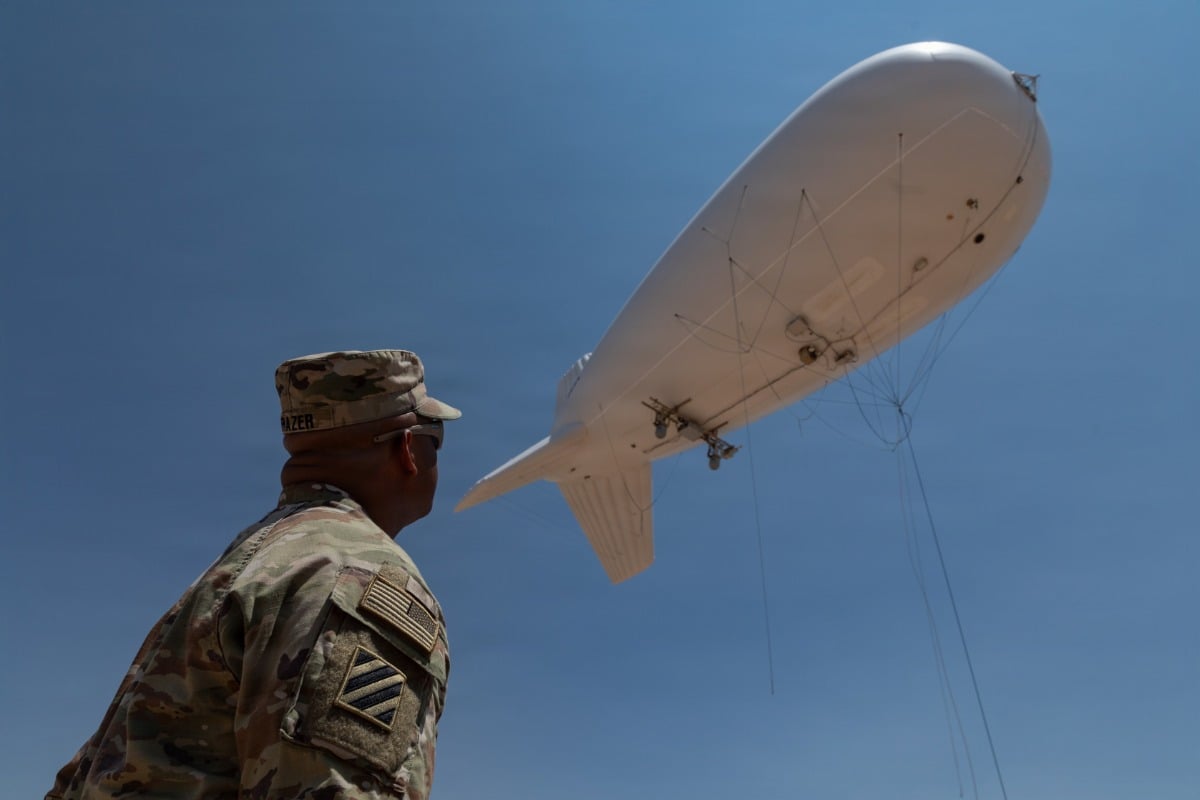
- The U.S. Army awarded TCOM LP a $447 million contract for production, fielding and sustainment of its Persistent Surveillance Systems-Tethered aerostat program.
- The contract runs through July 20, 2031, with work locations and funding to be determined through individual task orders.
TCOM LP, based in Columbia, Maryland, was awarded a $447 million contract by U.S. Army Contracting Command at Aberdeen Proving Ground, Maryland, to handle production, fielding, sustainment and lifecycle support for the Persistent Surveillance Systems-Tethered family of systems, an aerostat-based surveillance program the Army has relied on for more than a decade.
The contract itself is structured as an indefinite-delivery, indefinite-quantity agreement, a common Pentagon contracting tool that sets a ceiling value the Army can draw against over time through individual task orders rather than guaranteeing the full amount upfront, and it combines several different payment structures, including cost-plus-fixed-fee and firm-fixed-price arrangements, depending on the type of work ordered.
The Army solicited bids from ten companies but received only two, and work locations and specific funding will be determined order by order rather than fixed in advance, with the overall effort expected to run until July 20, 2031, giving TCOM a six-year runway to keep the aerostat fleet flying.
What exactly is an aerostat, and why does the Army need one this badly? It’s essentially a large, helium-filled balloon shaped like a blimp, tethered by a high-strength cable to a mobile mooring trailer on the ground, carrying cameras, radar and other sensors that can watch a wide area continuously for weeks without needing to refuel or land the way a drone or manned aircraft would. TCOM’s own aerostat platforms can operate at altitudes up to 16,000 ft (4,880 m) and provide 360-degree surveillance coverage on missions that can stretch beyond 30 days, giving ground commanders a persistent, elevated set of eyes over a base or contested area that complements what drones, aircraft and satellites can offer, since none of those platforms can loiter continuously over one spot for weeks at a stretch the way a tethered aerostat can.
The Persistent Surveillance Systems-Tethered program itself traces back to a 2016 Army decision to merge two earlier aerostat efforts, the Persistent Threat Detection System and the Persistent Ground Surveillance System, into a single unified program built to support what the Army has described as joint urgent operational needs, military language for capability gaps that emerge directly from troops in combat and demand a fast acquisition response rather than a years-long conventional procurement cycle. Those earlier systems proved especially valuable identifying improvised explosive devices, tracking insurgent movement and monitoring suspicious activity around bases in Iraq and Afghanistan, and TCOM’s tactical aerostat platforms have also been used to support U.S. Customs and Border Protection operations along the southern border, showing the same core surveillance technology has found uses well beyond a single overseas battlefield.
TCOM has been the Army’s primary engineering and sustainment partner on this program for years, having previously won a nearly $979 million hybrid contract in September 2019 covering engineering, logistics, operations and program management support for the same PSS-T family of systems, work the company performed out of facilities in Maryland, North Carolina, Pennsylvania and Arizona through a June 2024 completion date. This new $447 million award effectively extends that relationship into the next decade, shifting the contract’s emphasis toward production and fielding alongside continued sustainment, language suggesting the Army intends to keep expanding or replacing aerostat systems in its inventory rather than simply maintaining what it already has in the field.
Drones, satellites and other unmanned systems have proliferated dramatically across the Pentagon’s portfolio in recent years, and the Department of War has pushed hard toward cheaper, more expendable autonomous platforms as a central pillar of its modernization strategy. A large tethered aerostat is neither cheap nor expendable in that sense, and it’s also a fixed, visible target that an adversary with modern air defenses or long-range strike weapons could potentially locate and destroy, a vulnerability that has fueled debate within defense circles about how much longer aerostat-based surveillance remains viable in a fight against a well-equipped opponent rather than the counterinsurgency environments where the technology proved its worth.
The Army’s decision to lock in support for this program through 2031 suggests the service still sees enough value in an aerostat’s unmatched ability to loiter continuously over a fixed location to justify the investment, even as it simultaneously builds out cheaper, more distributed drone and satellite alternatives elsewhere in its surveillance architecture.