

- Russia's military grew from about 900,000 troops before 2022 to around 1.3 million in 2026 despite roughly 1.4 million total casualties.
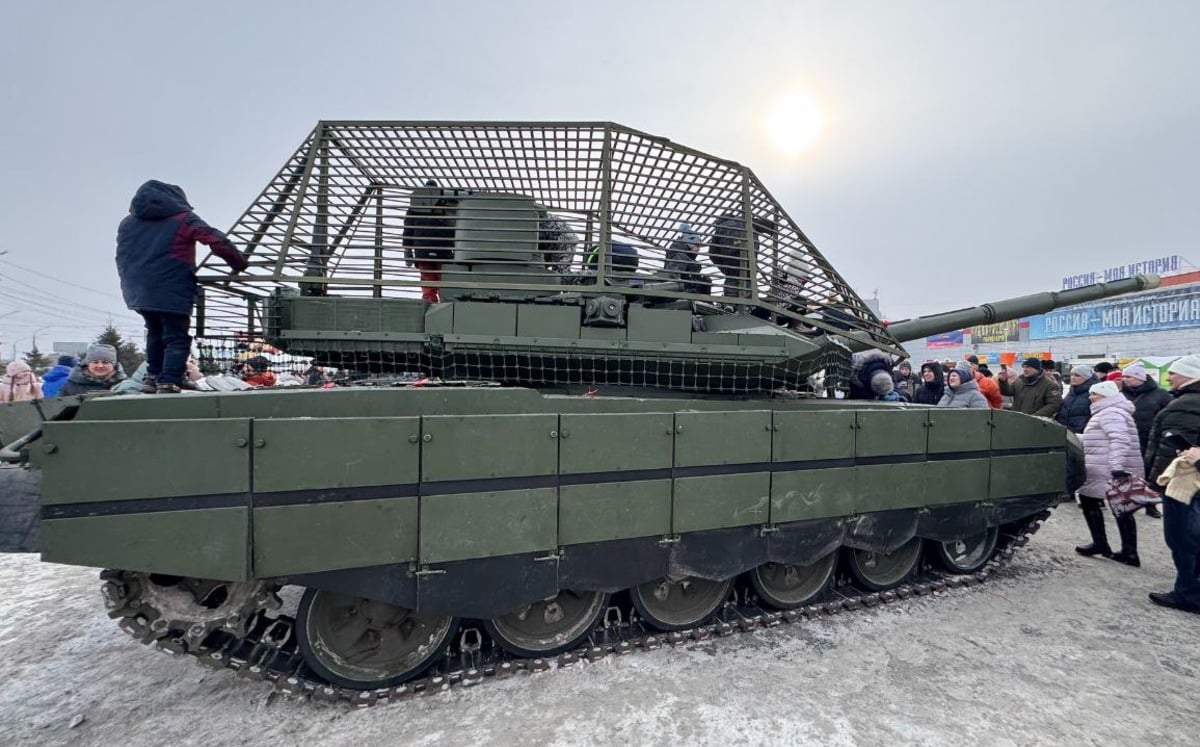
- Russia now produces more than 200 T-90 tanks, 400 BMP-3 vehicles, and 500 BTR-82 vehicles annually, fully rebuilding its armored fleet.
Russia will likely come out of its war against Ukraine as a more dangerous military power than it was before the invasion began, despite losing equipment and troops at a scale no major military has suffered in a conventional war since World War II, according to an analysis by Jakub Janovsky published on Fronts.co.
That forecast cuts against the instinct to assume years of brutal attrition have permanently crippled Russia’s fighting force, and it lands at a moment when NATO planners are actively trying to figure out exactly what kind of military will emerge from the wreckage once the fighting eventually stops.
Janovsky’s analysis found that Russia has not only stabilized its losses of tanks and armored vehicles but has fully rebuilt its fleet, drawing on a combination of ramped-up domestic production and deep drawdowns from Soviet-era storage depots that once held some of the largest stockpiles of military equipment anywhere in the world. Russia is now producing more than 200 T-90 tanks, more than 400 BMP-3 infantry fighting vehicles, and more than 500 BTR-82 armored personnel carriers annually, figures that describe a defense industrial base running at genuine wartime capacity rather than limping along on prewar output. The Defence Blog reported last year on one particularly visible sign of how deep those storage drawdowns have gone, documenting Russia’s revival of hundreds of T-62 tanks, a design that first entered Soviet service in 1961, pulled out of decades of storage specifically to replace losses the open-source tracking group Oryx had already confirmed exceeded 4,100 Russian tanks of all types destroyed, captured, or abandoned since the invasion began.
Russia has now largely exhausted the inherited Soviet stockpile that let it absorb losses this quickly in the first place, meaning any future conflict will force Moscow to rely almost entirely on fresh production rather than free replacements pulled from storage, a considerably slower and more expensive proposition. The ground forces also remain constrained by a battlefield reality that has defined the entire war: until Russia develops an effective, affordable way to counter the overwhelming volume of drones now saturating the front line, it cannot return to the kind of fast-moving mechanized warfare its armored vehicle fleet was originally built to fight.
Drones represent the one area where the analysis found Russia holds a genuine, durable advantage. Outside of Ukraine itself, Russia has built what the analysis describes as the most developed and combat-experienced drone force in the world, spanning both battlefield reconnaissance and strike drones and longer-range weapons capable of hitting targets deep behind the front line. The Kremlin has publicly stated its ambition to grow its Unmanned Systems Forces into a branch larger than the entire United States Marine Corps, a target that would make it larger than most mid-sized national armies on its own, though Janovsky’s analysis notes real uncertainty about whether Russia will actually integrate that drone force effectively with the rest of its military or keep it operating largely independently.
Aging Soviet-era airframes cannot simply be pulled out of storage and flown the way an old tank can be repaired and pushed back into a ground unit, since flying worn-out aircraft past their safe service life risks crashes that kill experienced pilots who take years to replace. Russia’s current production of 40 to 60 fighter jets annually, including a handful of semi-stealthy Su-57s, falls well short of what would be needed to offset both combat losses and the natural retirement of aging airframes, and Janovsky’s analysis found the situation is far more severe for Russia’s long-range aviation, noting the country is now producing just one Tu-160 strategic bomber every one to two years while its A-100 airborne early warning aircraft program appears to have stalled entirely without delivering a single operational unit. That decline comes precisely as NATO air forces maintain their existing size while adding fifth-generation stealth fighters like the F-35, widening a technological gap Janovsky’s analysis concludes Russia has no realistic near-term path to closing.
Air defense presents its own version of the same problem. Russian production of surface-to-air missile systems has roughly kept pace with confirmed losses, but the war has degraded Russia’s radar coverage, drained its stockpile of anti-aircraft missiles, and demonstrated repeatedly that expensive interceptor missiles simply cannot economically counter the volume of cheap drones and missiles that modern long-range strike campaigns can throw at a target. The Defence Blog has documented that dynamic playing out directly against Russia itself, reporting extensively on Ukraine’s long-range drone campaign against military airfields and strategic bombers, strikes that have forced Russia to spend heavily on new bomber shelters and decoys while continuing to lose aircraft it cannot replace at the rate they burn.
Manpower may ultimately prove the hardest problem of all to solve. Janovsky’s analysis found Russia’s military has grown from roughly 900,000 troops before the invasion to around 1.3 million in 2026, despite total wartime casualties estimated near 1.4 million, including roughly 500,000 killed, achieved by continuously lowering recruitment standards, drawing in convicted criminals, and running the first Russian mobilization since World War II. The Defence Blog previously reported on the Kremlin’s own inconsistent claims about how many recruits it adds each month, with Russian officials Vladimir Putin and Dmitry Medvedev citing contradictory figures without any public correction from the Ministry of Defense, an inconsistency Janovsky’s broader analysis situates within a deeper structural problem: Russia’s economy now runs at close to full employment, meaning the pool of people willing to fight has already been substantially drawn down and further recruitment will require considerably better pay and conditions than the military has needed to offer so far.
The underlying conclusion carries real weight for European planners watching this unfold from the outside: a military that manages to rebuild its ground forces, expand its drone branch into something larger than the U.S. Marine Corps, and hold onto over a million troops, even a poorly trained and demoralized force assembled under brutal wartime discipline, still adds up to a fighting force considerably larger and more battle-tested than the one Russia sent across the border in February 2022, and Europe’s own rearmament timeline may not have the luxury of assuming otherwise.