

- NODA AI won a $10 million Department of War contract on July 22, 2026 to develop MAESTRO, software that projects commander's intent across autonomous drones from any manufacturer.
- The contract integrates with LUCAS and other Multi-Domain Collaborative Autonomy programs, with capabilities tested through live demonstrations under jammed communications conditions.
NODA AI announced Wednesday it has secured a $10 million contract from the Department of War, the current name for the Department of Defense, to develop software that lets American military drones and autonomous vehicles keep executing a commander’s orders even after enemy jamming or cyberattacks cut off their communications links.
The contract funds an effort called MAESTRO, short for Multi-Domain Autonomous Enhanced System for Tactical Reasoning and Orchestration, which falls under a broader Pentagon initiative known as the Multi-Domain Collaborative Autonomy program. That program exists because the U.S. military now operates a sprawling and growing mix of autonomous drones, boats, ground robots and underwater vehicles built by dozens of different manufacturers, and none of them naturally talk to each other or share a common understanding of what a commander actually wants them to accomplish in a fight.
NODA’s software is designed to translate a commander’s intent, the operational goal and rules a human officer sets for a mission, into coordinated action across all of those different unmanned platforms simultaneously, regardless of which company built them or which physical domain they operate in, air, sea surface, undersea or land.
Modern battlefields increasingly feature electronic warfare designed specifically to jam radio signals and GPS, and adversaries like Russia and China have invested heavily in exactly that kind of communications disruption as a way to blind and confuse American drones and robots. NODA’s algorithms are built to maintain what the company calls custody of a commander’s intent even in denied, degraded, intermittent and limited communications environments, engineering terms that describe everything from a fully jammed battlefield to a spotty satellite link, so that autonomous systems keep pursuing their assigned mission rather than going dark or behaving unpredictably the moment they lose contact with human operators.
Dr. An Tran, who goes by Mike and serves as Director of Prototyping within the Office of the Under Secretary of War for Research and Engineering, framed the contract as part of a broader Pentagon push to prove out autonomy concepts through real testing rather than PowerPoint promises.
“You cannot predict the next fight, but you can engineer readiness for any version of it, and that is exactly what this effort does,” Tran said.
“Affordable mass only matters if that mass can think and fight as one team when the network degrades. MAESTRO advances vendor-agnostic autonomy we can integrate across LUCAS and the broader Multi-Domain Collaborative Autonomy portfolio, then prove through disciplined T-REX extermination rather than promise on a slide. Our job is to turn that evidence into fielded, operational capability, first for the Joint Force and, in the near future, alongside our closest allies,” Tran said.
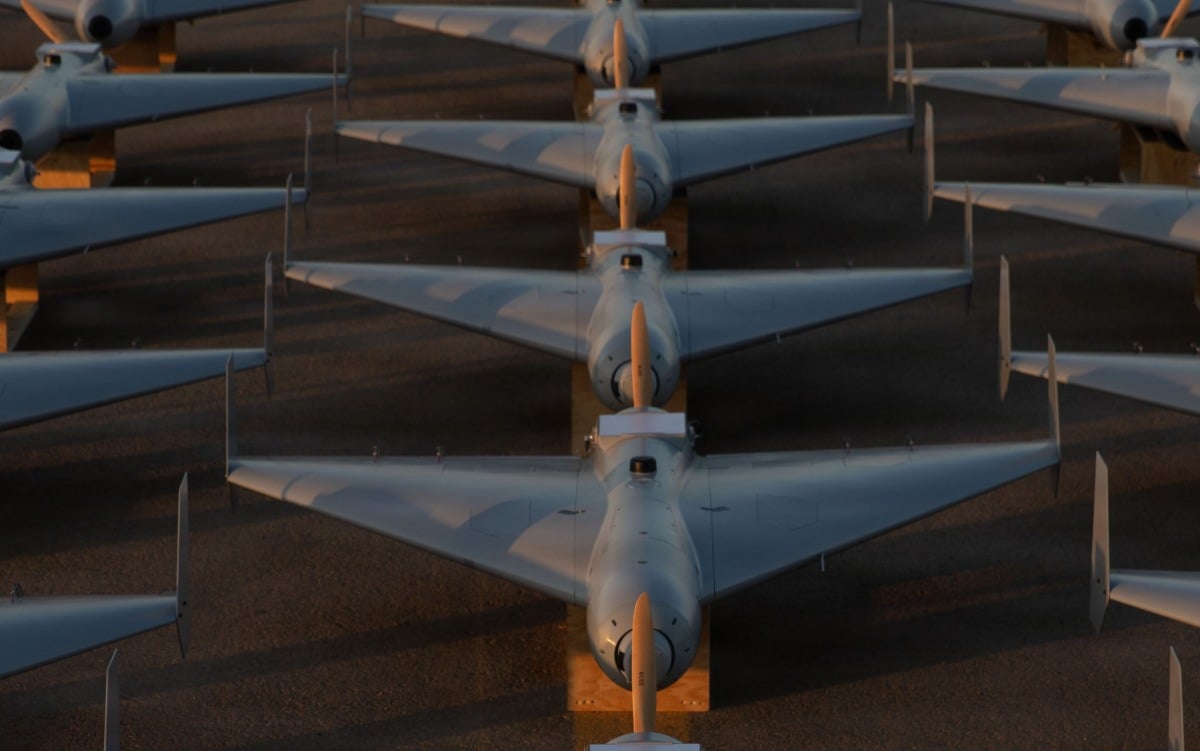
The contract explicitly ties into LUCAS, the Low-Cost Uncrewed Combat Attack System, a one-way attack drone the Pentagon unveiled in July 2025 that was reverse-engineered from Iran’s Shahed-136 loitering munition and is built by Arizona-based SpektreWorks at a reported cost of around $35,000 per unit, a fraction of the price of traditional cruise missiles or larger armed drones. LUCAS measures roughly 10 ft (3 m) long with an 8 ft (2.4 m) wingspan, carries a range of about 500 mi (800 km), and has already seen combat use with Task Force Scorpion Strike, a dedicated kamikaze drone unit CENTCOM activated in the Middle East, including a launch from the deck of the USS Santa Barbara in the Arabian Gulf. NODA’s integration work extends beyond LUCAS to other programs in the Pentagon’s autonomy portfolio, including systems known as MUSIC, Vigilant Spirit and Arbitrator, and the contract requires NODA to produce an interface and standards report that the government can use to keep extending that integration work regardless of which specific vendors win future competitions.
Philong Duong, CEO of NODA AI, described the contract as an extension of a basic military principle into robotic forces.
“Effective commanders project intent to subordinates and trust that they will execute,” Duong said.
“This contract advances that same first principle across an unmanned force: intent projected across dozens of platforms, any vendor, any domain, with the software maintaining custody of that intent when the network degrades. That is the evolution of autonomous deterrence and decisive autonomous engagements,” Duong said.
By building a software layer that can direct hardware from any manufacturer without requiring proprietary middleware or physical modifications, the Pentagon avoids locking itself into a single company’s ecosystem the way it has with some legacy weapons programs, preserving the ability to switch or add hardware vendors through future competitions without having to rebuild the underlying command and control software from scratch. NODA said its platform already connects dozens of government and original equipment manufacturer systems spanning from underwater vehicles to space-based assets, and this contract extends that existing integration work specifically into the Multi-Domain Collaborative Autonomy portfolio.
The award lands squarely inside a much larger Pentagon push to get lethal small drones into the hands of ordinary combat units fast. Defense Secretary Pete Hegseth signed a memo in July 2025 titled “Unleashing U.S. Military Drone Dominance” that directed the military to equip every Army squad with low-cost, expendable attack drones by the end of fiscal year 2026, prioritizing units in the Indo-Pacific, and criticized what he described as bureaucratic red tape that had left American forces behind adversaries who were mass-producing cheap drones. NODA’s contract will be validated through live, multi-domain demonstrations, including range testing of its tactical algorithms specifically under communications-contested conditions meant to simulate the kind of jamming American forces could face in a real conflict, giving the Pentagon a concrete test of whether software alone can turn a scattered collection of robots from different manufacturers into a force that keeps fighting together even when the enemy tries to cut the connection.