

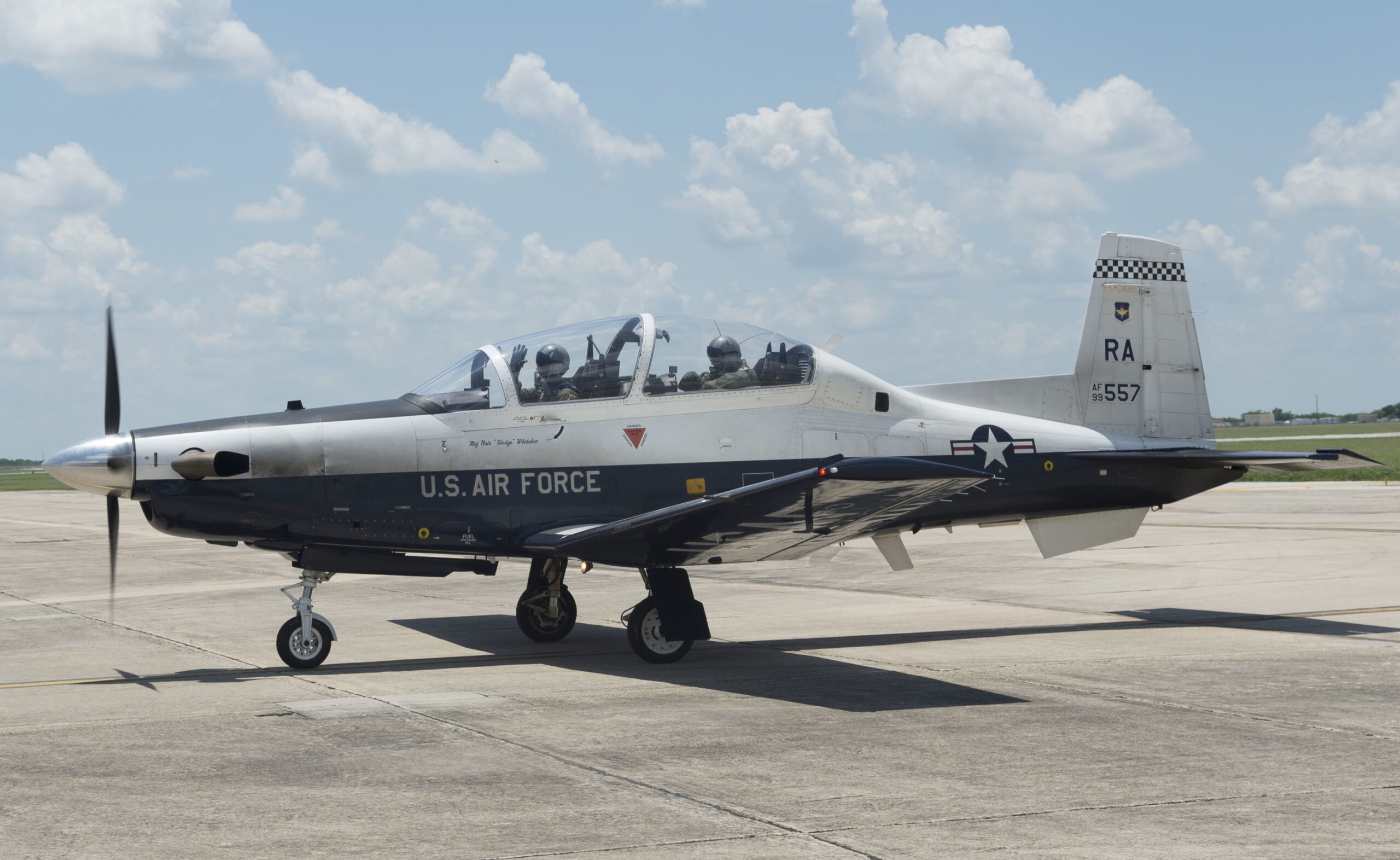
The U.S. Air Force Life Cycle Management Center’s Trainers Branch is looking for contractors that may be capable and willing to develop, deliver and integrate a comprehensive avionics system replacement for the T-6A primary trainer.
The Air Force has released a draft request for proposals for contractors interested in developing and delivering an avionics system replacement for the T-6A Texan II aircraft.
The current T-6A federated avionics system is comprised of analogue and first-generation digital components which have become increasingly impacted by obsolescence issues in recent years resulting decreased component reliability, declining aircraft availability rates and increased lifecycle sustainment costs.
In a notice, the Air Force announced that a comprehensive avionics system replacement is being considered to resolve the obsolescence issues and posture the T-6A for a long-term avionics lifecycle sustainment framework that is both reliable and cost-effective.
The replacement avionics system would require integration with the T-6A configuration at the time of installs and be capable of adapting to changes in the T-6A configuration over time. Desired objective is to understand the avionics system capabilities available that are compatible and interoperable with the T-6A.
The T-6A is a derivative of the Beechcraft PC-9 Mk II which was manufactured by Textron Aviation Defense (TAD) and is powered by a single PT-6A-68 Pratt & Whitney turboprop engine. The joint Air Force and Navy T-6A fleet is managed by the T-6 Program Office at Tinker AFB in coordination with Program Management Administration, (PMA)-273 located Naval Air Station Patuxeunt River.
The Air Force utilizes the T-6A to conduct primary pilot training which includes exposing entry level pilots to the cockpit environment and basic tactics associated with navigation, formation, and aircraft operation. The Air Force T-6A fleet operates from Air Education and Training Command (AETC) Training Wings located at Columbus AFB, Laughlin AFB, Randolph AFB, Sheppard AFB, Vance AFB, and Naval Air Station (NAS) Pensacola. Additionally, the Navy utilizes the T-6A to conduct Combat Systems Officer (CSO) training at NAS Pensacola alongside the Air Force.