

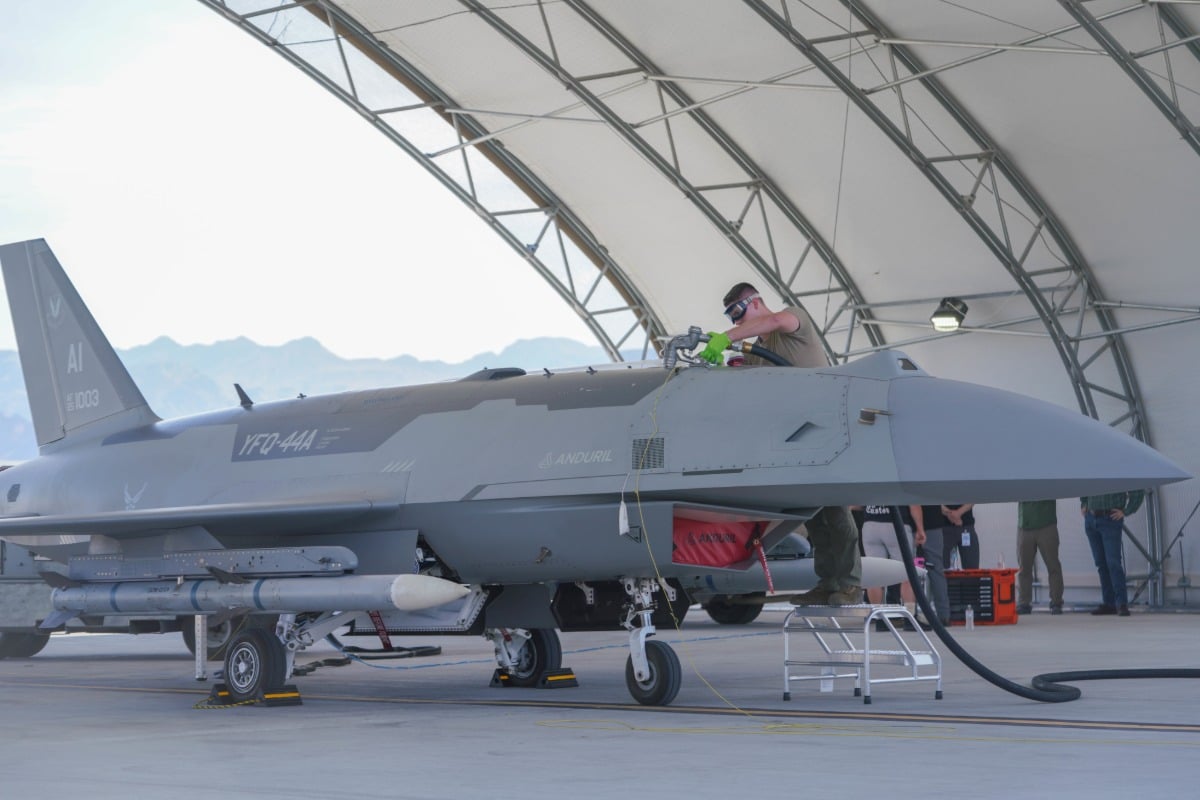
- The Air Force's Collaborative Combat Aircraft Experimental Operations Unit tested uncrewed aircraft during an Agile Combat Employment exercise at Creech Air Force Base, Nevada.
- Air Force Operational Test and Evaluation Center members observed the exercise as part of a new rapid operational testing procedure to speed CCA fielding decisions.
An unmanned fighter jet built to fly and fight alongside human pilots has left the sterile confines of a test range and flown its first real-world combat exercise in the Nevada desert, according to a release from Air Force Warfare Center Public Affairs published July 27, 2026.
The exercise, conducted at Creech Air Force Base by the Air Force’s Collaborative Combat Aircraft Experimental Operations Unit, pushed autonomous drone technology through an Agile Combat Employment scenario, the service’s term for rapidly dispersing aircraft and crews across multiple locations to keep an enemy guessing about where American airpower will strike next.
Collaborative Combat Aircraft, or CCA, describes a new category of semi-autonomous fighter drones the Air Force is developing to serve as robotic wingmen for piloted jets like the F-35 and F-22, extending sensor coverage and adding weapons capacity without putting additional aircrew at risk in contested airspace. The Defence Blog has tracked this program’s rapid maturation over the past year, from General Atomics flying its YFQ-42A prototype for the first time in August 2025 to Northrop Grumman’s YFQ-48A earning its official designation that December, and most notably to a live-fire milestone earlier this month when an Anduril-built YFQ-44A fired an AIM-120 AMRAAM missile at a digital target over the Mojave Desert, the program’s first weapons employment test.
The Creech exercise represents a different kind of milestone, less about proving the aircraft can fight and more about proving it can operate the way a real combat unit would, moving, launching, and coordinating across a dispersed battlefield rather than staying tethered to a single controlled test environment.
“Air superiority in today’s increasingly contested environments requires the rapid fielding of affordable mass,” said Air Force Chief of Staff Gen. Ken Wilsbach.
Wilsbach’s comment fits into a broader industrial push behind the concept, one that recently pushed the Air Force to award production contracts to Anduril and General Atomics in June 2026 covering the first 150 aircraft under what the service calls Increment 1, with officials signaling ambitions to eventually field somewhere between several hundred and roughly 1,000 CCAs across the fleet, according to prior reporting from The Defence Blog citing program tracking published by Shephard Media.
The Creech exercise specifically tested the Experimental Operations Unit, the Air Force’s designated organization for developing how CCA aircraft will actually be employed in combat, a distinct mission from the flight testing and weapons integration work happening elsewhere in the program. Throughout the multi-day event, the unit generated multiple sorties intended to demonstrate the aircraft’s reliability and extended range, integrated CCA flights with manned aircraft operating in the same local airspace to simulate projecting power across a distributed battlefield, and ran through scenarios designed to inform requirements the Air Force will eventually build into future versions of the aircraft.
“This exercise was about getting the systems into the hands of the warfighter,” said Lt. Col. Matthew Jensen, commander of the Experimental Operations Unit.
Jensen’s unit sits at the center of what the Air Force describes as an unusually fast development timeline, moving the CCA concept from a paper program to actual flight testing in under two years, a pace the service holds up as a pathfinder for how it wants to buy weapons systems going forward. Part of that speed comes from embedding operators, the actual pilots and crews who will someday fly and fight alongside these drones, into the development process from the earliest stages rather than waiting until a system is fully mature before letting warfighters touch it, an approach the release credits with accelerating how quickly lessons learned in exercises like this one can reshape the aircraft’s design and employment concepts.
Members of the Air Force Operational Test and Evaluation Center also observed the Creech exercise, participating in what the release describes as a new, rapid operational testing procedure designed to gather data outside the Air Force’s traditional, often lengthy testing pipeline.
“Our test teams can continuously use these warfighter-run exercises to gather and analyze data that aids in informed CCA fielding decisions well ahead of the normal process to deliver combat capability when needed by our Air Force and the Nation,” said Brigadier General Jesse Friedel, commander of the Air Force Operational Test and Evaluation Center.
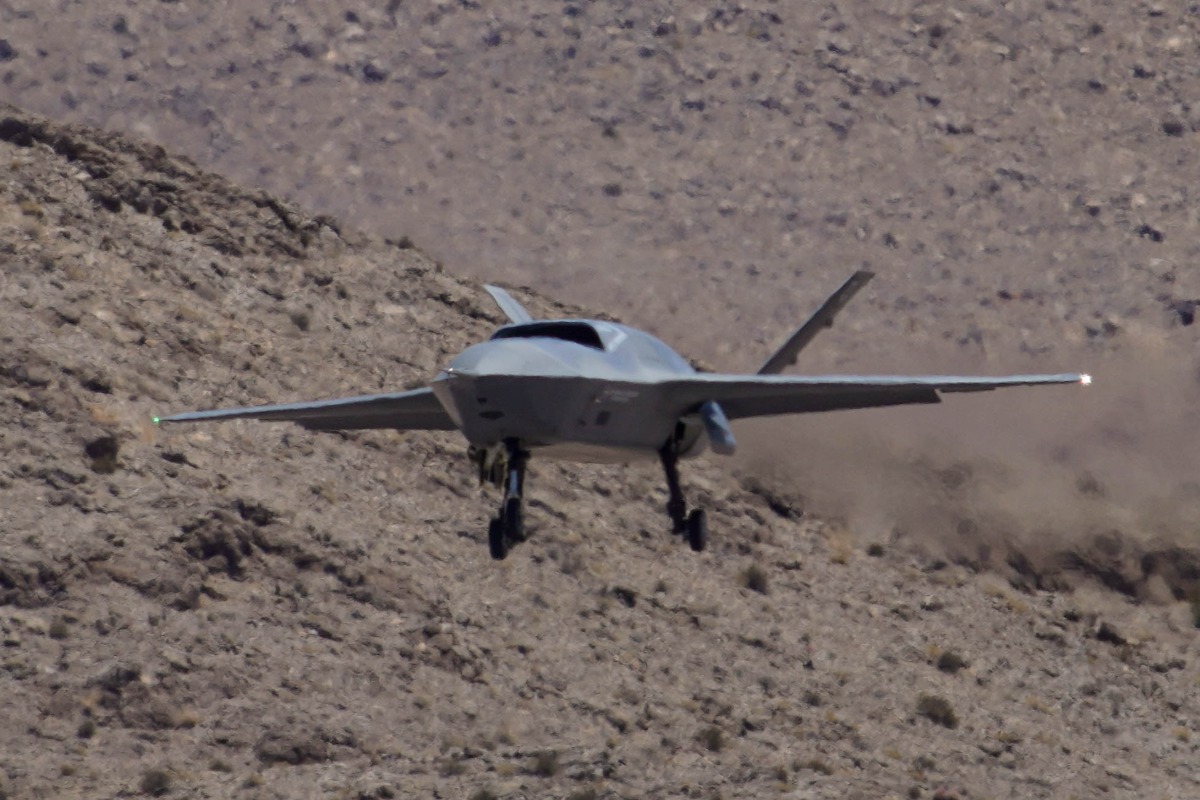
Friedel’s comment points to a deliberate shift in how the Air Force is trying to compress the traditional gap between a weapon system passing formal testing and that same system reaching operational units in the field, a gap that has historically stretched years for complex aircraft programs and that officials clearly hope CCA can avoid by folding evaluation directly into exercises run by the people who will eventually operate the aircraft in combat.
Operating CCA aircraft across multiple dispersed locations emerged as a learning objective in its own right during the exercise, forcing operators to adapt to the kind of rapid repositioning and improvisation that contested combat environments demand rather than the predictable rhythms of a fixed test range. Crews worked throughout the event to integrate more advanced autonomous capabilities into their operations, a step the release frames as central to the program’s broader vision of effective human-machine teaming, the still-evolving practice of blending human judgment with autonomous decision-making in ways that let a single pilot effectively command multiple aircraft at once.
“The exercise was not only a test of technology but a testament to the warfighters who are actively shaping CCA development,” Wilsbach said. “The lessons learned at Creech will directly influence how the Air Force integrates these cutting-edge concepts into future combat ops.”