

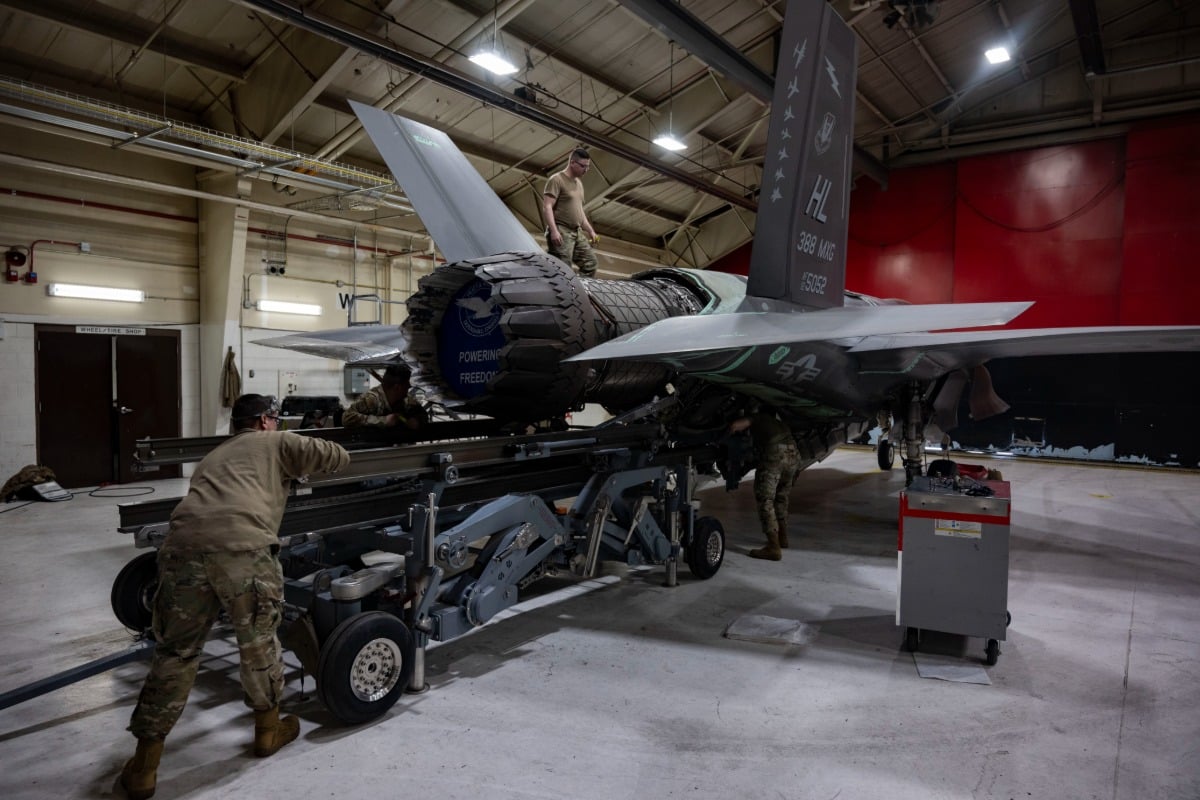
- RTX's Pratt & Whitney received a $53,755,700 Navy order for F135 engine engineering work, funded partly by U.S. and partly by allied partner money.
- Naval Air Systems Command at Patuxent River, Maryland, is managing the uncompeted contract, with work expected to finish in December 2028.
RTX Corp.’s Pratt & Whitney Military Engines division in East Hartford, Connecticut, has been awarded a $54 million order to perform engineering work on the F135, the engine that powers every version of the F-35 Lightning II stealth fighter, according to the contract announcement.
The order, issued under a fixed-price incentive structure that rewards the contractor for hitting cost and schedule targets while also covering additional costs on a fee basis, falls under a broader agreement the U.S. Navy previously established with Pratt & Whitney to manage this kind of engineering work as problems arise. Rather than funding new engine production, the money pays for what the Navy calls non-recurring engineering, plain-English shorthand for the specialized design and testing work engineers do once, to solve a specific technical problem, rather than the repeatable manufacturing labor that builds engines on an assembly line.
That distinction matters because the F135 has needed a lot of one-time fixes over its service life. The engine generates more than 40,000 pounds (18,144 kg) of thrust and represents the most powerful fighter powerplant ever put into production, according to Pratt & Whitney’s own technical materials, but its journey from design table to daily operations has been rougher than the Pentagon originally planned. The U.S. Government Accountability Office found in a 2023 audit that F135 sustainment problems would add roughly $38 billion in unplanned maintenance costs across the fleet’s lifetime, driven largely by a cooling system that engineers now acknowledge was undersized for the sensors and electronics the F-35 eventually carried. Separately, Pratt & Whitney has spent recent years developing field fixes for issues including premature wear on protective coatings inside the engine’s turbine blades and a vibration problem known as harmonic resonance that affected a small number of engines, according to reporting from Air & Space Forces Magazine.
This new order continues that pattern of chasing problems as they surface rather than waiting for a full redesign. The contract funds work described as the early identification, development and qualification of corrections to both potential and actual operational issues, meaning engineers are tasked with catching emerging problems before they ground aircraft and building tested solutions once they do. The order also pays for evaluating how long individual engine components can safely remain in service based on real-world flight data, a process the Navy says will extend engine life, sharpen operational readiness rates and ultimately reduce the maintenance and life cycle costs that have made the F135 one of the most expensive line items in the entire F-35 program.
The order explicitly supports the Air Force, Marine Corps and Navy, the three American services that fly the F-35 in its A, B and C model variants respectively, along with the F-35 Cooperative Program Partners, the group of allied nations that helped fund the fighter’s original development, and Foreign Military Sales customers, countries that purchased F-35s through the separate government-to-government sales process. More than 1,300 F135 engines now power aircraft across roughly 20 allied nations, according to Pratt & Whitney, which means an engineering fix developed under this contract could eventually reach squadrons from Europe to the Pacific rather than staying confined to American bases.
Work under the order will be spread across seven locations, with the vast majority, 74 percent, performed at Pratt & Whitney’s East Hartford, Connecticut headquarters. The remaining work is split among Middletown, Connecticut and West Palm Beach, Florida at 7 percent each, Indianapolis, Indiana at 6 percent, Windsor Locks, Connecticut at 3 percent, Aguadilla, Puerto Rico at 2 percent, and North Berwick, Maine rounding out the final 1 percent. That geographic footprint reflects how deeply embedded the F135 supply chain has become across the Northeast in particular, with Connecticut alone hosting 84 percent of the engineering effort funded by this single order.
The Navy is putting up $14,000,000 in Fiscal Year 2026 research, development, test and evaluation funds, while the F-35 Cooperative Program Partners are contributing $22,274,290 of their own, a split that underscores how allied nations now directly bankroll a meaningful share of the fighter’s ongoing engineering support rather than relying solely on American defense spending. The Pentagon did not put this contract out for competitive bidding, a common practice for follow-on engineering work tied to a system only its original manufacturer has the technical data and tooling to modify. Naval Air Systems Command, headquartered at Patuxent River, Maryland and responsible for managing naval aviation programs including the Navy and Marine Corps versions of the F-35, is overseeing the award.
The work is expected to wrap up in December 2028, a timeline that runs well past the current push to finalize the F135’s next production batches, Lots 18 and 19, which the F-35 Joint Program Office confirmed were delayed roughly six months into early 2026 as the Pentagon and Pratt & Whitney worked through the engine’s ongoing production and sustainment challenges, according to Air & Space Forces Magazine.