

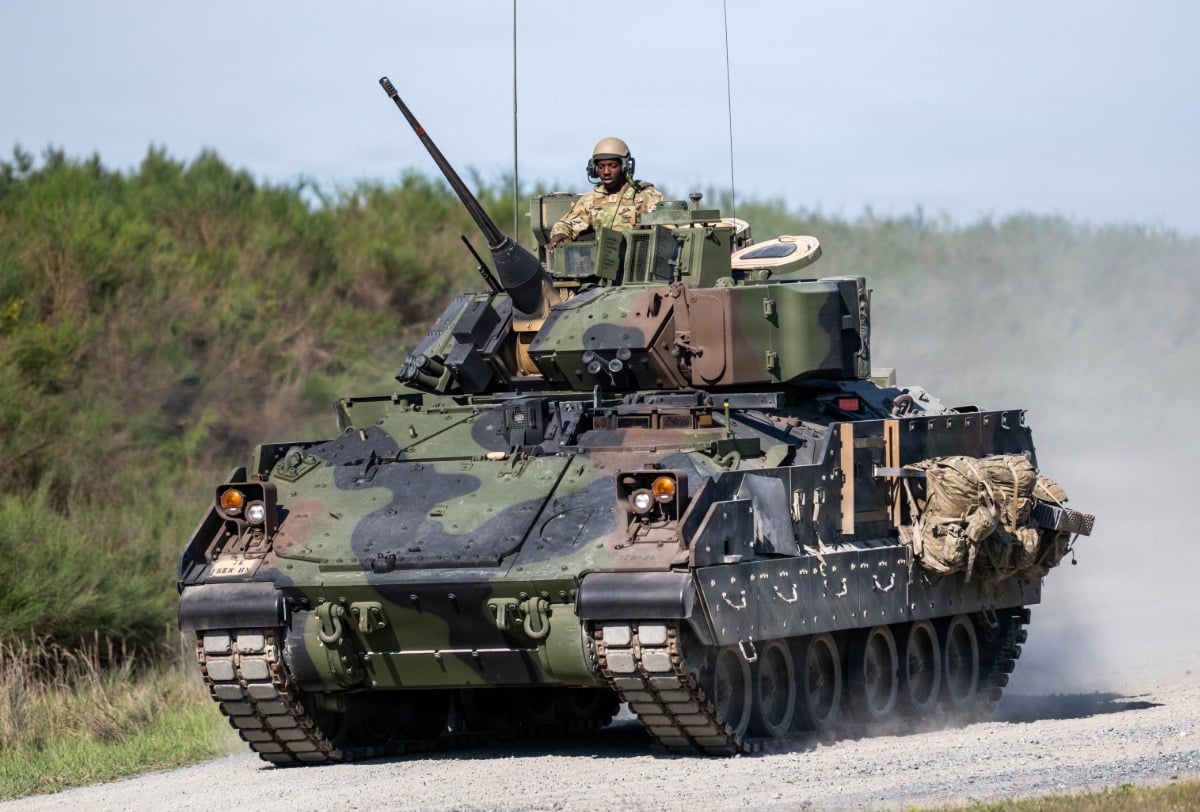
- DRS Network and Imaging Systems LLC of Melbourne, Florida, was awarded a sole-source contract worth $55,714,779 for Bradley Fighting Vehicle IBAS engineering services.
- Army Contracting Command-Redstone at Redstone Arsenal, Alabama, issued the contract on July 6, 2026, after determining DRS is the only qualified source.
DRS Network and Imaging Systems LLC, based in Melbourne, Florida, has been awarded a $55.7 million contract to provide engineering services for the Improved Bradley Acquisition Subsystem, known as IBAS, the sighting, targeting and missile control system that lets Bradley Fighting Vehicle crews spot, track and engage enemy targets, according to a federal contract award notice dated July 6, 2026.
The Bradley Fighting Vehicle is the Army’s armored troop carrier and fire support vehicle, a tracked combat platform that has served as a mainstay of American mechanized infantry units since the 1980s and has drawn renewed attention for its battlefield performance in Ukraine. IBAS sits at the center of what makes the Bradley lethal, since it is the subsystem that fuses sensors, optics and fire control software into the targeting picture a gunner actually sees before pulling the trigger.
The contract, formally numbered W31P4Q-26-C-0018, was not put out for competitive bidding. Federal contracting rules generally require agencies to open work to multiple bidders, but the award notice states plainly that this contract was issued on a sole-source basis because DRS is the only responsible source capable of performing the work, citing statutory authority under Title 10 of the U.S. Code as implemented by federal acquisition regulations governing situations where no other supplier can meet an agency’s requirements. A redacted Justification and Approval document prepared by the Army’s Tactical Aviation and Ground Munitions Project Office at Redstone Arsenal, Alabama.
IBAS was originally developed under a competitive, two-source arrangement between Raytheon and DRS or their corporate predecessors, meaning the Army once had genuine choice between suppliers for this system. Over the program’s lifespan, a series of corporate acquisitions and government-approved transfer agreements consolidated ownership of the complete IBAS technical data package, the proprietary schematics, source code, diagnostic software and specialized depot-level test equipment needed to maintain and upgrade the system, entirely in DRS’s hands. Raytheon, despite being an original developer of the technology, no longer possesses the current, complete data needed to service the fielded system and has not submitted a bid on any IBAS solicitation since a 2018 contract, according to the justification document.
Officials posted a public notice seeking alternative sources on SAM.gov, the government’s contract opportunity portal, first in December 2024 and again in August 2025, explicitly inviting any capable company to step forward. Four firms responded with capability statements: DRS, Raytheon, Cortina Solutions and Ricardo Defense. After technical evaluation, the Army determined only DRS qualified. Raytheon’s submission confirmed it lacked access to the current, complete technical data package needed to perform obsolescence management and failure analysis on the fielded system, while Cortina Solutions and Ricardo Defense, as non-incumbent vendors, could not demonstrate any legitimate rights to the underlying proprietary intellectual property at all, according to the justification document.
The document also walks through why the Army rejected the obvious alternatives to a sole-source deal. Attempting full and open competition would require a new vendor to reverse-engineer one of the most complex subsystems on the Bradley, a process the document describes as involving extreme duplication of cost that would exceed the value of the contract itself and introduce a schedule delay of several years.
Shifting the work in-house was equally unworkable, since government depots and engineering centers lack the proprietary data and specialized test equipment DRS controls. Taking no action at all was judged the most damaging option of the three, since it would immediately halt efforts to fix parts obsolescence and failure issues across the Bradley fleet, a gap the document warns would directly degrade the vehicle’s operational readiness and put the safety of soldiers who rely on the vehicle at risk.