

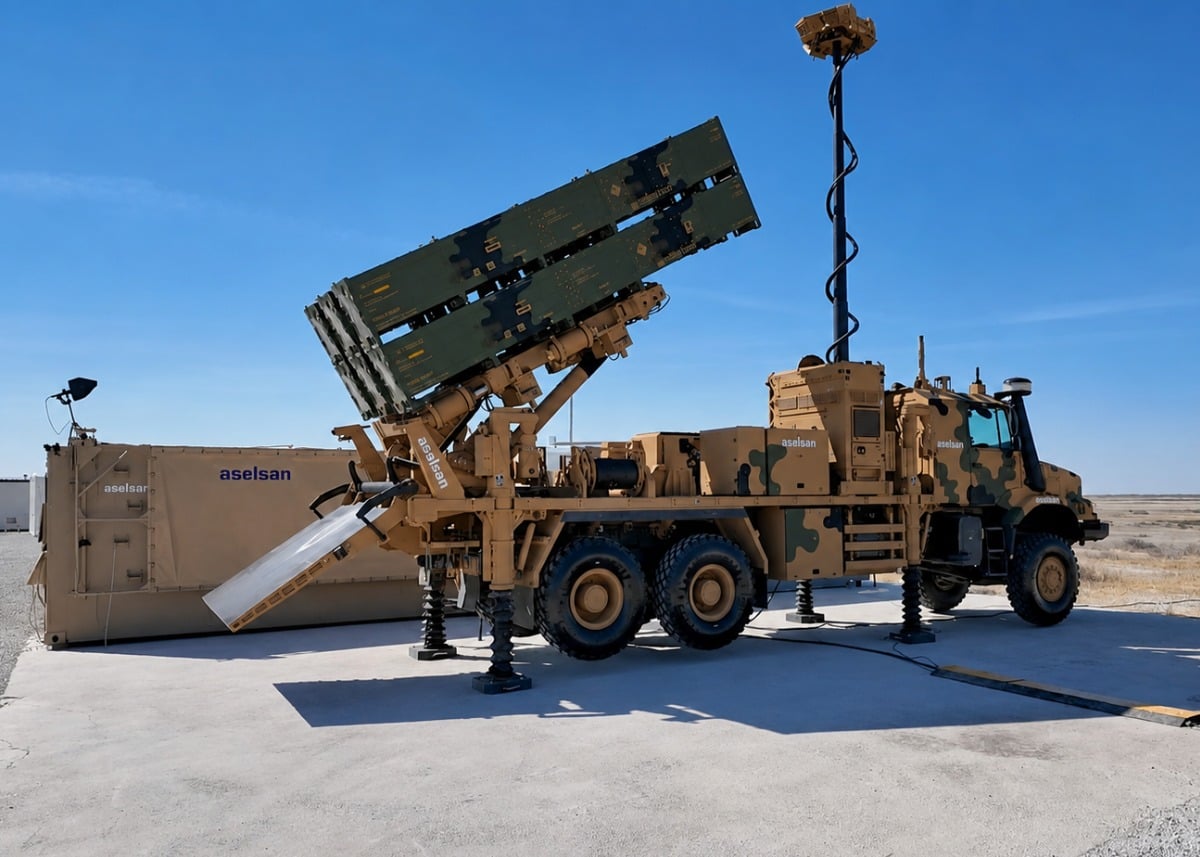
- President Erdoğan announced an additional $24 billion for Türkiye's Steel Dome air defense project at the NATO Summit in Ankara.
- Türkiye aims to reach 5 percent of GDP in defense and security spending by 2030, five years ahead of NATO's 2035 target.
Türkiye President Recep Tayyip Erdoğan announced an additional $24 billion in funding for Türkiye’s Steel Dome air and missile defense project during the opening session of the NATO Summit in Ankara, according to Turkish defense outlet Ulusavunma.
“We have taken measures to raise the ratio of our defense spending to 3.5 percent by 2030,” Erdoğan said, according to Ulusavunma’s report. “Without a doubt, our country’s real success lies in the breakthrough in our defense industry. In terms of production and export capacity, we have entered the world’s top 10 countries. We have allocated an additional 24 billion dollars for the air and missile defense capabilities most felt as lacking in our alliance, through our STEEL DOME project.”
Steel Dome, known in Turkish as Çelik Kubbe, is a next-generation, network-centric air defense architecture designed to protect Türkiye’s airspace using a multi-layered, integrated system rather than a single weapon platform. The concept works by linking multiple distinct air defense systems, each built to intercept threats at a different altitude band, into one shared command-and-control structure that Turkish officials describe as a “system of systems.” At the low end, the Korkut very short-range system handles close-in threats using radar-guided autocannons, while Hisar-A+ and Hisar-O+ cover short and medium-range interception, and the domestically developed Siper system extends coverage into the long-range and ballistic missile defense tier, together forming a layered umbrella spanning from very low altitude threats up through high-altitude ballistic targets.
Radar networks, electro-optical sensors, and command centers feed data into an artificial intelligence-supported decision system that shares information across every element of the network in real time, letting the system automatically identify what kind of threat it is facing, whether a drone, cruise missile, fighter jet, or ballistic missile, and select the most appropriate interceptor to respond without requiring a human operator to manually coordinate between separate, siloed systems. The radar backbone relies on active electronically scanned array, or AESA, technology for both search and fire-control functions, a radar design that can track multiple targets simultaneously and switch beams electronically rather than relying on a mechanically rotating antenna, giving the system faster reaction times against the kind of saturation attacks that have become increasingly common on modern battlefields.
Türkiye first unveiled Steel Dome publicly in August 2025, when Erdoğan attended a ceremony marking the delivery of 47 initial system elements into the national inventory, and Aselsan General Director Ahmet Akyol has since said the company expects to deliver more than 100 additional subsystems next year as production scales up further. Aselsan, Türkiye’s largest defense electronics manufacturer, leads the project in coordination with Türkiye’s Presidency of Defense Industries, working alongside missile maker Roketsan, state ordnance manufacturer MKE, and research institute TÜBİTAK SAGE. The company has already converted that ambition into concrete contracts, signing a $1.9 billion agreement with Türkiye’s Secretariat of Defence Industries in September 2025, followed by a separate €780 million ($900 million) deal announced in June 2026 specifically covering additional Steel Dome technology components, with deliveries under that agreement scheduled to run between 2028 and 2032, according to reporting from Breaking Defense.
Erdoğan’s Wednesday announcement places Steel Dome within a broader defense spending push tied directly to commitments Türkiye and other NATO members made at the alliance’s 2025 summit in The Hague, where allies agreed to raise combined defense and security spending to 5 percent of GDP by 2035. Erdoğan said Türkiye has already reached 1.5 percent of GDP in security-related spending and intends to hit the full 5 percent target by 2030, five years ahead of the alliance-wide deadline, a pace that would make Ankara one of the fastest movers among NATO’s 32 members toward that shared goal.
Erdoğan used part of his remarks to thank the United States, Spain, Germany, and Italy specifically for deploying additional air defense batteries to Türkiye in response to missile threats the country has faced, an acknowledgment that even as Ankara builds its own domestic air defense architecture, it has relied on allied Patriot batteries and other systems stationed on Turkish soil to fill gaps Steel Dome has not yet closed. That dependence on allied support for a country now positioning itself as a major NATO defense exporter, having entered what Erdoğan described as the world’s top 10 nations by defense production and export capacity, underscores exactly the gap Steel Dome is meant to eliminate over the coming years.
The Ankara summit gave Erdoğan a platform to push a broader argument about how NATO allies should cooperate on defense industry matters more generally, and he used Steel Dome as evidence that Türkiye’s own investment record backs up the argument. Erdoğan called for the removal of restrictions among allies on defense industrial cooperation, framing barriers to technology sharing and joint production as an obstacle to the kind of rapid capability growth Steel Dome represents, and he pressed European allies specifically to take on greater responsibility for continental defense rather than continuing to lean heavily on American commitments. He also urged European Union members not to duplicate NATO’s own defense efforts through separate EU-only initiatives, warning that excluding non-EU NATO allies like Türkiye from European defense programs would waste limited resources and create what he called an artificial division within the continent’s broader security architecture, a message aimed squarely at ongoing friction between Ankara and Brussels over Türkiye’s access to EU-funded defense cooperation mechanisms.
Erdoğan’s remarks also touched on Türkiye’s broader NATO capability commitments beyond Steel Dome specifically, with Turkish coverage of the speech noting that Ankara expects to meet nearly all of the 361 capability targets the alliance assigned it, doing so roughly three years ahead of the deadlines originally agreed. That figure gives Steel Dome’s $24 billion allocation additional context, positioning it as the largest single element within a much broader Turkish effort to demonstrate it can deliver on NATO capability commitments faster than the alliance’s own timelines require, at a moment when Washington has pushed European and Turkish allies harder than ever to prove they can shoulder more of the continent’s defense burden without direct American backing.