

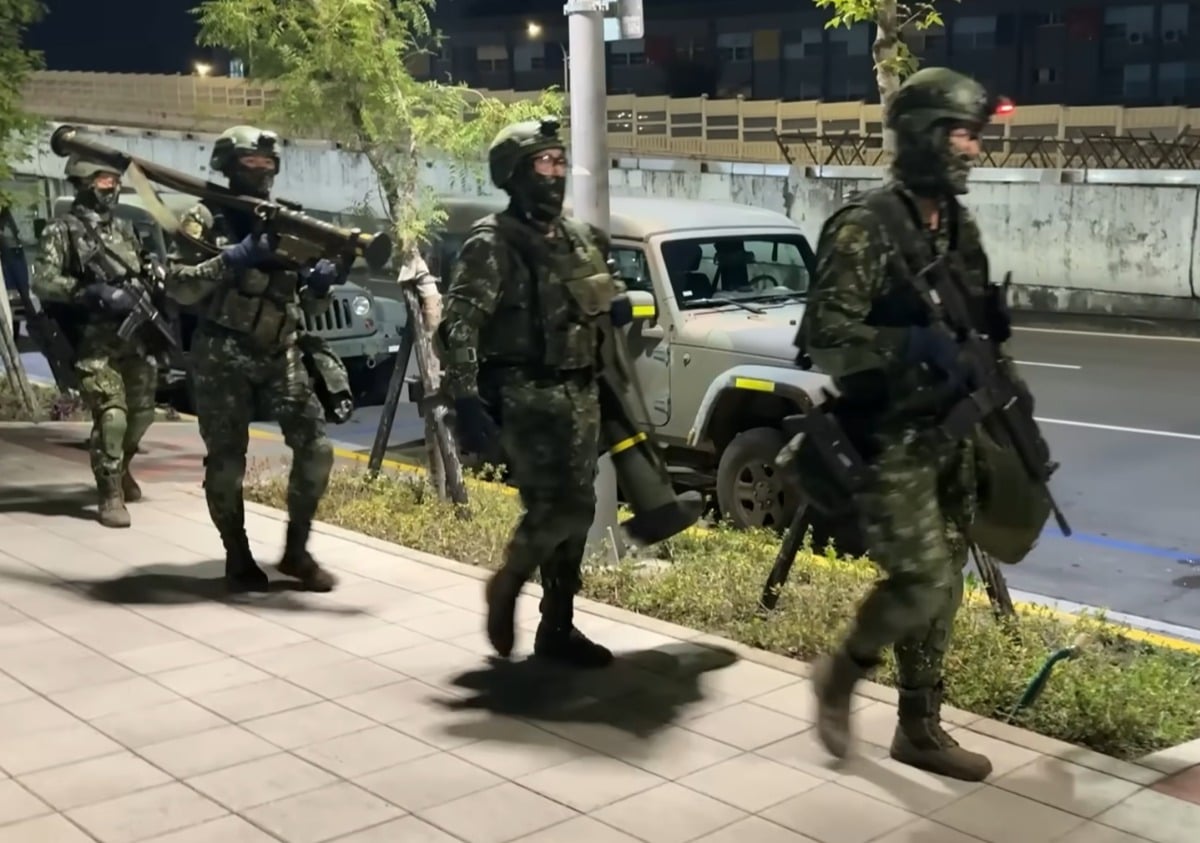
- A Taiwanese lawmaker claimed a military unit has only one of nine administrative vehicles usable under the Chinese-parts ban.
- Defense Minister Wellington Koo said he needed to investigate the claim during a July 1, 2026 Legislative Yuan hearing.
A Taiwanese military unit that once had nine administrative vehicles at its disposal now has just one it can actually drive, according to a claim a lawmaker raised directly to the island’s defense minister this week, Taiwan’s FTV News reported.
Kuomintang legislator Ma Wen-chun pressed Defense Minister Wellington Koo during a Legislative Yuan questioning session on July 1, 2026, saying grassroots units had told her that the Ministry of National Defense’s ban on Chinese-made equipment and components, in place since 2024, had left some units unable to use most of their non-combat vehicles because those vehicles contain Chinese parts purchased before the policy took effect. Koo told lawmakers he would need to look into the specific situation before responding in detail, a response that left the claim itself unverified even as the broader policy behind it is not in dispute.
The ban Ma referenced sits at the center of Taiwan’s broader effort to purge Chinese-made hardware from its military supply chains, a policy driven by the same security logic pushing Taipei to reduce dependence on Beijing across its economy and technology sector more broadly. Taiwan’s government has grown increasingly concerned that Chinese-manufactured components, from vehicle parts to consumer drones built by companies like DJI, could carry hidden vulnerabilities or simply cannot be trusted as reliable supply during a crisis with the very country those components came from. Wellington Koo, who became Taiwan’s first civilian defense minister since Andrew Yang when President Lai Ching-te appointed him in April 2024, has overseen that de-Sinicization push alongside a broader modernization effort that has included commissioning the island’s first M1A2T Abrams tank battalion and taking delivery of new F-16V fighter jets from the United States, moves The Defence Blog has covered as part of Taiwan’s accelerating response to Chinese military pressure across the strait.
The exchange in the legislature grew more pointed when Ma displayed a photograph of a Taiwanese light tactical wheeled vehicle fitted with Chinese-brand tires and asked Koo directly whether the tires were permitted for use. Koo responded that the specific batch of tires had been purchased in 2020, before the ban took effect, and that because tires stored unused can remain viable for up to ten years, the ministry still needed to decide whether to discard that batch entirely rather than use it out. That answer highlighted a genuine gray area in the policy, since equipment purchased legally before a ban took effect does not automatically become unusable, but neither does it fit cleanly into a policy meant to eliminate Chinese content from the military’s supply chain going forward.
Chao Ya-ping, director of the Ministry of National Defense’s procurement office, stepped in during the hearing to draw a sharper distinction between two categories of vehicles the ban treats differently. Combat vehicles, Chao said, face an absolute prohibition on Chinese components with no exceptions and no ongoing debate within the ministry, while administrative and utility vehicles fall under a somewhat softer standard requiring the military to avoid Chinese-brand parts only when alternative suppliers from other countries are available on the market. Chao added that the Army had already been directed to reopen public procurement solicitations for administrative vehicle parts specifically to identify non-Chinese suppliers capable of filling the gap left by the ban.
Cost quickly became the sharper edge of the exchange, since Ma pointed out that Chinese-brand components frequently sell for less than equivalent parts from European, American, Japanese, or South Korean manufacturers, raising the practical question of whether the ministry’s policy carries a real budgetary cost on top of the readiness concerns she had already raised. Chao held firm on that point, telling lawmakers the ministry would continue choosing suppliers from other countries even when Chinese alternatives cost less, treating the security rationale behind the ban as non-negotiable regardless of price. Ma said she understood the ministry’s position and asked that it establish clear guidelines within a set deadline so units in the field would have concrete standards to follow rather than ambiguity about which existing equipment remains usable.
The exchange captures a tension running through Taiwan’s broader push to de-risk its defense supply chains from Chinese sourcing, since the policy’s security logic is straightforward even as its practical rollout keeps surfacing awkward questions the ministry has not fully resolved. Taiwan’s military already contends with a defense industrial base that imports the large majority of its critical components and a backlog of promised American weapons systems running into the tens of billions of dollars, constraints that make the abrupt loss of previously reliable, low-cost Chinese parts a genuine operational headache even when the underlying security concern driving the ban is not seriously contested by anyone in the room.