

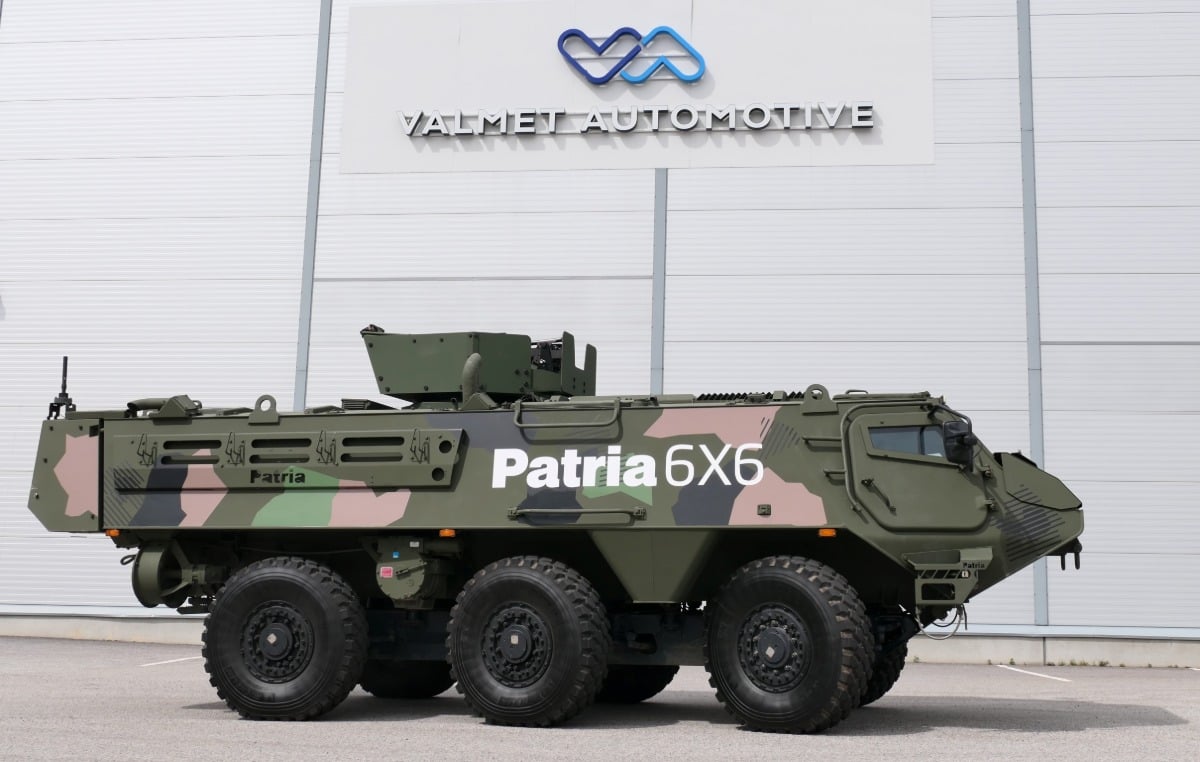
- Valmet Automotive and Patria signed a multi-year agreement to manufacture Patria 6x6 armored vehicles at Uusikaupunki, Finland, at annual rates of hundreds of vehicles.
- Full production capacity is targeted for early 2027, with the cooperation supporting approximately 240 jobs per 100 vehicles across the Finnish subcontractor network.
A factory that spent decades building cars for some of the world’s most prestigious automotive brands is being prepared to produce Patria 6×6 armored vehicles at annual rates of hundreds of vehicles, with full capacity expected in early 2027. Valmet Automotive, the Finnish contract manufacturer based in Uusikaupunki whose client history includes Porsche, Mercedes-Benz, and Saab, signed an expanded agreement with Finnish defense company Patria on Monday to manufacture Patria’s 6×6 armored personnel carriers at annual production rates of hundreds of vehicles per year, according to Patria.
The previous cooperation agreement was announced on December 4, 2025, covering the technology transfer of Patria’s armored vehicle manufacturing expertise and the production of the first vehicles. Monday’s agreement, signed roughly six months later, expands that arrangement into a multi-year production commitment at full industrial capacity.
The speed at which this happened matters as much as the volume it promises, because Rannus committed to “create important additional capacity for Patria quickly and to a high standard, reaching full capacity already in early 2027,” meaning that a technology transfer agreement announced in December 2025 will have produced a fully operational armored vehicle production line within roughly thirteen months, an exceptionally compressed timeline by any defense industry standard and one that reflects a deliberate choice by both companies to treat this not as a gradual industrial pivot but as an urgent response to a changed security environment.
Patria’s 6×6, the platform at the center of this expansion, is a modern wheeled armored personnel carrier designed to carry troops across difficult terrain while protecting them from small arms fire, shell fragments, and mine blasts. The vehicle sits in a category the Finnish and broader NATO militaries have prioritized heavily since Russia’s full-scale invasion of Ukraine demonstrated the decisive role of protected mobility in high-intensity ground combat. Wheeled armored vehicles in the 6×6 and 8×8 class have proven more survivable and more deployable than their Cold War predecessors in the Ukrainian experience, and NATO members have been competing to acquire and produce them faster than the existing defense industrial base can supply. Finland, which joined NATO in April 2023 after decades of non-alignment, has particularly strong incentive to build domestic production capacity for exactly this type of vehicle.
Jussi Järvinen, Executive Vice President for Protected Mobility at Patria, explained the strategic logic behind technology transfer as a production model. “Technology transfer has been an integral part of Patria’s business model for the past couple of decades, and it has significantly contributed to the success of Patria’s vehicle programs,” Järvinen said. He noted that Patria has been increasing production at its own facilities in Hämeenlinna, Finland, and Valmiera, Latvia, but needed additional capacity beyond what those plants could provide. “Valmet Automotive implemented the technology transfer particularly quickly, and vehicle production started in a short time,” Järvinen said. “The expansion of this excellent cooperation brings us tremendous scalability.”
That word, scalability, is the core of what Monday’s deal delivers. Patria can design and engineer protected mobility vehicles, and it has done so successfully for decades, with its AMV 8×8 armored vehicle family sold to Finland, Poland, Sweden, Slovenia, South Africa, and other customers. But designing vehicles and manufacturing them at the volumes modern military procurement requires are separate industrial challenges, and the second one has historically been the bottleneck. Defense manufacturers typically operate specialized facilities with modest production rates measured in dozens of vehicles per year. A contract manufacturer that routinely builds tens of thousands of precision vehicles annually for commercial automotive clients brings an entirely different production discipline to the challenge.
Valmet Automotive has been manufacturing vehicles under contract since 1968, when it began producing Saab cars under a licensing arrangement. Over the following five decades it assembled vehicles for Porsche, including the Boxster and Cayman models, for Mercedes-Benz, and for other premium manufacturers, accumulating expertise in managing complex supply chains, maintaining exacting quality standards, and ramping production up and down rapidly in response to customer demand. That last capability, fast ramp-up, is precisely what makes the company valuable to Patria right now, and it is the reason Rannus could credibly promise full armored vehicle production capacity by early 2027 from a technology transfer agreement announced in December 2025.
The employment implications of the expanded agreement are substantial, particularly for the Finnish industrial base. Patria noted that taking the entire subcontractor network into account, the cooperation between the two companies generates employment for approximately 240 people per 100 vehicles produced annually. At production rates of hundreds of vehicles per year, that figure translates into thousands of jobs distributed across Finnish suppliers, component manufacturers, and service providers, creating an economic argument for domestic armored vehicle production that extends well beyond the defense policy rationale.
The commercial value of the cooperation has not been disclosed by either company, which is standard practice for defense manufacturing agreements involving sensitive pricing and delivery schedules. What is confirmed is that the agreement is multi-year, covers the Patria 6×6 platform, targets annual production in the hundreds, and is expected to reach full capacity in early 2027. Patria’s continuing investments at its own Hämeenlinna and Valmiera facilities mean the Valmet Automotive arrangement supplements rather than replaces the company’s existing production infrastructure, giving Patria a three-site European manufacturing network for its armored vehicle programs.
The broader context for this deal is a European defense industrial base that has been under acute pressure since February 2022 to produce military equipment faster than peacetime capacity was ever designed to allow. Armored vehicle manufacturers across the continent have been hiring, investing, and seeking production partnerships to close the gap between what governments want to order and what factories can deliver. Finland’s answer, at least for the Patria 6×6, is to turn one of its most sophisticated manufacturing facilities from building luxury cars to building protected vehicles for soldiers, and to do it fast enough that the capacity is real and available before the geopolitical situation that created the demand has time to evolve further.