

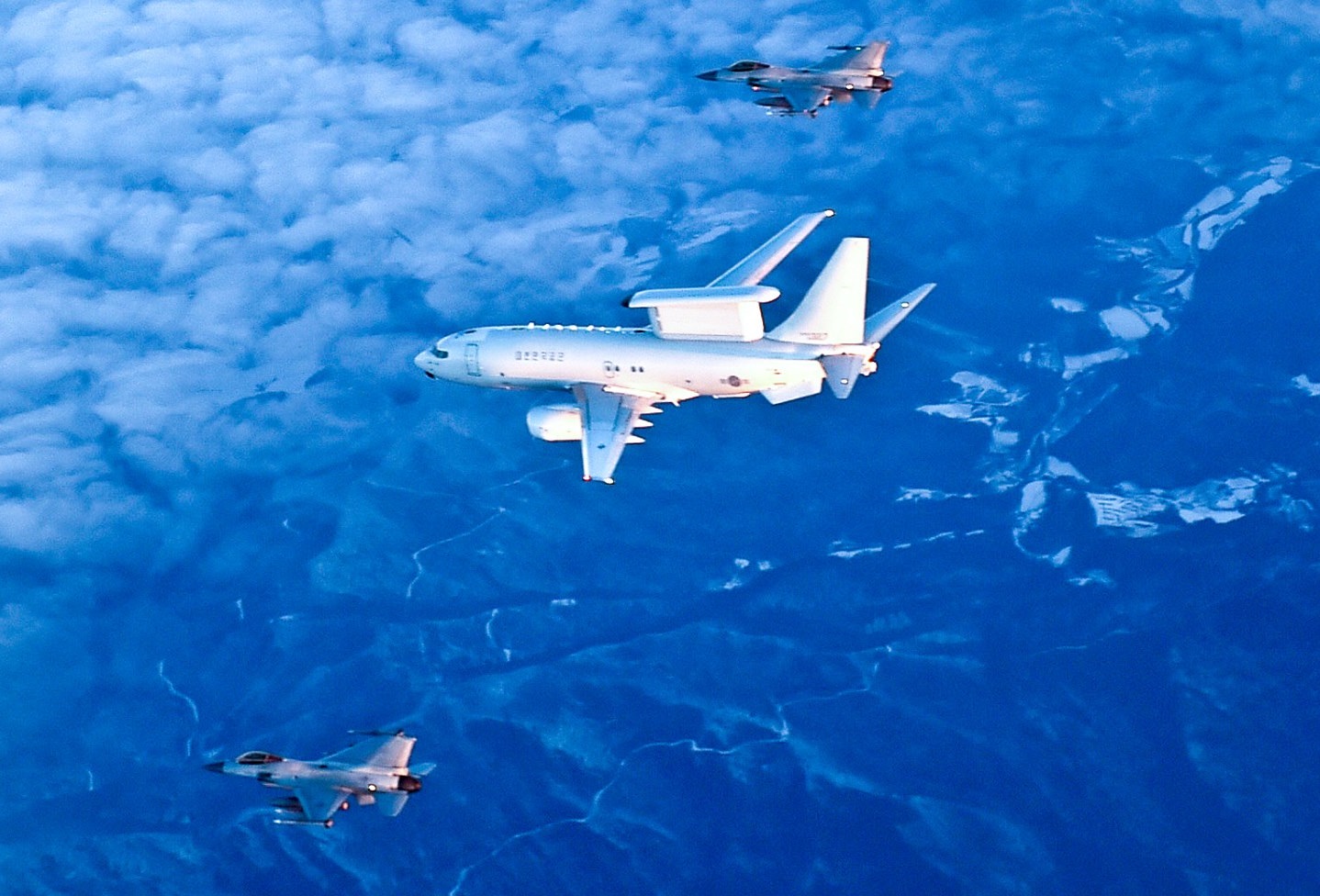
South Korea’s Defense Project Promotion Committee approved on 26 June plans to acquire more airborne early warning and control (AEW&C) aircraft from overseas as part of efforts to beef up its aerial surveillance capabilities, the arms procurement agency said.
In a statement presented by the Defense Acquisition Program Administration (DAPA), said that the country will launch the project next year to introduce more aircraft from overseas by 2027, rather than developing one at home, with a budget of 1.59 trillion won (US$1.32 billion).
According to the statement, the South Korean military has been pushing to buy two more early warning aircraft. Currently, the Air Force operates four Boeing E-737 AEW&C since 2011.
“The project aims to better counter growing security threats by neighboring countries and to minimize possible surveillance vacuums,” a DAPA official said.
The AEW&C equipped with the multi-role electronically scanned array (MESA) radar includes two side-looking arrays, as well as a top-hat array that uses “endfire” techniques to steer the radar beam forward and aft of the aircraft.
According to DAPA, a single aircraft able to monitor the entire Korean peninsula. It can track up to 1,000 airborne or surface targets simultaneously, while also directing combat operations. It carries a flight crew of two and a mission crew of six to 10.
The committee also approved a project to secure advanced Baekdu reconnaissance aircraft. The plan will be pushed for between 2021 and 2026 with 870 billion won, according to the DAPA.
Equipped with a remote control and signaling system, the Baekdu spy planes are supposed to carry out missions to gather signal intelligence from North Korea.
Currently, the military operates six units and seeks to replace four of them with advanced ones, according to the DAPA.
“After buying platforms from overseas, we will equip them with indigenous systems,” a DAPA official said. “The upgraded units are expected to improve our SIGINT capabilities.”