

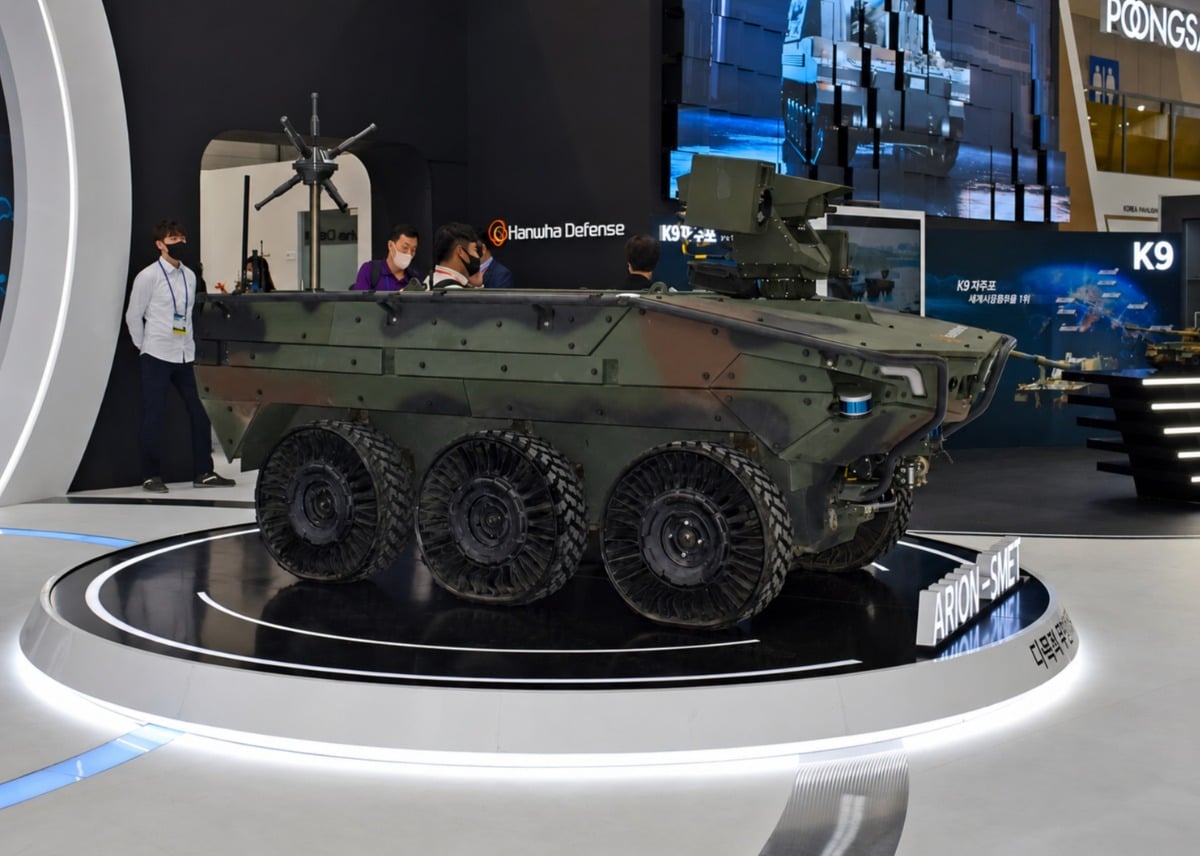
- South Chungcheong Province and Nonsan city won selection for South Korea's AI defense robotics innovation cluster, securing approximately $16 million in central government funding through 2030.
- The cluster will be built in Nonsan's Naedong and Yeonmu-eup districts, covering a 45,190 square meter (486,500 sq ft) testing and certification facility focused on unmanned ground vehicles.
South Chungcheong Province and the city of Nonsan have secured selection as the site of South Korea’s new AI defense robotics innovation cluster, winning a national competition that will channel approximately $32 million in total public investment into the region through 2030, Yonhap News Agency reported on June 12.
The Defense Acquisition Program Administration, South Korea’s primary weapons procurement authority, selected the Chungnam-Nonsan cluster from among competing regional bids, unlocking $16 million in central government funding alongside matching local contributions for a combined total of approximately $32 million over five years.
The cluster will be built in the Naedong and Yeonmu-eup districts of Nonsan, a city in South Chungcheong Province roughly 160 km (100 miles) south of Seoul that sits at the geographic center of South Korea’s existing military-industrial infrastructure. Nonsan is home to the Republic of Korea Army’s three-service headquarters complex, the Korea National Defense University, and the Korea National Defense Industrial Complex, giving the new cluster immediate proximity to the military customers, research institutions, and testing environments that a defense robotics program requires from its first day of operation. That concentration of military infrastructure was cited as a key factor in the region’s selection.
The cluster’s stated focus is unmanned ground vehicles, the category of military systems that covers everything from lightly armed reconnaissance robots to logistics haulers and fully autonomous combat platforms. UGVs have moved from experimental curiosity to operational priority across major militaries over the past decade, driven by the same demographic and strategic pressures bearing down on South Korea specifically. South Korea’s standing military has shrunk by roughly 20% over the past six years to approximately 450,000 personnel, according to the South China Morning Post, a consequence of one of the world’s lowest birth rates. Robots that can perform reconnaissance, logistics, and eventually combat functions reduce the manpower burden on a force that cannot grow its way out of the problem.
The cluster’s design covers the full development pipeline from research through production. Chungnam Techno Park, the province’s primary technology commercialization agency, will anchor the operation, working alongside Konyang University, the Korea Industrial Technology Testing Institute, the Korea Institute of Industrial Technology, the Korea Automobile Research Institute, and the KAIST Mobility AX Research Center, the mobility and autonomous systems laboratory of the Korea Advanced Institute of Science and Technology. That combination of industrial testing capacity, university research capability, and automotive engineering expertise reflects the hybrid civil-military nature of robotics development, where commercial autonomous vehicle technology and military UGV development share significant underlying engineering challenges.
The physical infrastructure component is equally concrete. South Chungcheong Province plans to build a 45,190 square meter (486,500 square foot) testing and certification facility in Yeonmu-eup, creating a dedicated space where AI defense robots can be evaluated, stress-tested, and certified for military service without having to travel to separate facilities scattered across the country. The goal, as described by provincial officials, is a single location that supports research, testing, evaluation, and demonstration under one roof, compressing a development timeline that currently requires moving hardware between multiple sites.
The cluster fits into a broader national push that South Korea has been accelerating throughout 2026. As The Defense Post reported in May, the Korea Institute for Defense Analyses and the National Information Society Agency signed an agreement to coordinate civilian and military AI development under a unified national strategy, part of Seoul’s stated ambition to position South Korea among the world’s top three AI powers. The Defense Acquisition Program Administration’s innovation cluster program, which launched a new competitive cycle in early 2026, is one of the primary mechanisms for converting that national ambition into regional industrial capacity, dispersing defense technology investment across the country rather than concentrating it in the capital.
South Chungcheong Province had been building toward this selection aggressively. As the Seoul Economic Daily reported in March, the province signed memoranda of understanding with Hanwha Aerospace, Hyundai Rotem, LIG Nex1, and Korea Aerospace Industries, four of South Korea’s largest defense manufacturers, as part of its bid to demonstrate industrial credibility to the selection committee. Those partnerships signal that the cluster is not intended to function as a government research facility operating in isolation, but as an ecosystem where large defense primes can co-develop and commercialize technology alongside universities and smaller companies seeking to enter the defense market.
Ahn Ho, the province’s director of industrial economy, framed the ambition plainly in comments carried by Yonhap. “We will enhance the competitiveness of regional defense companies based on advanced technologies such as AI and lead K-defense,” Ahn said.
K-defense, the informal term South Korean officials and industry use to describe the country’s defense export brand, has become one of the most commercially successful stories in global arms sales over the past four years. South Korea’s export contracts for artillery systems, armored vehicles, fighter aircraft, and air defense missiles have turned the country into a top-tier supplier to NATO members, Gulf states, and Southeast Asian nations simultaneously. The Nonsan cluster is Seoul’s bet that AI military robotics will be the next chapter of that story, and that winning the technology race now, before the international market fully crystallizes around a standard, is worth the investment of five years and $32 million to find out.