

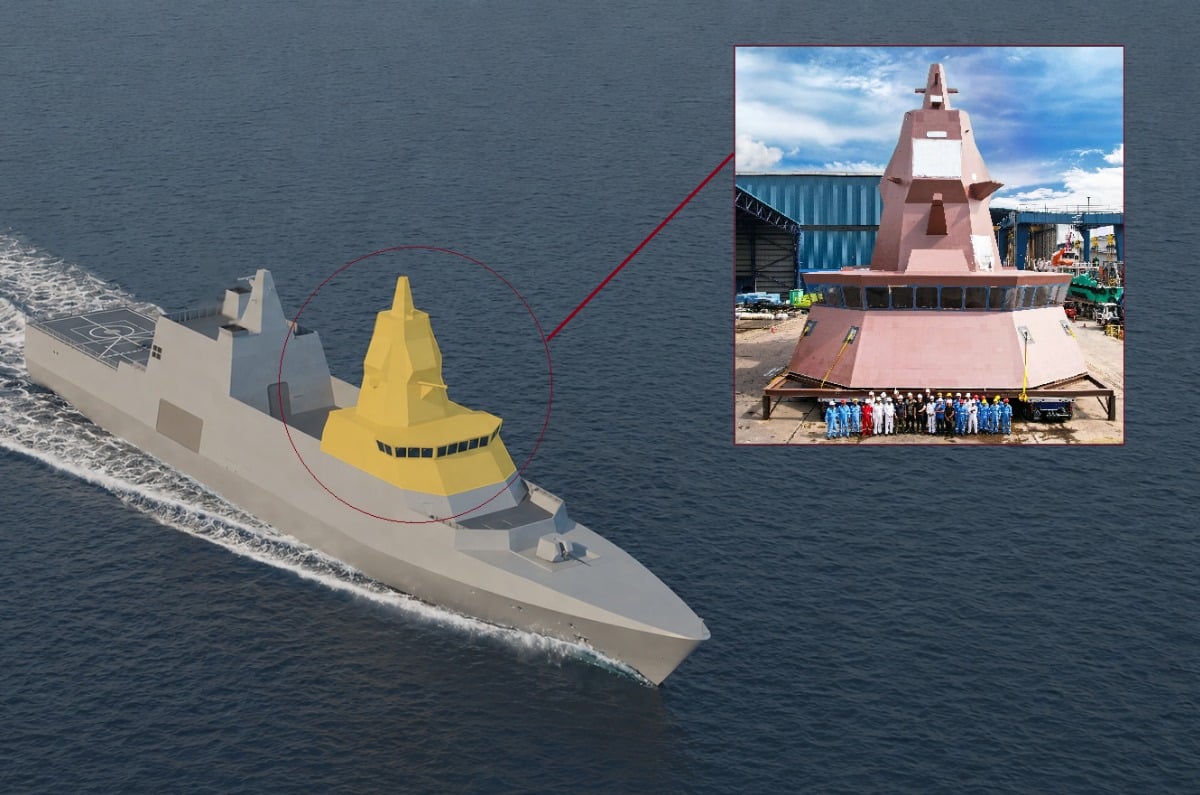
- Penguin Shipyard International delivered the first of six composite superstructures to Saab on June 27, 2026 for Singapore's MRCV.
- The Republic of Singapore Navy's Multi Role Combat Vessel program will deliver six ships starting in 2028.
A Singapore shipyard has built the largest composite structure ever assembled for a vessel in the country’s history, and it is destined for a warship designed to command fleets of robots at sea. Penguin Shipyard International completed and delivered the first of six carbon fiber composite superstructures on June 27, 2026, handing the massive assembly over to Swedish defense firm Saab for integration into the Republic of Singapore Navy’s new Multi Role Combat Vessel, known as the MRCV, a class of ship the Navy is building to replace its aging Victory-class missile corvettes that have served since 1989.
Saab describes the finished piece as the largest composite ship structure ever built in Singapore and one of the largest anywhere in Asia, a claim tied directly to the sheer scale of the MRCV itself, a 150-meter (492-foot) vessel with a displacement of roughly 8,000 to 8,400 tonnes (8,800 to 9,250 tons) depending on the source, making it the largest and most complex warship Singapore has ever constructed.
The composite piece covers the ship’s forward superstructure and integrated mast rather than the entire vessel, a distinction that matters because the rest of the MRCV’s hull remains conventional steel, built separately by Singapore’s ST Engineering at its Benoi Yard, where the first ship in the class, also named Victory, launched in October 2025. Saab manufactured the raw composite sheets at its facilities in Sweden and shipped them to Singapore, where Penguin’s engineers fitted and fabricated them into the finished superstructure before sending the completed assembly to ST Engineering Marine for final integration onto the steel hull, a manufacturing chain that spans two continents before the pieces ever come together into a single warship. The forward mast alone weighs roughly 60,000 kilograms (132,000 pounds) and had to be shipped from Sweden in disassembled flatpack sections because no single piece could be transported whole, underscoring just how large this composite assembly actually is compared to the aluminum hulls Penguin has built throughout its history.
Composite superstructures are not a new idea for Saab, which previously supplied similar carbon fiber structures for the Republic of Singapore Navy’s eight Littoral Mission Vessels, commissioned between 2017 and 2020, using a design the company calls the Saab Lightweight Integrated Mast. What makes the MRCV project different is scale and partnership, since this marks the first time Penguin, a Singapore shipbuilder founded in 1976 and known as the world’s largest builder of IMO-registered aluminum commercial ships, including armored security vessels, has taken on composite construction or any naval defense project at all. Composite materials like carbon fiber offer real advantages over steel for a warship’s upper structure, cutting weight by roughly half according to figures cited by Singapore’s Ministry of Defence, which lowers the ship’s center of gravity and improves stability while freeing up weight margin that engineers can use later to add new equipment as the MRCV’s mission requirements evolve over its service life.
Penguin’s Managing Director James Tham framed the delivery as a turning point for the company’s own capabilities rather than just a milestone for the MRCV program itself.
“This milestone marks the successful completion of Penguin’s first composite shipbuilding project and our first naval defence project. The capabilities developed through this project will be integrated across our broader shipbuilding operations, strengthening our ability to undertake more advanced programmes in the future,” Tham said.
Saab’s own executives emphasized a different set of advantages, ones that speak directly to how the composite material changes what the finished warship can do in combat rather than just how it performs in the water. Daniel Oscarsson, head of Saab’s Business Unit Surface Ships, pointed to benefits that extend well beyond weight savings alone.
“By integrating composite superstructures into naval ships, our customers benefit from advantages such as low weight, decreased radar cross-section and reduced life-cycle costs,” Oscarsson said.
A reduced radar cross-section means the ship is harder for an adversary’s radar to detect and track at long range, a stealth characteristic that composite materials can achieve more easily than steel because they can be shaped into smoother, radar-deflecting forms without the seams, rivets, and protrusions that complicate a traditional metal hull. That capability matters for a vessel designed to operate as what Singapore’s Ministry of Defence calls a mothership, a warship built to launch, control, and recover fleets of unmanned surface vessels, aerial drones, and underwater vehicles rather than fighting primarily on its own, since the MRCV’s mission bay can hold eight containerized modules that let the Navy reconfigure the ship’s capabilities for different missions within a short turnaround.
Fredrik Martinsson, Saab’s head of project management for its Business Unit Surface Ships, tied the Penguin delivery to a broader strategy of deepening the company’s footprint in Singapore rather than treating the milestone as a standalone achievement.
“We are seeing a growing number of customers entrust Saab with addressing their operational needs. To better serve these customers locally, we continue to strengthen our strategic partnership with Penguin Shipyard International. With its long-standing heritage and deep expertise in shipbuilding in Singapore, Penguin shares Saab’s strong commitment to understand and meet customer requirements. This makes Penguin a valued and trusted partner for Saab,” Martinsson said.
The MRCV program itself represents one of the more ambitious naval shipbuilding efforts underway in the Indo-Pacific region, with Singapore’s Defence Science and Technology Agency overseeing a design that combines a modern frigate’s combat capability with an operational range exceeding 7,000 nautical miles (13,000 kilometers) and endurance beyond 21 days at sea, roughly double the range of the Formidable-class frigates the MRCV will operate alongside. Construction is already underway on the second, third, and fourth vessels in the six-ship class, with steel cutting on the third and fourth hulls completed in April 2026, and deliveries to the Republic of Singapore Navy are expected to begin in 2028.