

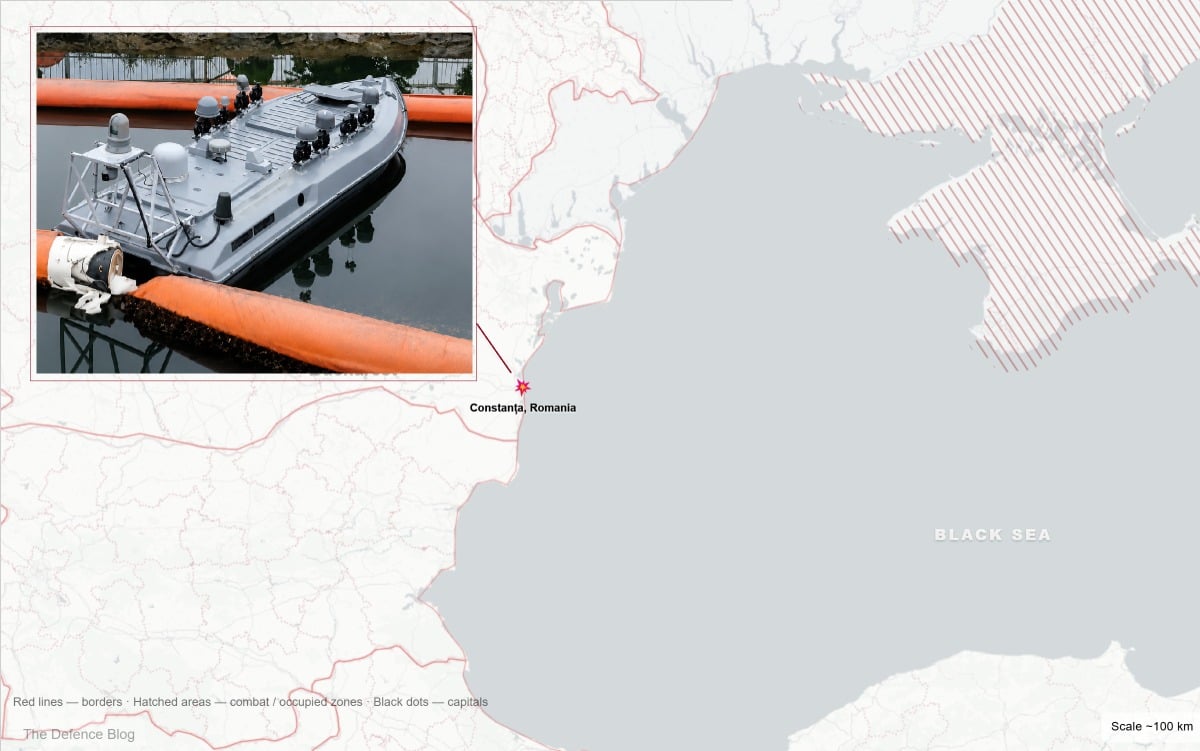
- A maritime drone of the type used in the war in Ukraine self-detonated on June 5 at 10:30 a.m. in berth 78 of Constanța civilian port, Romania, causing no casualties.
- Romanian authorities subsequently found three more maritime drones on the Romanian coast and launched a full coastline search involving helicopters from Constanța and Tulcea.
A maritime drone of the type used in the war in Ukraine self-detonated Friday morning inside the civilian port of Constanța, Romania’s largest Black Sea harbor, after authorities discovered the device at berth 78 and began working to neutralize it.
The explosion occurred at approximately 10:30 a.m., roughly four and a half hours after the drone was first spotted at 5:50 a.m. near the headquarters of the Romanian Agency for Saving Human Life at Sea. The area had already been secured and evacuated. No casualties were reported.
Romania’s Ministry of National Defense confirmed that the drone was discovered on June 5 at approximately 5:50 a.m. in berth 78 of the civilian port of Constanța, near the headquarters of the Romanian Agency for Saving Human Life at Sea, known by its Romanian acronym ARSVOM. Forces from Romania’s domestic intelligence service, the SRI, along with the Coast Guard and Ministry of National Defense personnel, secured and isolated the area while specialists worked to assess and render the device safe. Despite those efforts, the drone self-detonated at approximately 10:30 a.m., triggering the activation of the Red Intervention Plan, Romania’s highest-level emergency response protocol, and a mass evacuation alert sent to residents in Constanța and the neighboring county of Tulcea.
Initial information indicates that a tugboat and a hangar near the Oil Terminal warehouses were affected by the fire following the explosion. No casualties were reported. Romanian Deputy Interior Minister Raed Arafat, confirming the detonation to reporters, stated that SMURD medical helicopters and Black Hawk military helicopters from Tulcea had been mobilized to conduct reconnaissance along the entire coastline.
“There is a suspicion, naturally, that there could be others. That is why we are checking. If there was one, there could be others. The certain information does not exist, the suspicion exists and the suspicion is legitimate,” Arafat said.
Three more maritime drones were subsequently found on the Romanian coast following the explosion in Constanța port, according to Digi24, citing unnamed sources. Authorities expanded the search perimeter and continued reconnaissance operations along the Black Sea coast as of Friday afternoon, with the full scope of the intrusion still being established.
Constanța is not an ordinary port. Located on Romania’s Black Sea coast approximately 225 km (140 miles) east of Bucharest, it is the largest port on the Black Sea and one of the most important logistics and transit hubs in southeastern Europe. It serves as a critical node for NATO’s eastern flank logistics, handles a substantial volume of Ukrainian grain exports that have resumed under international arrangements, and sits within the broader strategic geography that Russia has been contesting since its full-scale invasion of Ukraine began in February 2022. The presence of a war drone in its civilian harbor, whether the result of a deliberate attack, a navigation failure, or a drone that lost its target lock and drifted into Romanian territorial waters, represents a qualitatively different kind of security event than the aerial drone incidents that have occasionally scattered debris over Romanian territory in previous years.
Ukraine has used unmanned surface vessels extensively and effectively against Russian naval targets, striking warships, patrol boats, and port infrastructure deep inside waters Russia considered secured. Russia has been developing its own maritime drone capability in response, and on May 25, a Russian maritime drone struck the Ukrainian Navy’s sail training ship Druzhba while it sat docked in the port of Odesa. Both sides are now sending unmanned boats into each other’s ports.