

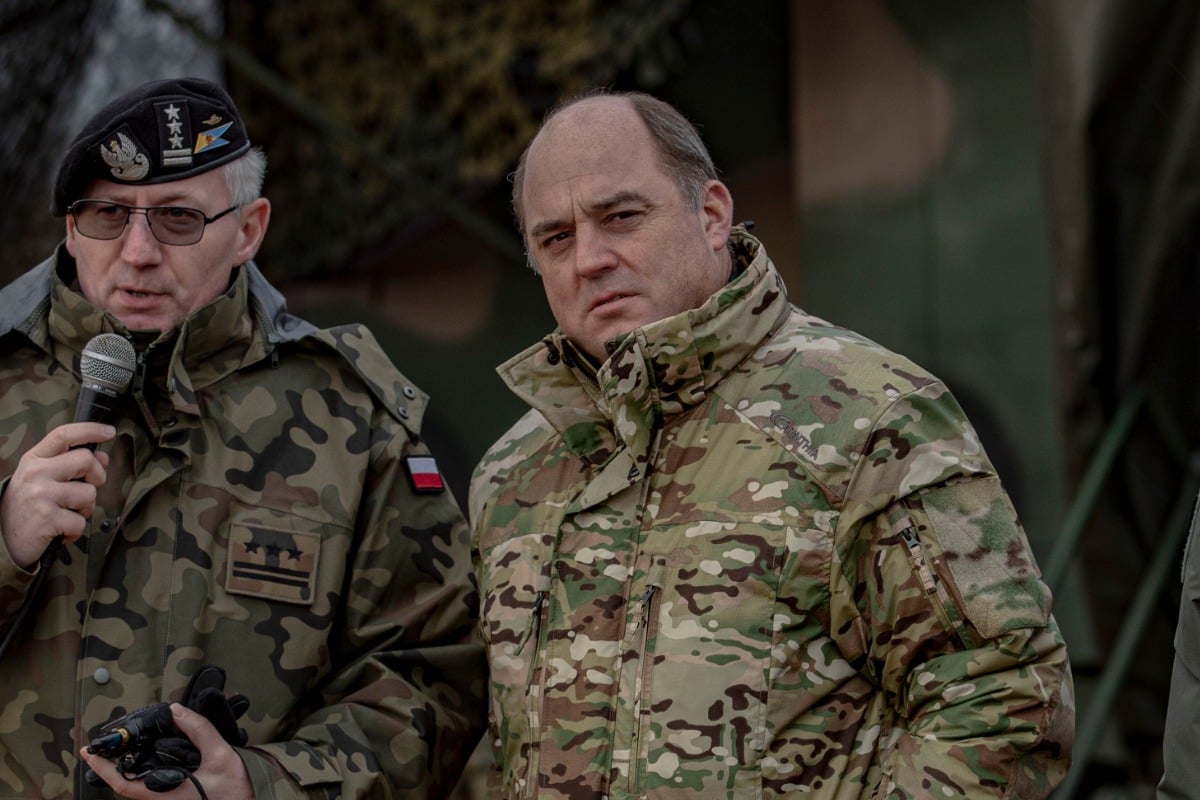
- Ben Wallace said he recommended Israel help Ukraine and that Netanyahu's government declined, citing concerns about upsetting Russia.
- Wallace served as UK Defence Secretary from 2019 to 2023 and made the disclosure in a post on X.
Britain’s longest-serving Conservative defense secretary since Winston Churchill says he personally urged Israel’s government to help Ukraine early in the war, and that Benjamin Netanyahu’s government turned him down because it didn’t want to anger Moscow, the UK Defence Journal reported.
Ben Wallace, who ran Britain’s Ministry of Defence from 2019 to 2023 and became one of the earliest and most vocal Western officials pushing for weapons deliveries to Kyiv, disclosed the exchange in a post on X, tying Israel’s refusal directly to Russia’s subsequent purchases of Iranian attack drones and the strikes those drones have since carried out against Israeli territory.
Wallace made the claim while responding to Eugene Kontorovich, a law professor at George Mason University and senior fellow at the America First Policy Institute, who had renewed a proposal urging Israel to recognize Argentine sovereignty over the Falkland Islands, the British territory in the South Atlantic that Argentina calls the Malvinas. Kontorovich first floated the idea in January as a way to reward Argentine President Javier Milei and pressure Britain over its recognition of a Palestinian state, and he revived it this month citing new UK sanctions against Israeli organizations and planned trade restrictions.
“Six months ago, I urged Israel recognize the Malvinas as Argentinian territory, occupied by the UK. Such action seems even more appropriate now, as London’s even more radical government sanctions Israeli NGOs and prepares to impose broad trade restrictions including on Jerusalem,” Kontorovich wrote.
Britain has never accepted any challenge to its sovereignty over the Falklands, a position both major British political parties have maintained consistently since Argentina’s failed 1982 invasion of the islands, and residents voted overwhelmingly in a 2013 referendum to remain a British territory. Wallace responded to Kontorovich not by defending that position directly but by pivoting to what he described as Israel’s own record of standing by allies, recounting a specific appeal he says he made to Netanyahu’s government on Ukraine’s behalf.
“I recommended to Benjamin Netanyahu’s government that he help Ukraine. Israel declined saying they didn’t want to upset Russia. So Russia kept spending nearly $1bn+ on Iranian drones. Now ordinary Israelis have to face the consequences of Netanyahu’s judgement,” Wallace wrote.
Wallace did not stop at criticizing a single policy decision, extending his criticism to what he characterized as Israel’s broader economic relationship with Russia since the invasion began.
“Since the invasion of Ukraine Israel has welcomed all the dirty Russia money and crooks. A sad decline for a once decent Country,” Wallace wrote.
Israel’s reluctance to arm Ukraine was well documented throughout the early years of the war, with Jerusalem providing humanitarian assistance and limited protective equipment, such as helmets and body armor, while consistently declining to supply weapons or air defense systems Ukrainian officials repeatedly requested, including the Iron Dome system credited with intercepting rockets and drones over Israeli territory. Israeli officials at the time linked that caution publicly to two specific concerns, preserving a deconfliction arrangement that lets Israeli warplanes strike Iranian-linked targets in Syria without clashing with the Russian military forces stationed there, and protecting the large Jewish community still living inside Russia, whose safety officials worried could be jeopardized by a more openly pro-Ukraine posture from Jerusalem.
Wallace’s account drew a public endorsement from John Foreman, who served as Britain’s Defence Attaché in both Moscow and Kyiv, giving him a firsthand vantage point on how Israeli diplomats in the Russian capital handled the same pressure.
“Made the same point to the Israeli ambassador in Moscow, where Iranian agents were plotting to kill his staff,” Foreman wrote.
That detail underscores just how tangled the relationship between Iran, Russia, and Israel had already become even before October 2023, since it describes Israeli diplomatic staff in Moscow facing an alleged Iranian threat to their own safety at roughly the same period Israel was declining to help Ukraine specifically to avoid provoking the same government, Russia, that has spent years deepening its own military partnership with Tehran. Iran has supplied Russia with thousands of Shahed-136 attack drones since 2022, weapons Moscow has rebranded domestically as the Geran-2 and used extensively against Ukrainian cities and infrastructure, and the technology-sharing relationship between the two countries has continued expanding even as Iran’s own drone stockpiles came under direct Israeli and American attack during the two rounds of open warfare between Israel and Iran that have unfolded since 2025.
This is not the first time Wallace has aired this grievance publicly. He wrote in The Daily Telegraph in April 2024, shortly after Iran launched a barrage of more than 350 drones and missiles at Israel, that he had personally pleaded with Israel’s ambassador in London for support to Ukraine and been told plainly that Israel did not want to upset Russia, arguing at the time that alliances work both ways and that British support for Israel’s own defense should come with an expectation of reciprocity. This week’s exchange adds new specifics to that longstanding complaint, identifying Netanyahu’s government by name as the direct recipient of his recommendation and drawing an explicit line from that early refusal to the drone attacks Israeli civilians have endured since.