

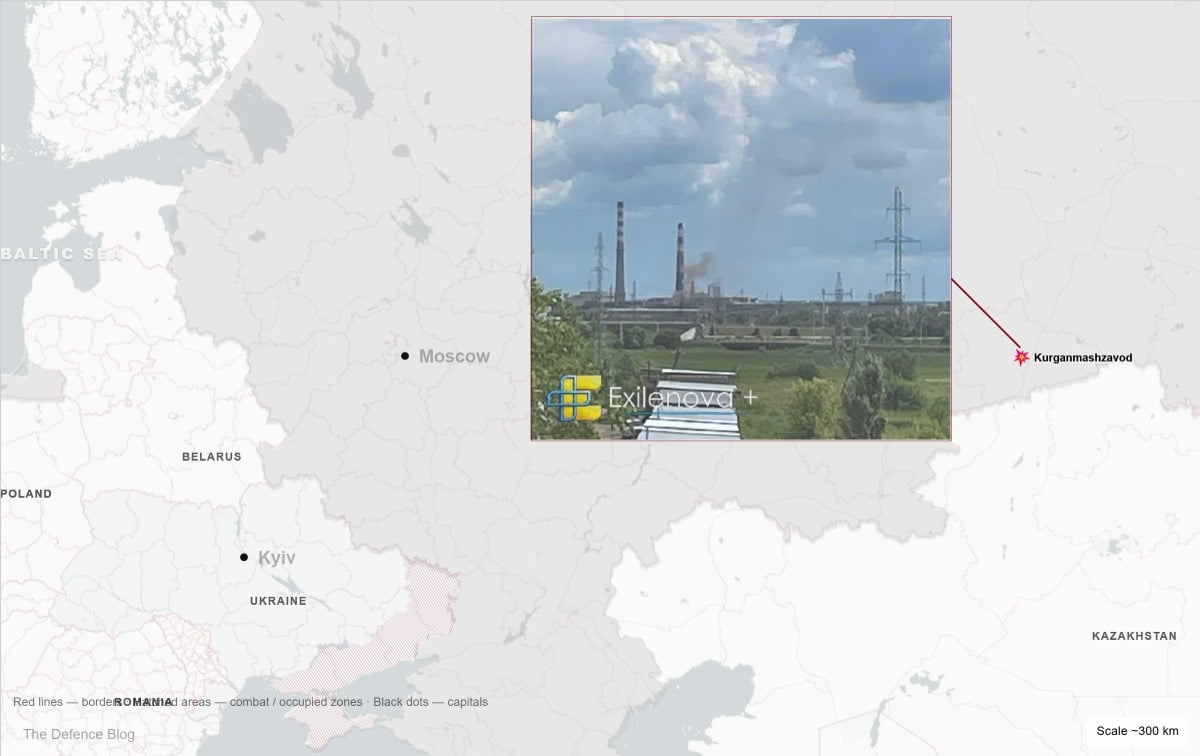
- Explosions and drone alerts were reported in Kurgan, Russia on July 1, 2026, with Russian outlet Astra geolocating smoke to the Kurganmashzavod BMP production factory.
- Kurganmashzavod manufactures BMP-2 and BMP-3 infantry fighting vehicles and is one of the largest defense enterprises in Russia's Ural region.
Strong explosions rocked the city of Kurgan in Russia’s Kurgan Oblast on July 1, 2026, accompanied by a drone alert across the region, Militarnyi reported.
Analysis of photos and video published by the Russian independent monitoring outlet Astra confirmed that smoke was rising specifically from the territory of Kurganmashzavod, the largest defense manufacturing enterprise in the region and the factory responsible for producing the BMP-2 and BMP-3 infantry fighting vehicles that form the backbone of Russia’s mechanized infantry formations, along with their modernized variants, for the entirety of the full-scale war in Ukraine.
Kurganmashzavod, which translates directly as the Kurgan Machine-Building Plant, sits approximately 1,800 km (1,118 miles) east of Ukraine’s border and roughly 400 km (249 miles) southeast of Yekaterinburg, positioning it well inside what Russia has treated as a relatively secure industrial rear far from the range of most Ukrainian long-range weapons at the beginning of the war. That assumption has eroded systematically throughout 2025 and 2026 as Ukraine’s domestically produced cruise missiles, including the FP-5 Flamingo built by Fire Point with a stated range of 3,000 km (1,864 miles), have demonstrated the ability to reach targets across the Urals and into western Siberia, a geographic shift in the war’s physical dimensions that Russian defense planners did not originally plan for.
The BMP-2 and BMP-3 that Kurganmashzavod manufactures are Russia’s primary infantry fighting vehicles, armored tracked platforms that carry dismounted infantry troops while providing fire support through an onboard cannon and, in the BMP-3’s case, a 100 mm gun capable of firing both conventional rounds and anti-tank guided missiles. The BMP-2 entered Soviet service in 1980 as an upgrade to the original BMP-1, armed with a 30 mm 2A42 autocannon that has proven effective against both light armor and low-flying aircraft including drones, and it has been among the most visible vehicle types on Russian force dispositions throughout the war in Ukraine, documented by the Oryx blog in losses exceeding 1,500 units. The BMP-3, introduced in 1987, carries a more complex weapons package but shares the same tracked chassis philosophy optimized for combined arms operations in European terrain. Both platforms remain in active production at Kurgan, with Russia requiring continuous output to replace vehicles destroyed at the front, where mechanized losses have been extraordinarily high.
Astra’s geolocation of smoke to the Kurganmashzavod grounds is significant because it provides specific targeting confirmation beyond simply establishing that explosions occurred in the city, which a drone alert and civilian reports would confirm on their own. Identifying the smoke source as the factory rather than civilian infrastructure or a fuel depot changes the strategic weight of the incident considerably: if the production facilities themselves sustained damage rather than just the surrounding area, Russia’s ability to replace BMP losses at the front faces at least a temporary disruption at the point of manufacture.
Ukraine has not officially claimed the Kurgan strike at the time of reporting, a pattern consistent with Ukraine’s general approach to deep-strike operations inside Russian territory, where official attribution frequently follows hours or days after the initial attack rather than accompanying it in real time. Militarnyi’s report and Astra’s geolocation analysis provide the primary factual foundation for the incident, and the drone alert issued across Kurgan Oblast constitutes independent Russian confirmation that unmanned aircraft reached the region, even if the specific target and damage extent remain unconfirmed by any official Ukrainian or Russian source.