

- Russia launched 5,929 air attack means against Ukraine in June 2026, with Ukrainian forces reporting 5,277 destroyed or suppressed, an 90 percent neutralization rate.
- Drones accounted for 5,173 of the 5,277 reported intercepts, with peak attacks on June 2 (729 launched) and June 15 (681 launched).
Russia launched 5,929 air attack weapons against Ukraine in June 2026, ranging from cheap one-way drones to ballistic missiles traveling at several times the speed of sound, and Ukraine’s air defenses intercepted or electronically suppressed 5,277 of them, a combined neutralization rate of 90 percent, according to daily figures released by the Ukrainian Air Force and reviewed by The Defence Blog.
The 652 weapons that broke through represent the gap between what Ukraine’s multi-layered defense network destroyed or disrupted and what reached Ukrainian airspace uncontested, a figure that carries enormous human consequence even as a headline percentage makes the defensive performance sound formidable.
The composition of the June campaign reveals how completely Russia’s air attack strategy has shifted toward mass drone employment as the primary means of overwhelming Ukrainian defenses. Of the 5,277 targets Ukraine reported destroying or suppressing, 5,173 were unmanned aerial vehicles, accounting for more than 98 percent of all intercepts recorded during the month. Cruise missiles accounted for just 59 of the reported intercepts, ballistic missiles for 39, and anti-ship missiles for 6. That breakdown is not accidental: cheap one-way attack drones, particularly the Iranian-designed Shahed-136 derivatives Russia now manufactures domestically and fields under the Geran designation, cost a fraction of what any interceptor missile costs, forcing Ukraine’s air defense network to expend expensive radar-guided or infrared-guided interceptors against targets that individually cost a few thousand dollars. At scale, that asymmetry compounds into a significant attritional pressure on Ukraine’s finite interceptor stockpiles.
Russia’s June campaign featured two particularly intense saturation events that stood out even within a month of sustained high-tempo attacks. On June 2, Russia launched 729 air attack means in a single day, Ukraine’s largest single-day count for the month, and reported destroying or suppressing 642, including 602 UAVs, 29 cruise missiles, and 11 ballistic missiles. On June 15, Russia launched 681 air attack means, with Ukraine reporting 632 neutralized, including 582 UAVs, 30 cruise missiles, 15 ballistic missiles, and 5 anti-ship missiles. Both days generated the highest single-day throughput of surviving weapons in June, with 87 weapons penetrating defense on June 2 and 49 on June 15.
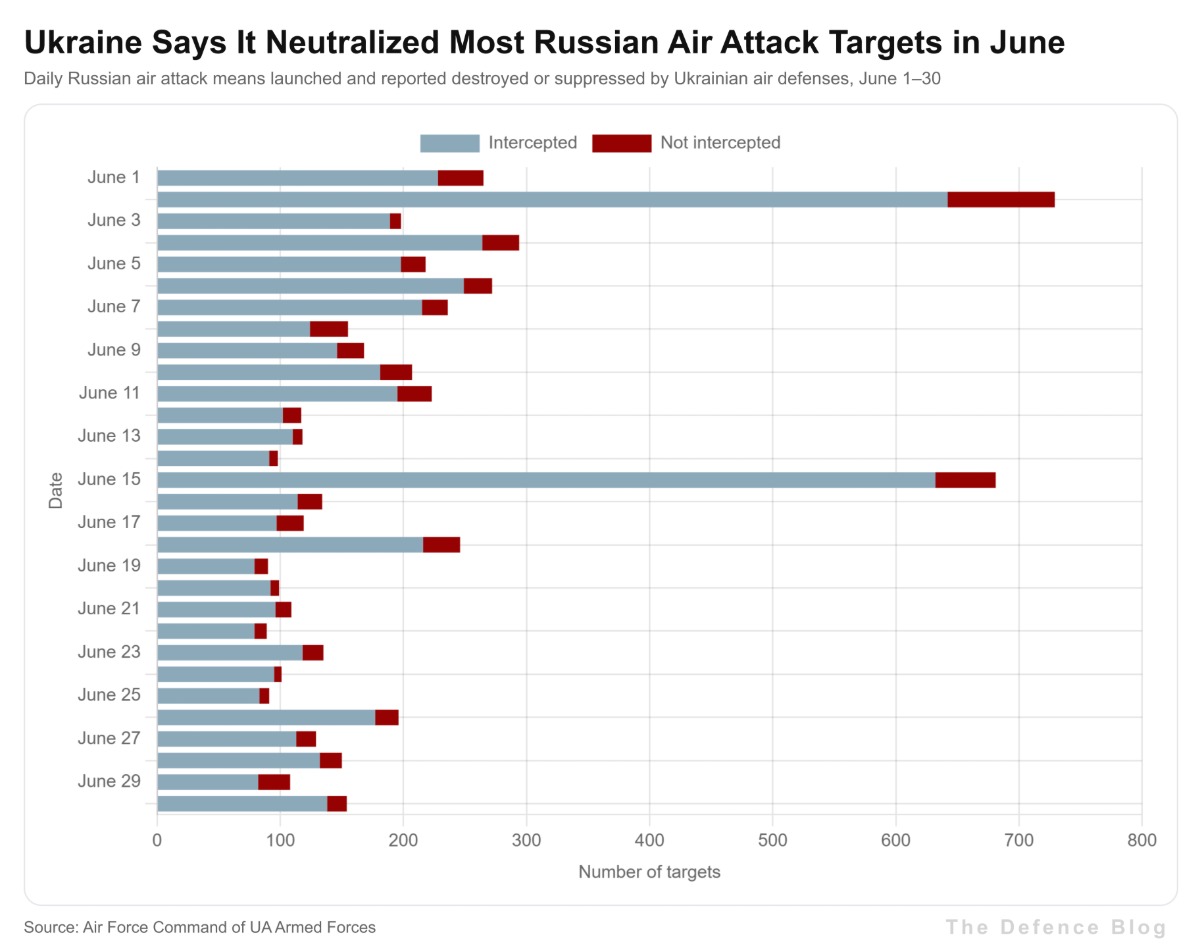
Six days across the month exceeded 200 launched air attack means, on June 2, 4, 5, 6, 11, and 15, with the first eleven days of the month marking the most concentrated burst of sustained high-volume attacks before a relative lull from mid-month gave way to another escalation around June 18. The lowest single-day volume of the month came on June 22, when Russia launched 89 air attack means and Ukraine reported 79 destroyed or suppressed, leaving 10 unaccounted. That day represents the closest the month came to what might be called a quiet day, and even then nearly 90 weapons were launched.
The 89 percent neutralization rate Ukraine reported for June is consistent with the rates the Ukrainian Air Force has published across recent months, though the methodological question of what “suppressed” means in Ukrainian reporting is worth understanding. Ukraine’s daily figures distinguish between weapons physically destroyed, typically by interceptor missiles, guns, or interceptor drones, and weapons electronically suppressed, a category that encompasses jamming-induced crashes, spoofed GPS navigation causing a weapon to steer off course, and electronic countermeasures that degrade a weapon’s guidance or detonation system without the intercepting force firing anything. The suppression figure inflates the headline interception rate compared to strictly kinetic intercepts, but it also represents a genuine defensive outcome: a jammed Shahed that crashes in a field rather than reaching its target is a neutralized weapon regardless of the method used.
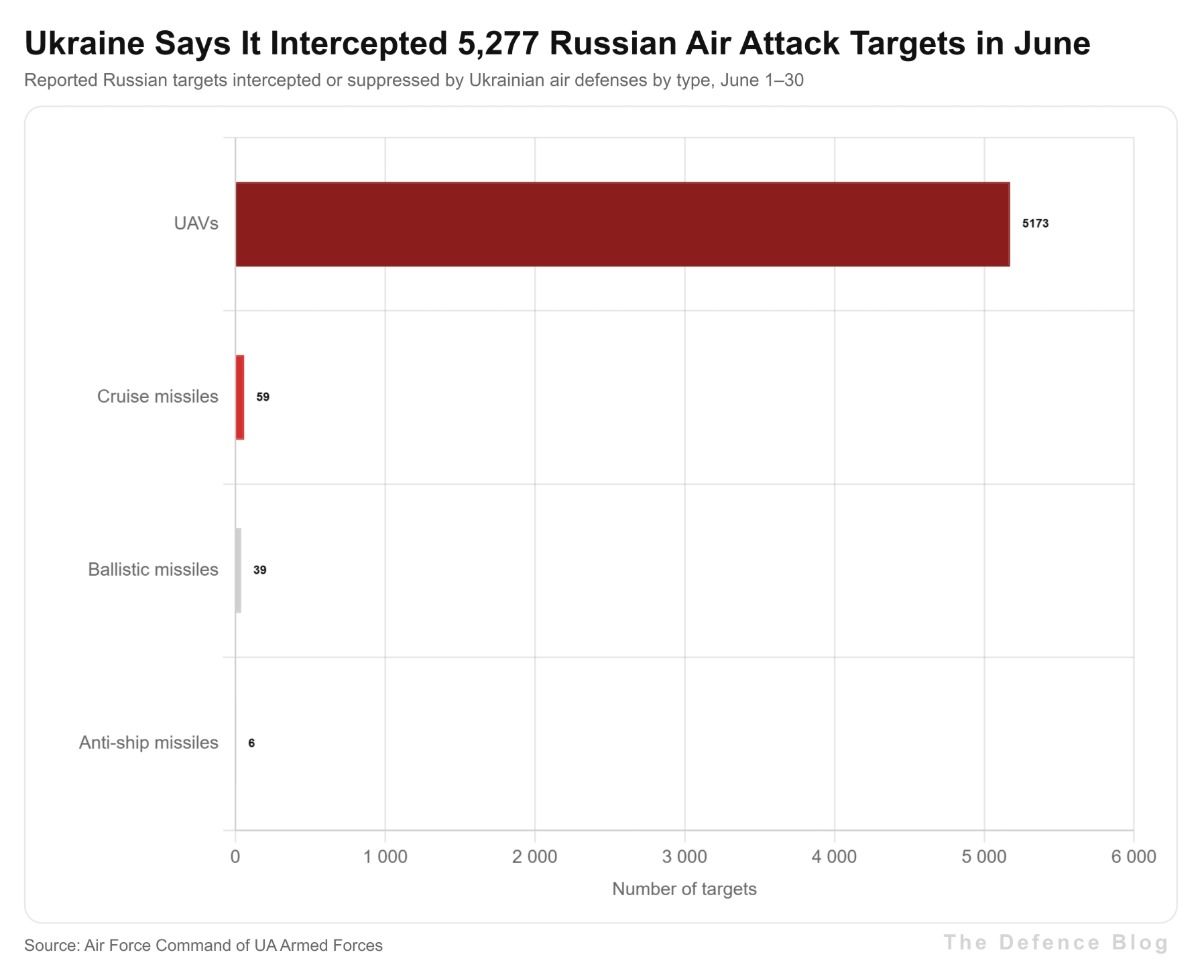
The 652 weapons Ukraine’s forces reported not destroying or suppressing during June include every category of weapon Russia employs, from drones to ballistic missiles, and they collectively represent the core of why Russian attacks impose costs on Ukraine despite the high interception rate. A single ballistic missile traveling at speeds of 2,000 to 3,000 m/s (6,562 to 9,843 ft/s) on a trajectory that gives Ukraine’s ground-based systems perhaps 90 to 120 seconds of engagement time is a fundamentally different defensive problem than a subsonic drone crossing the border at 180 km/h (112 mph) and cruising for hours within range of multiple interceptor systems. The 39 ballistic missiles Ukraine reported intercepting in June, against an unstated total launched, represent some of the most difficult defensive work in the entire monthly accounting, because ballistic missile intercepts require Patriot or SAMP/T systems whose interceptor stockpiles are limited and whose resupply from Western partners is a persistent challenge that Ukrainian officials raise publicly and frequently.
Russia’s attack tempo in June 2026, measured across the full 30 days of data, averaged roughly 198 air attack means per day, making it the most intense sustained campaign period tracked to that point in 2026. That average conceals a wide variance, from the 89-weapon minimum on June 22 to the 729-weapon maximum on June 2, but the underlying trend is consistent with what Western analysts have observed throughout the year: Russia continues to increase both the volume and the mix of weapons in each attack wave, adding ballistic missiles and cruise missiles to drone swarms specifically to complicate Ukraine’s triage decisions about which targets to prioritize for expensive interceptors and which to allow electronic warfare systems to handle.
Ukraine destroyed or jammed 89 percent of what Russia threw at it in June. The remaining 11 percent set buildings on fire, disrupted power grids, killed civilians, and damaged military infrastructure.