


Russian military analysts have publicly examined potential missile strike options against Japan, outlining a detailed multi-phase campaign aimed at neutralizing the country’s defense infrastructure.
According to analysis, published by the pro-Kremlin outlet Voennaya Khronika (“Military Chronicle”), Russia views the positioning of the locally made Type 12 and U.S.-supplied MRC Typhon missile systems—with a range of over 2,000 kilometers—as a direct threat to its eastern territory.
The analysts argue that any response to such deployments would require a complex, multi-tiered strike involving air-, sea-, and ground-launched precision weapons.
The proposed first phase would involve the destruction of Japan’s key air and missile defense nodes, particularly Patriot PAC-3 batteries located in Hakodate (Hokkaido), Iruma, and Gifu. The report claims these targets would require between 25 and 45 cruise missiles per site—using systems such as the Kh-101 or Iskander—or, alternatively, 10–12 Kinzhal hypersonic missiles to bypass interception entirely.
In parallel, the Russian analysts suggest targeting Japan’s early warning radars, including the J/FPS-3UG stations in Tobetsu and Kyogamisaki, and the J/FPS-4 site at Mt. Tokao.
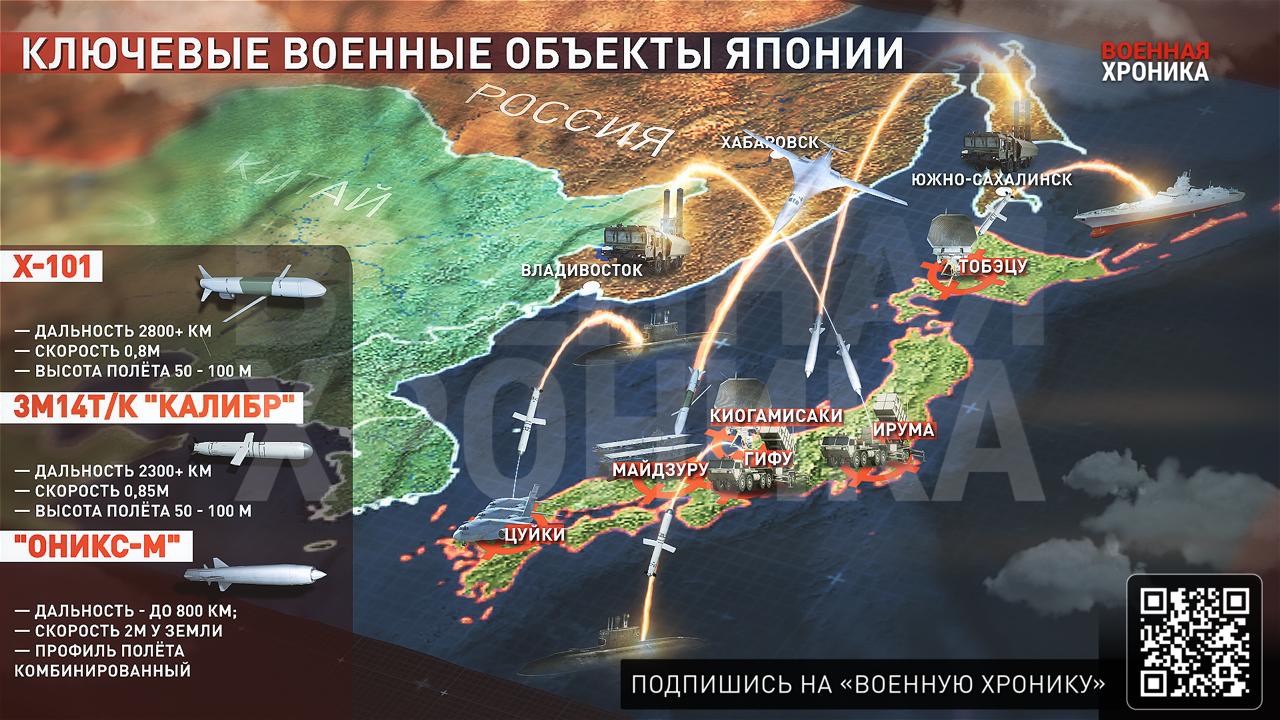
“The objective is to blind Japan’s early warning and air defense network,” the report said. Each radar site, according to the analysis, would require approximately seven Kh-101 missiles to be effectively neutralized.
The second strike phase would shift focus to power projection infrastructure, including Japan’s naval bases at Maizuru and Ominato, which the report says could be incapacitated using 20–25 Kalibr cruise missiles per site. Disabling these ports, the analysis argues, would critically reduce the Japanese Self-Defense Forces’ ability to operate in the region.
The third phase would target military-industrial facilities, specifically shipbuilding yards operated by Mitsubishi Heavy Industries in Nagasaki, Kobe, Shimonoseki, and Yokohama. According to the report, these sites are vital not only to Japan’s maritime capabilities but also to the maintenance of U.S. naval assets forward-deployed in the region. A successful strike, the analysis claims, would compromise the U.S.-Japan security architecture.
In total, Voennaya Khronika estimates the strike package would require 200 to 250 Kh-101 missiles, though the use of Kinzhal systems in certain scenarios could reduce the number of cruise missiles required—albeit with added operational complexity.
The authors point to Russia’s experience in Ukraine as having refined strike coordination and saturation techniques intended to overwhelm modern missile defense systems.
While the scenario is presented as a theoretical response to future U.S. and Japanese missile deployments, the tone and technical detail of the analysis have raised eyebrows among regional security analysts. The article does not specify any timeline for such operations but underscores a growing willingness within Russia’s military sphere to discuss offensive operations against NATO-aligned nations in East Asia.