

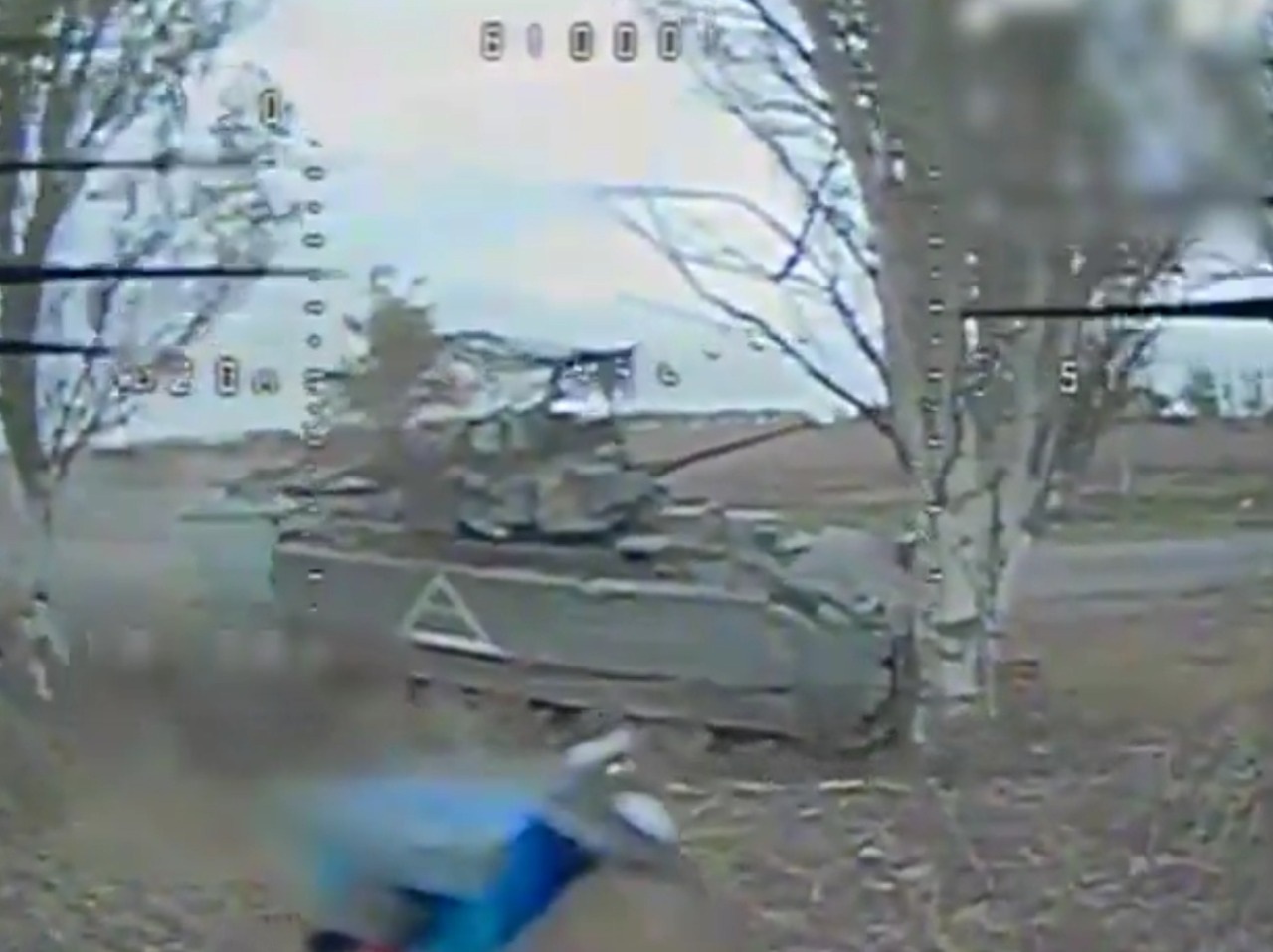
Russian forces released new footage showing an operation to destroy a disabled Ukrainian M2A2 Bradley ODS-SA infantry fighting vehicle — a task that required seven explosive-laden FPV drones, highlighting the vehicle’s durability and battlefield survivability.
According to the Voennyi Osvedomitel Telegram channel, the Bradley lost mobility following the initial attack but remained intact after its crew evacuated. The cause of the damage remains unclear, though Russian reports suggest the vehicle may have struck a mine. Despite its immobilization, Russian troops attempted to completely destroy the vehicle to prevent Ukrainian forces from recovering or repairing it.
The Russian account itself acknowledged the challenge, calling the incident “another example of the high survivability of this IFV.”
Even Russia’s Ministry of Defense has recognized the American vehicle’s battlefield performance. In a report published by the 38th Research Institute of Armored Equipment of the Russian Ministry of Defense, analysts concluded that the M2A2 Bradley ODS-SA surpasses Russia’s own BMP-3 infantry fighting vehicle in key combat characteristics.
According to the report, the Bradley outperforms the BMP-3 “in resistance to shell fire, bulletproof and mine protection, firepower, operational and technical characteristics, and ergonomics.” The analysis underscores a rare public admission of Western equipment advantages by Russian military experts.
The incident and subsequent analysis reflect a broader trend observed on the battlefield since the start of large-scale Russian operations in Ukraine: Western-designed armored vehicles often demonstrate greater crew survivability and combat effectiveness under fire. The Bradley’s ability to remain structurally intact despite explosive attacks — even after losing mobility — has been repeatedly documented in combat footage and after-action assessments.
The M2A2 Bradley ODS-SA, manufactured by BAE Systems and supplied to Ukraine under U.S. security assistance packages, is equipped with enhanced armor, advanced optics, and a Bushmaster cannon. Its reinforced hull design and mine-resistant floor give it greater protection against explosive threats than many Soviet-era infantry vehicles.
In this latest case, the vehicle’s resilience forced Russian units to expend considerable effort and resources to ensure its destruction. The fact that seven FPV drones were required to finish off a vehicle already rendered immobile highlights the Bradley’s ability to withstand repeated attacks and continue protecting its crew long after initial damage.