

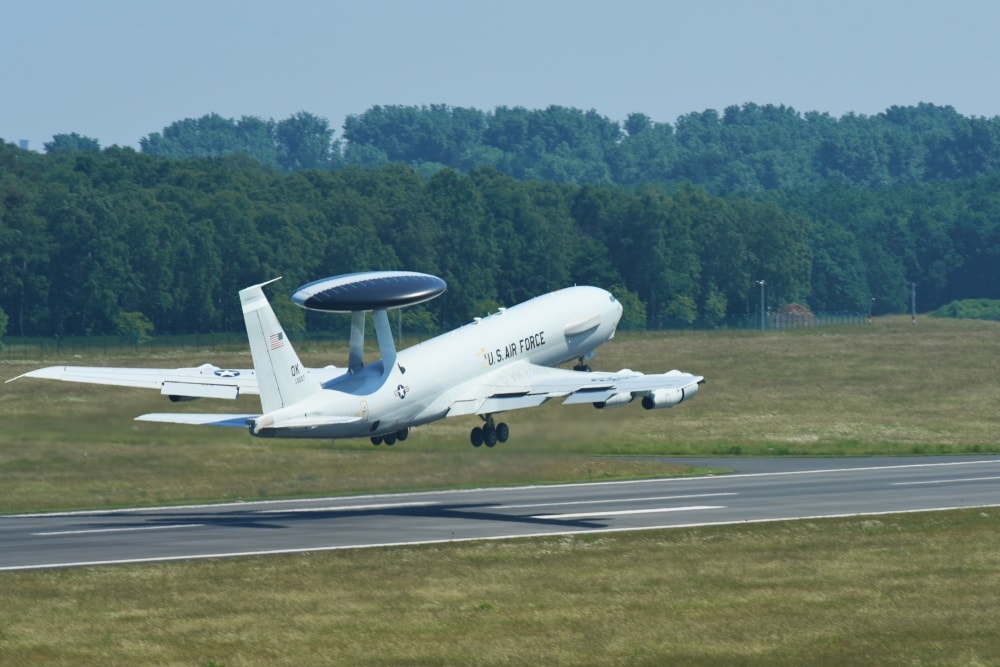
Raytheon contracted for AWACS risk reduction study

On 21 September, the U.S. Department of Defence (DoD) has announced that Raytheon Co. is awarded a contract for Phase II risk reduction for the Airborne Warning and Control System (AWACS).

According to the DoD’s statement, the Raytheon Co. has been awarded a $14 million contract for a risk reduction study on the AWACS aircraft.

The contract provides for risk reduction activities related to early system-level integration; AWACS-specific modifications to the existing sensor electronics unit; AWACS-specific antenna solutions; and integration prototyping.

- ADVERTISEMENT - CONTINUE READING BELOW -

Also noted that work will be performed in Fort Wayne, Indiana, and is expected to be completed by March 20, 2020.

An Airborne Warning and Control System (AWACS) is an airborne radar picket system designed to detect aircraft, ships and vehicles at long ranges and perform command and control of the battlespace in an air engagement by directing fighter and attack aircraft strikes.

AEW&C aircraft are used for both defensive and offensive air operations, and are to the NATO and US forces trained or integrated Air Forces what the Command Information Center is to a US Navy warship, plus a highly mobile and powerful radar platform.

The system is used offensively to direct fighters to their target locations, and defensively, directing counterattacks on enemy forces, both air and ground.

Readers who wish to follow our weekly coverage can subscribe to the Weekly Defense Roundup.

If you wish to report a grammatical or factual error in this article, please let us know by using the online form.

Executive Editor
  • In this story
  • USA

Support The Defence Blog

Independent reporting takes resources. Join us on Patreon.

Become a patron

More Like This

Gallatin AI wins US Army contract for contested logistics software

Feeding, fueling, and arming a corps-sized force of tens of thousands of soldiers across months of sustained combat, with supply lines potentially stretching a...

US Space Force orders first PTS-G maneuverable anti-jam satellites

The U.S. Space Force has selected Viasat and Intelsat to produce the first two operational PTS-G Swarm 1 satellites, with Viasat delivering one dual-band...

Drone locks onto target 43km away without GPS signal

A Canadian defense software company has demonstrated that its autonomous targeting system can acquire and track a target at a range of 43 km...

Pyka’s DropShip nails precision airdrop with no pilot aboard

A California aerospace firm demonstrated something the U.S. military has been trying to solve for years: getting critical supplies to exactly the right place,...

Northrop gets $31M to sustain Poland’s advanced missile defense system

The United States has awarded Northrop Grumman an additional $31 million to keep Poland's advanced air and missile defense command system operational, deepening the...