


The U.S. Department of Defense has deployed advanced optic and surveillance systems along the rugged U.S.–Mexico border to improve detection and monitoring in support of U.S. Customs and Border Protection.
The Ground-Based Operational Surveillance System–Expeditionary (GBOSS-E), the Long Range Advanced Scout Surveillance System (LRAS3), and the Common Remotely Operated Weapon Station (CROWS) are now being employed by service members assigned to Joint Task Force Southern Border.
According to the Department of Defense, these platforms—whether mounted on towers, concealed in terrain, or integrated onto armored vehicles—are designed to provide persistent coverage across wide stretches of desert and mountainous terrain. Together, they form a layered surveillance network to detect illegal crossings and reinforce perimeter security in coordination with CBP agents.
The Ground-Based Operational Surveillance System–Expeditionary is one of the most capable fixed-position monitoring assets in the military’s inventory. Mounted on telescoping masts or permanent towers, GBOSS-E combines electro-optical and infrared cameras, radar, and laser rangefinding to provide continuous coverage over large areas.

“Integrating the GBOSS-E system into our mission set has enhanced our Soldiers’ ability to detect threats from a distance. These systems allow our Soldiers to pick up on movement and heat signatures through radar and camera capabilities that enhance monitoring efforts, especially at night and from a distance,” said Sgt. 1st Class Sean Marshall of the 759th Military Police Battalion. “In an austere environment like Yuma, where the desert extends for miles, the GBOSS-(E) is a force multiplier that enables us to use the terrain to our advantage.”
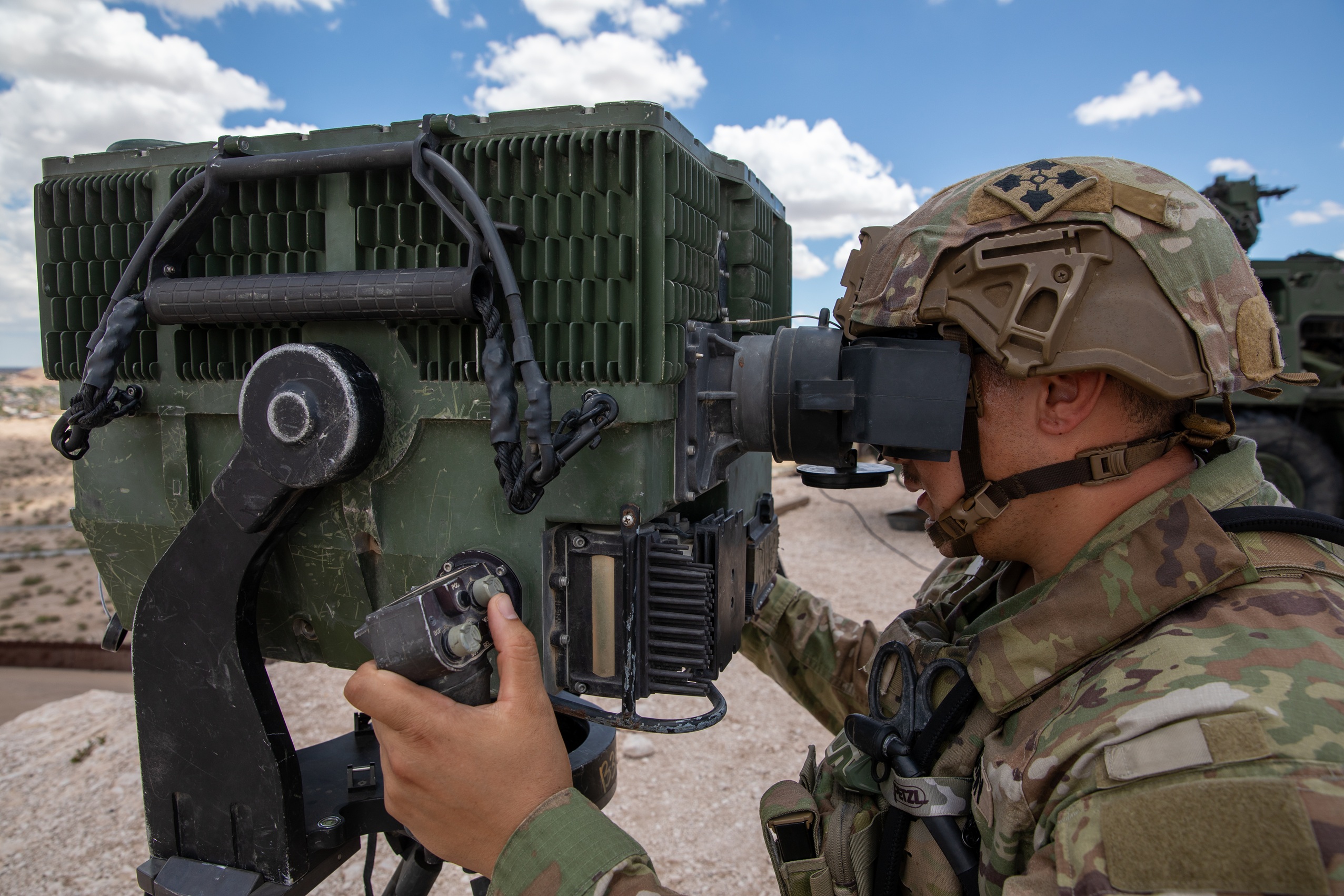
The Long Range Advanced Scout Surveillance System, mounted on mobile platforms such as the Stryker armored vehicle, combines thermal imaging, day optics, GPS, and a laser rangefinder. Originally a reconnaissance asset for Cavalry units, LRAS3 now supports Infantry formations and has been adapted for homeland security missions.
“This system allows a Stryker with a mounted LRAS3 to provide U.S. Border Patrol with the information and location needed to interdict suspected illegal aliens,” said 1st Lt. Elias Stephenson of the 2nd Battalion, 12th Infantry Regiment. “It’s used in areas that have substantial observation capabilities to support the detection capabilities of the system and enable U.S. Border Patrol interdiction.”
The Common Remotely Operated Weapon Station, originally designed to mount crew-served weapons, has been adapted for surveillance-only missions along the southern border. Stabilized optics, thermal cameras, and a laser rangefinder provide Soldiers with observation and detection capabilities while remaining inside armored protection.

“The Common Remotely Operated Weapon Station (CROWS) is a remote camera system on the Stryker that is normally used for the Stryker’s mounted machine gun for targeting in combat,” Stephenson said. “For the southern border mission, we don’t have weapons mounted so it’s been repurposed to extend our duration for detection and monitoring capabilities. This allows our vehicle commanders to detect individuals at greater distances and enable border apprehensions.”
Together, GBOSS-E, LRAS3, and CROWS represent a suite of military surveillance tools adapted for domestic security missions. The Pentagon said their integration demonstrates both the flexibility of these systems and the close cooperation between the Department of Defense and the Department of Homeland Security in protecting national sovereignty.
By combining elevated towers, mobile reconnaissance platforms, and remotely operated optics, service members and CBP agents can monitor broad areas of otherwise inaccessible terrain. The systems are designed to detect movement, track activity, and provide actionable information to law enforcement for interdiction.
As deployments continue under Joint Task Force Southern Border, the Pentagon emphasized that the mission enhances both border security and military readiness. Soldiers gain real-world training in austere environments, while CBP benefits from advanced surveillance capabilities in critical sectors along the southern border.