


A new image circulating on Chinese social media appears to show another next-generation combat aircraft undergoing flight testing—marking the third such design spotted in recent months, and underscoring China’s rapid expansion of its advanced airpower programs.
The photo, which lacks a confirmed location or timestamp, shows a sharp-edged delta-wing aircraft with a distinct elongated nose and blended wing-body fuselage—features consistent with reduced radar signature and long-range strike roles.
The aircraft’s silhouette is unlike that of China’s next-gen J-36 or J-50 stealth combat aircraft, prompting speculation that it may be either a new crewed platform or a large unmanned combat aerial vehicle (UCAV).
Andreas Rupprecht, a widely respected military aviation analyst and author known for tracking Chinese aerospace developments, commented on the latest sighting, stating: “A third image of that mysterious CCA UCAV (?) was just posted by by78/SDF.”
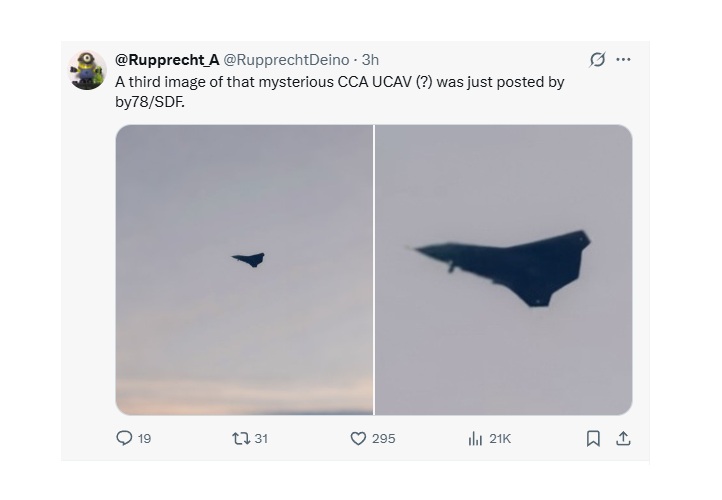
The aircraft’s planform shows no vertical stabilizers and a highly swept wing leading edge—features typical of designs optimized for low observability. The long, narrow forward fuselage extension suggests internal payload capacity and enhanced aerodynamics for long-range flight.
While no official designation or program name has been released, Chinese defense forums and open-source intelligence communities have speculated that the platform could be part of a larger initiative by the People’s Liberation Army Air Force (PLAAF) to field a family of unmanned or optionally manned strike aircraft. These systems are believed to be aimed at expanding China’s long-range precision strike capabilities while reducing risk to aircrews.
The emergence of this platform follows earlier sightings of other experimental aircraft, including tailless designs and drone prototypes. If confirmed to be a UCAV, the aircraft could serve as a strike escort for the J-50, China’s next-generation air dominance fighter, or operate independently in contested environments where stealth and endurance are prioritized.
The timing of the test flight remains unclear, but the image suggests that the platform is in an early but flyable prototype stage, with at least three separate visual confirmations now posted since early 2025.