

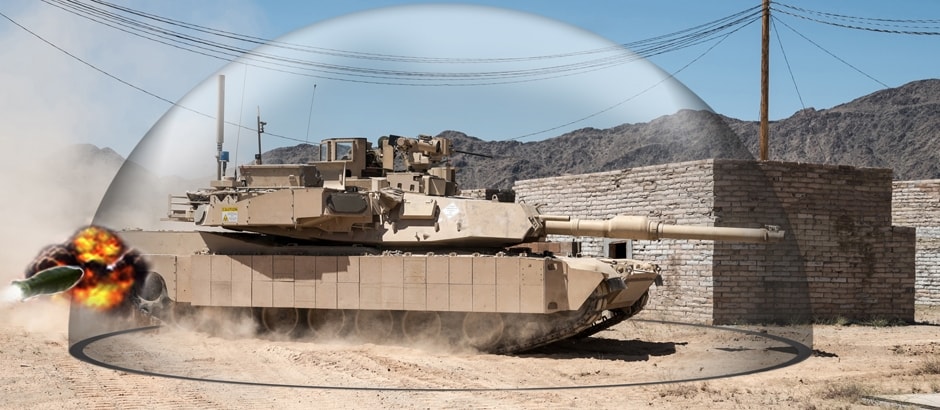
Leonardo, through Leonardo DRS, has been awarded a contract potentially worth more than $80 million to provide the U.S. Army and Marine Corps with additional Trophy active protection systems.
Leonardo hs announced on 8 January that the company has been awarded an $80 million contract for procurement new modular active protection systems, called the Trophy.
This brings the total funded value of the program to over $200 million and will equip several more brigades with Abrams Trophy.
Developed by long-time partner Rafael Advanced Defense Systems Ltd. of Israel, Trophy provides combat-proven protection against anti-armor rocket and missile threats, while at the same time locating and reporting the origin of the hostile fire for immediate response.
With no extra armor weight or decrease in vehicle performance, Trophy dramatically improves the survivability of the crew and vehicle.
The system uses active electronically scanned array radar to see through harsh combat conditions to provide continuous 360-degree protection for the vehicle. Once a threat is detected, the onboard computer classifies the threat.
Leonardo DRS, based in the U.S., is focused on the supply of products, services and integrated support to the Armed Forces as well as to intelligence agencies and defence companies worldwide.
The U.S. Army has an urgent need to equip armored vehicles with advanced protective technologies more capable than just passive armor.
“Advanced protection,” defined broadly as next-generation systems that automatically defend against enemy threats without burdening a vehicle with excessive heavy armor or a commander with limited options, is now one of the Army’s top modernization priorities. Active Protection Systems (APS) are one such advanced protection technology the U.S. military is testing. APS automatically detect and neutralize incoming threat projectiles before they reach a target. They are designed to cast a protective field around the vehicle through which RPGs and guided missiles cannot penetrate, while adding no substantial weight to the vehicle.