

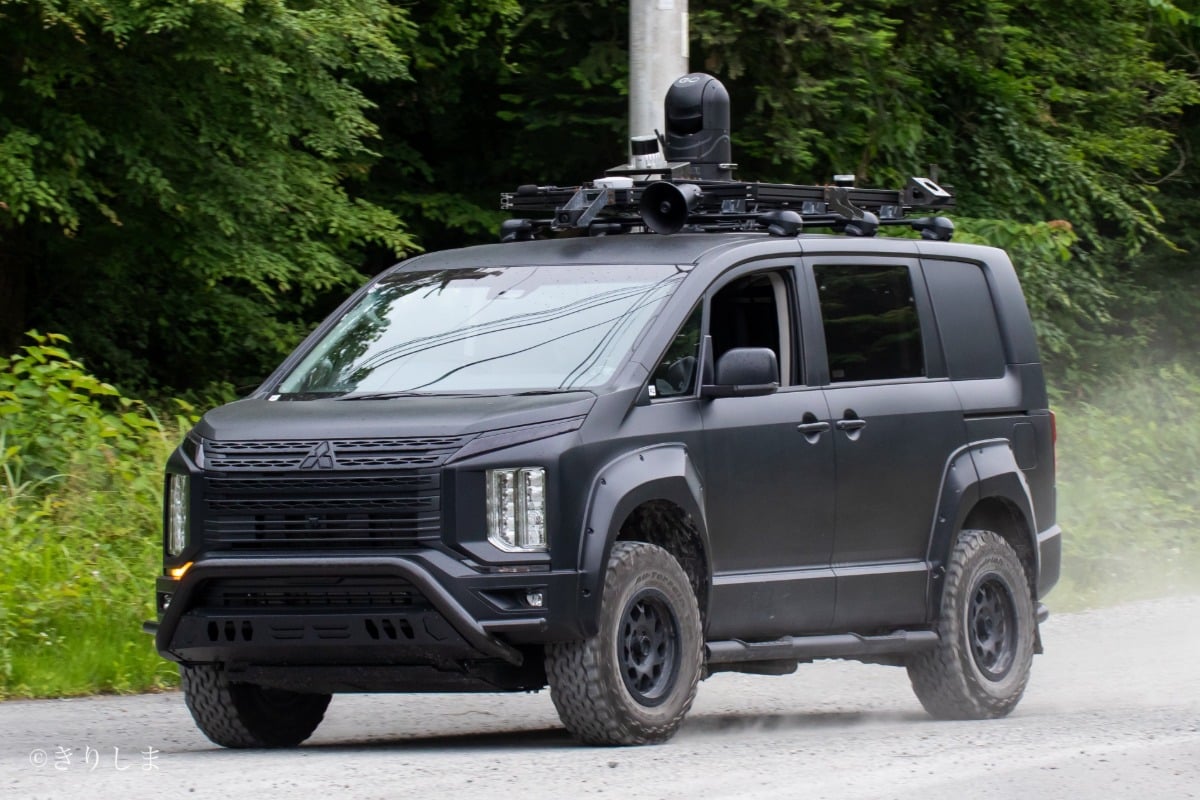
- A sensor-laden matte-black Mitsubishi Delica D:5 minivan with no license plates or unit markings was photographed near Japan's Fuji firepower exercise on June 7, 2026.
- Mitsubishi Heavy Industries holds a Japanese government contract worth approximately $12 million to develop a semi-autonomous UGV system by April 2028, per Australian Defence Magazine.
A matte-black Mitsubishi Delica D:5 minivan bearing no license plates, no unit markings, and a rooftop loaded with cameras, sensors, antennas, and a loudspeaker was photographed operating near Japan’s largest Ground Self-Defense Force live-fire exercise in Shizuoka Prefecture on June 7, 2026, according to Japanese military photo journalist Masaya Takewaka, writing for Transport News.
The vehicle was driven by a person in camouflage uniform and appeared to carry monitoring equipment inside the passenger compartment including a large display screen. The configuration resembles equipment associated with UGV-related testing, but neither JGSDF nor Mitsubishi Heavy Industries has publicly confirmed the vehicle’s role.
The Fuji General Firepower Exercise, known in Japan as Sōkaen, is the JGSDF’s most prominent annual live-fire demonstration, held at the Higashi-Fuji Training Area at the foot of Mount Fuji. The event gathers the force’s most advanced equipment and draws military observers and media from across Japan. The appearance of an unmarked, sensor-laden civilian vehicle operating in the vicinity, driven by uniformed personnel but carrying no official identifying markings, is consistent with the kind of discreet field evaluation that defense programs conduct when testing hardware in a realistic operational setting without announcing the activity publicly.
The Mitsubishi Delica D:5 is a large all-wheel-drive minivan produced by Mitsubishi Motors, marketed around the concept of an all-rounder vehicle combining passenger capacity with genuine off-road capability. The current generation shares its platform and electronic four-wheel-drive system with Mitsubishi’s Outlander SUV, giving it considerably better terrain performance than a standard commercial van while retaining the inconspicuous civilian appearance that makes it useful for observation or relay work near an active exercise without drawing attention. Its interior volume is large enough to accommodate monitoring workstations, control hardware, and communications equipment that field research teams typically require.
The rooftop configuration is what most clearly signals a non-standard purpose. Camera clusters for visual perception, multiple antenna mounts for communications and data links, and additional sensor modules pointing in multiple directions are consistent with a mobile perception and telemetry platform rather than an ordinary staff vehicle. The large display visible inside the passenger compartment reinforces that interpretation, suggesting the vehicle was monitoring or controlling something external rather than simply transporting personnel. Whether that external system was a separate unmanned ground vehicle, an unmanned aerial vehicle, or some combination of the two is not publicly confirmed.
Japan’s push to develop autonomous and semi-autonomous ground systems has accelerated sharply in recent years, driven by both strategic necessity and the direct lessons being absorbed from the Ukraine conflict. Japan’s Acquisition, Technology and Logistics Agency awarded Mitsubishi Heavy Industries a contract worth approximately $12 million to research and produce a semi-autonomous UGV system before April 2028 under the agency’s Rapid Acquisition Program, as Australian Defence Magazine reported in February 2026. That contract places Mitsubishi Heavy Industries directly in the running as a developer of Japan’s domestically produced autonomous ground capability, the company whose name appears most prominently in speculation about the mystery Delica given its known role in Japanese defense vehicle development.
Japan’s urgency in this area is driven by a demographic reality with no near-term solution. Japan’s military acquisition agency ATLA has stated that demographic trends, specifically the country’s aging and shrinking population, are limiting the pool of candidates for military service, making automation and labor-saving unmanned systems not simply a capability enhancement but a structural necessity for sustaining the JGSDF’s operational capacity over coming decades. An unmanned vehicle that can conduct reconnaissance, carry supplies, or support combat operations reduces the manpower burden on a force that cannot recruit its way out of a generational personnel shortfall.
Japan’s 2026 defense budget allocated approximately $42 million for an AI-driven off-road UGV system designed to operate in teaming with unmanned aerial vehicles, listed as one of seven major research priorities, a funding line that signals the government is treating autonomous ground systems as a near-term fielding priority rather than a long-range research project. Field evaluations of the kind the Sōkaen sighting may represent are typically how programs in this phase validate sensor configurations, communications architectures, and autonomous behaviors under conditions closer to real operational environments than any laboratory can replicate.