


- Iwaya firm displayed a stratospheric aerostat system at ATLA’s Technology Symposium 2025, highlighting potential defense applications.
- The company said it is already providing high-altitude platforms to the Japan Air Self-Defense Force and is studying payloads for communications and information collection.
A Hokkaido-based company has presented a stratospheric aerostat system with emerging defense uses at the annual “Technology Symposium 2025,” hosted by Japan’s Acquisition, Technology & Logistics Agency (ATLA) in Tokyo on November 11–12.
In this context, aerostat refers to a high-altitude platform kept aloft by lighter-than-air gas, capable of long-duration observation, communications support, or scientific missions. Although the symposium is an ATLA event, the display was organized by Iwaya, a private firm known for developing high-altitude platforms designed for both manned and unmanned stratospheric operations.
The exhibition, titled “Development and Prospects of High-Altitude Aerostats Aimed at Multi-Domain Use,” outlined how stratospheric aerostats—initially developed for commercial sightseeing and research—may support Japan’s defense needs in future missions.
According to the materials displayed by Iwaya, the company aims to achieve “manned stratospheric sightseeing flights at low cost,” using a capsule suspended beneath a high-altitude platform capable of reaching the stratosphere. But the company added that it has recently identified “defense-sector needs that were not previously expected” and has found “security-related demand for high-altitude aerostats.”
Company representatives said Iwaya is already supplying high-altitude platforms to the Japan Air Self-Defense Force (JASDF) for countermeasure research. The company says it is evaluating additional applications, including “information collection and communications modules,” and is studying the platform’s potential as an LTA-type High Altitude Platform Station (HAPS).
Panels displayed at the symposium explained that tethered aerostats and free-flying stratospheric systems can provide long-duration observation capability, rapid deployment, and flexible payload integration. One panel stated that, when tethered, the platforms can maintain “long-term fixed-point operation at altitudes from 500 to 3,000 meters,” supporting persistent surveillance or communications relay. The company said such systems can also be rapidly deployed to “regions where communications infrastructure has been lost in disasters.”
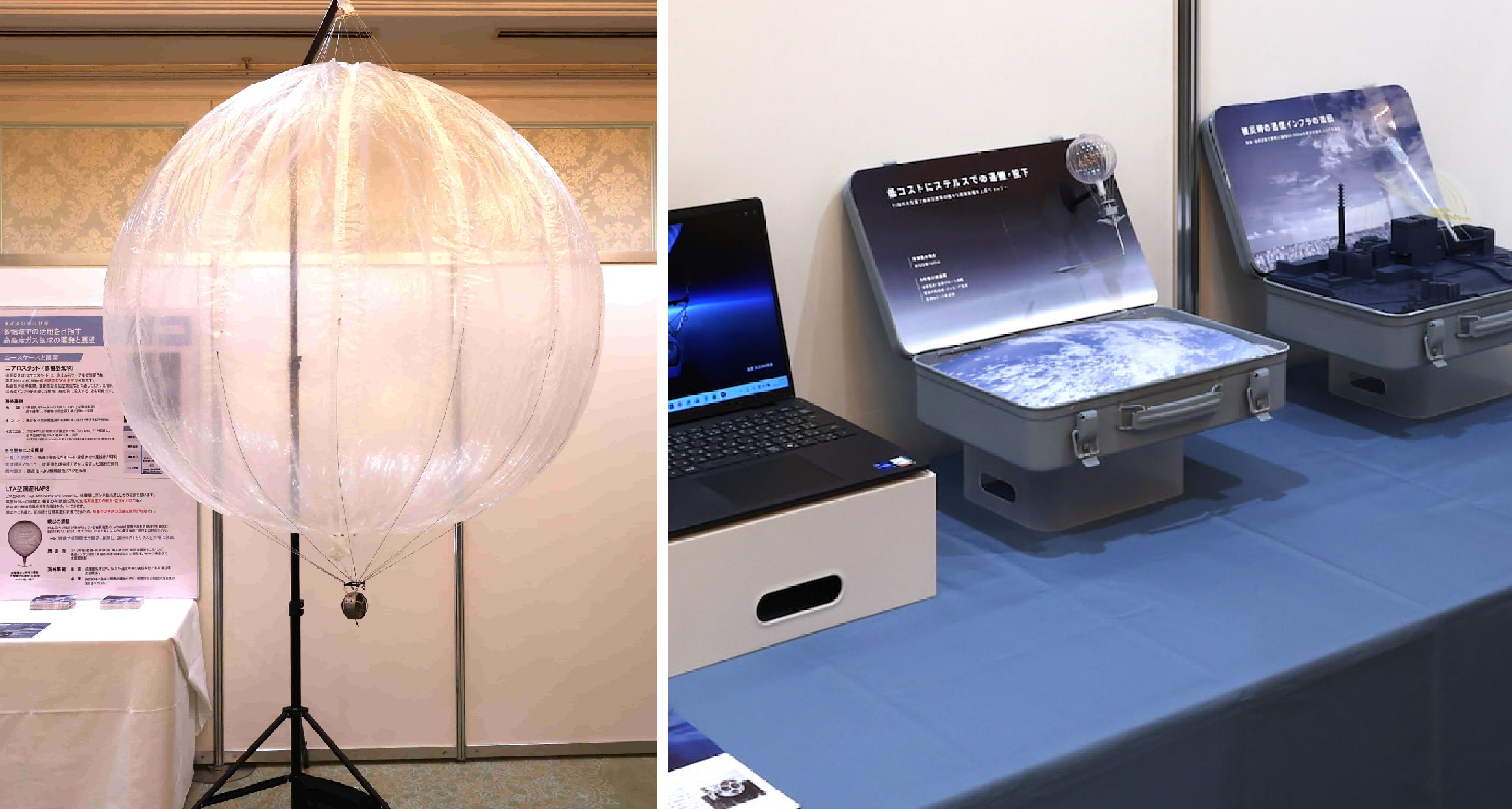
The exhibit compared international examples, including the U.S. Tethered Aerostat Radar System (TARS), India’s disaster-monitoring balloon programs, and Israel’s “Sky Dew” aerostat, which entered operational use in 2022 for detecting low-altitude threats.
Iwaya explained that its high-altitude systems offer advantages such as “low cost,” “immediacy” — the ability to reach 20 km altitude within one to two hours — and “flexibility,” enabling payloads for observation, communications, or scientific missions.
The company also presented its broader development activities, noting progress since its founding in 2016. Exhibition panels stated that Iwaya Giken has advanced both manned and unmanned aerostat technologies and that it received an “ICAO 24-bit address allocation” from Japan’s Civil Aviation Bureau, enabling controlled operations similar to aircraft. The firm reported “more than 50 unmanned flights” and the development of life-support and capsule systems for manned missions.
A large spherical aerostat mock-up was displayed inside the venue alongside technical panels describing its structure and potential mission sets. The mock-up illustrated how lightweight materials and internal design enable long-duration stratospheric operations.
Company officials suggested that if future demand expands beyond commercial tourism, high-altitude aerostats could serve as next-generation platforms for persistent surveillance, atmospheric monitoring, and emergency communications. According to the exhibition material, they believe the technology “could become an asset supporting future multi-domain operations.”