

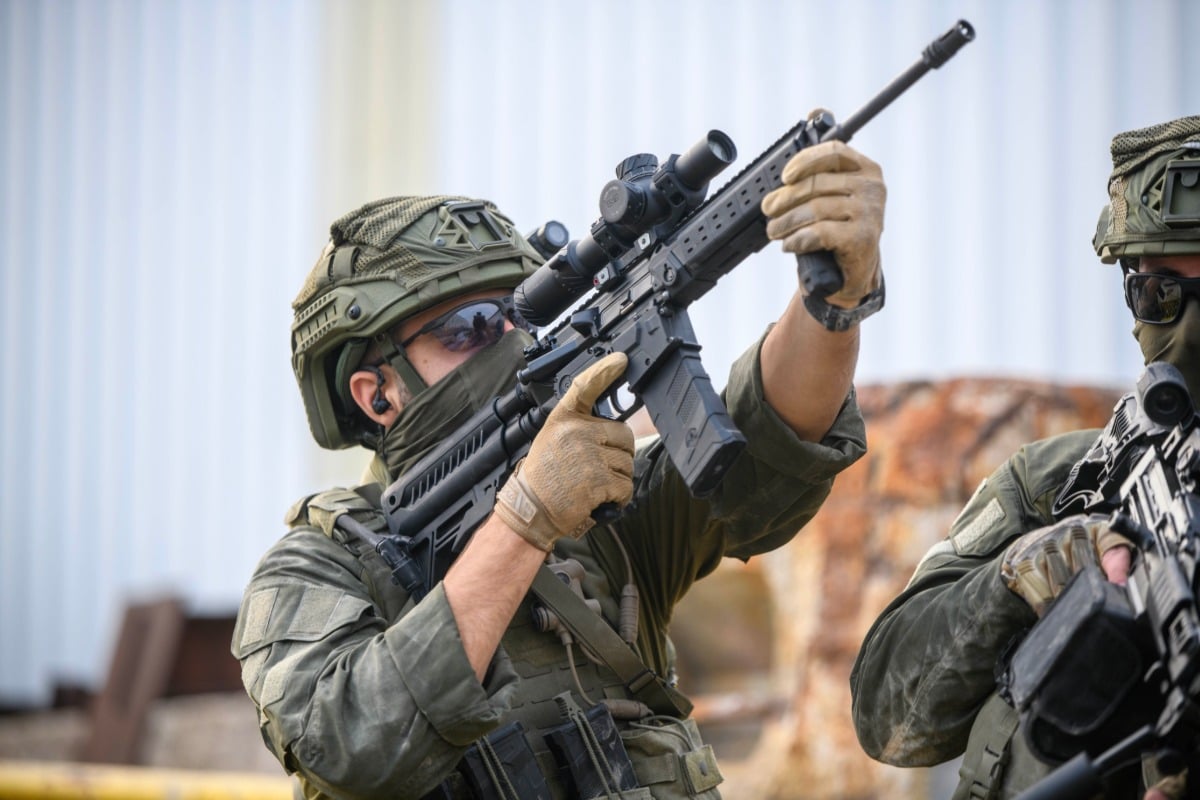
- IWI's ARBEL fire-control module integrates into standard AR-15 rifles and times trigger release to help operators intercept small drones.
- IWI Chief Product Manager Adam Fraser told The Defence Blog ARBEL first underwent real-world testing about a decade ago.
A rifle that decides, mid-trigger-pull, when to let the round go, not the shooter, is now fielded or in procurement across an estimated 10 to 15 European countries, according to Israel Weapon Industries (IWI). The system, called ARBEL, does not detect drones or aim the weapon. It does one thing: it controls the timing of trigger release once a soldier has already found, tracked, and decided to engage a small aerial target.
That narrow scope is central to how IWI positions the system, and to the questions worth asking about it. As small first-person-view (FPV) drones have become one of the defining threats to frontline infantry in Ukraine and beyond, a wave of counter-drone products (detection radars, jammers, dedicated interceptor weapons) has entered the market. ARBEL is different in that it is not a new weapon at all, but a fire-control module retrofitted into the lower receiver of a standard AR-15 platform, a rifle already carried by the soldier.
The Defence Blog sent Adam Fraser, Chief Product Manager at IWI, a set of questions covering ARBEL’s development and testing history, the performance data the company is prepared to share, operator training timelines, the system’s limitations, and where IWI sees the technology heading next.
The following Q&A was submitted and answered in writing. Questions are presented as sent to IWI; answers have been lightly edited only for formatting.
Q: When did ARBEL first undergo real-world testing against an actual drone threat, rather than only range trials, and what changed in the company’s approach to the system’s development as a result?
A: ARBEL was developed through the same continuous improvement process that guides all IWI products. As a manufacturer, our role is to design systems that meet defined operational requirements, work closely with end users throughout development, and support qualification and validation testing. While we do not participate in operational deployments or comment on the real-world employment of our systems, user feedback gathered through the development and evaluation process has been instrumental in refining ARBEL and optimizing its performance. The ARBEL first underwent real-world testing about a decade ago. Like all of our products, it continues to evolve through an ongoing feedback-and-improvement cycle. At IWI, we have a short loop between the engineers and operators, as several of us are reservists. As such, the feedback loop is quite short, and as the battlefield and the use of drones evolve, we’re able to tweak the ARBEL accordingly.

Q: What specific test results is IWI willing to disclose, for example the number of drones neutralized per rounds fired during live trials, and were any of these tests conducted or verified by a party independent of IWI?
A: We prefer not to reduce the ARBEL to a single statistical figure, as drone interception is influenced by numerous variables including target type, flight profile, engagement geometry, environmental conditions, and operator proficiency. However, we can share that during realistic live demonstrations and representative operational simulations, ARBEL has repeatedly demonstrated the ability to neutralize attacking drones within 10 seconds, using very few rounds, against targets traveling at speeds up to 60 km/h and at engagement distances beyond 100 meters. These demonstrations have been conducted both by IWI personnel and by customers evaluating the system under their own testing protocols.
Q: On average, how long does it take an inexperienced shooter to reach a confident level of drone interception using ARBEL, and does IWI provide operator training directly in the countries where the system is deployed?
A: One of ARBEL’s greatest strengths is its simplicity. The system is integrated into a standard AR-15 lower receiver without changing the manual of arms, allowing operators to retain the weapon platform, controls, safety procedures, and optics they already know. This significantly reduces the training burden, as there is virtually no learning curve associated with operating the rifle itself. Activating ARBEL is equally straightforward: the operator simply pulls the trigger and maintains rearward pressure, allowing the system to function as designed. Importantly, the first shot remains purely mechanical, ensuring that the weapon retains full functionality regardless of the electronic system’s status. Once users become familiar with the trigger behavior, successful drone engagement depends primarily on their existing marksmanship skills rather than on learning an entirely new weapon system. We work closely with our customers to provide system training, and in most cases, after just a couple of rounds of practice, the operator is trained and confident in the system. The short learning period is due to the operator already being used to their weapon, so it’s just about flipping on the ARBEL mode and them getting used to minor elements such as continuously holding back the trigger.
Q: Against which types of drones does the system perform worst, and have there been any documented cases where ARBEL did not perform as expected under field conditions?
A: ARBEL was specifically designed as a last-line defensive capability against small tactical drones, particularly FPV platforms that have become increasingly common on modern battlefields. These systems are inexpensive, widely available, easy to weaponize, and operate at low altitudes and relatively short engagement distances, making them a persistent threat to frontline forces despite their relatively limited individual payloads. ARBEL addresses this challenge by providing every infantry operator with an immediate self-protection capability using the rifle they already carry, rather than relying on specialized equipment or dedicated counter-UAS teams that may not be available when seconds matter.
Through real-world use and testing, the ARBEL has performed successfully. The world of drones is quite vast, and this has proven to be the solution against small tactical drones, particularly FPV platforms.
Q: How has operational experience with ARBEL influenced refinements to the system’s algorithms, and are there plans to adapt it for a broader range of threats beyond small FPV drones?
A: As the manufacturer, we’re not involved in the operational deployments of our systems; however, user feedback gathered through the development and evaluation process has been instrumental in refining the ARBEL and optimizing its performance. It is equally important to understand what ARBEL is and what it is not. ARBEL is a trigger-control mechanism. It does not detect drones, track targets, identify threats, or improve aiming. Those tasks remain entirely with the operator and any external sensors or optics available. The system is designed to reduce the human factors associated with engaging highly dynamic aerial targets by optimizing the firing sequence once the operator has already detected, acquired, and decided to engage the target.
As to whether there are plans to adapt the ARBEL to address a broad range of threats beyond small FPV drones, as a small arms manufacturer, our focus is to develop a counter-drone capability within the small arms space. We are not looking to address larger drones, as that space is already quite full with counter-UAS solutions. Our objective was to leverage the weapon already carried by the soldier and ask a fundamental question: how can we enable that same weapon to provide an effective defense against the small tactical drones that are increasingly used for surveillance and to carry small payloads against frontline forces? The ARBEL was created as a result, providing soldiers with an immediately available last-line defensive capability against a threat that is increasingly present on the modern battlefield.
Q: What gaps in infantry protection against drones remain unresolved even with ARBEL in use, and what does IWI believe needs to appear in the next generation of similar systems?
A: No single technology can solve every aspect of the counter-drone challenge. As unmanned threats continue to evolve, we expect counter-drone solutions to become increasingly layered, with early detection, identification, electronic warfare, kinetic interception and passive protection all playing complementary roles. The ARBEL provides a highly practical, immediately available last layer of defense for the individual operator, but it is not designed to replace those other capabilities. Because every soldier can become the target of a drone attack, survivability should not depend solely on the presence of specialized personnel or equipment. By incorporating the ARBEL directly into the operator’s primary weapon, it introduces no additional equipment burden and requires no transition to a dedicated counter-drone weapon during an engagement. Equipping a larger portion of a unit with this capability also allows multiple operators to engage the same threat simultaneously, increasing the probability of interception while reducing the engagement time and the total volume of ammunition required.
Looking ahead, we believe future infantry counter-UAS capabilities will increasingly emphasize better integration between sensors, targeting aids and effectors, while maintaining the simplicity, reliability and immediate availability that are essential for frontline soldiers operating under combat conditions.