

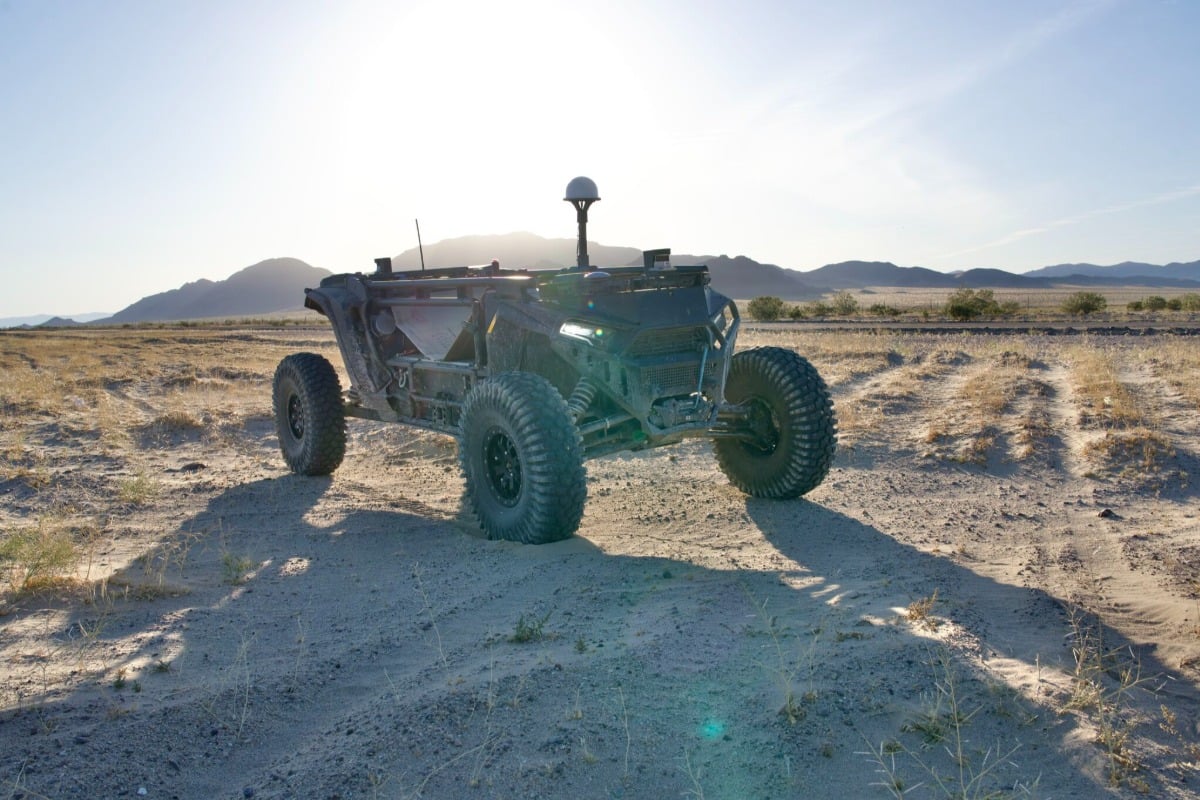
- Marine Corps Systems Command awarded Overland AI a $19.7 million contract for unmanned ground vehicles and OverWatch/OverDrive software supporting the MADIS air defense program.
- The sole-source agreement, announced in 2026, requires delivery of vehicles and spares by October 27, 2027, with work performed in Seattle, Washington.
The U.S. Marine Corps Systems Command in Quantico, Virginia awarded Seattle-based Overland AI a $20 million contract to supply unmanned ground vehicles and accompanying software in direct support of the Marine Air Defense Integrated System, the Corps’ primary mobile air defense capability, with deliveries required by October 2027.
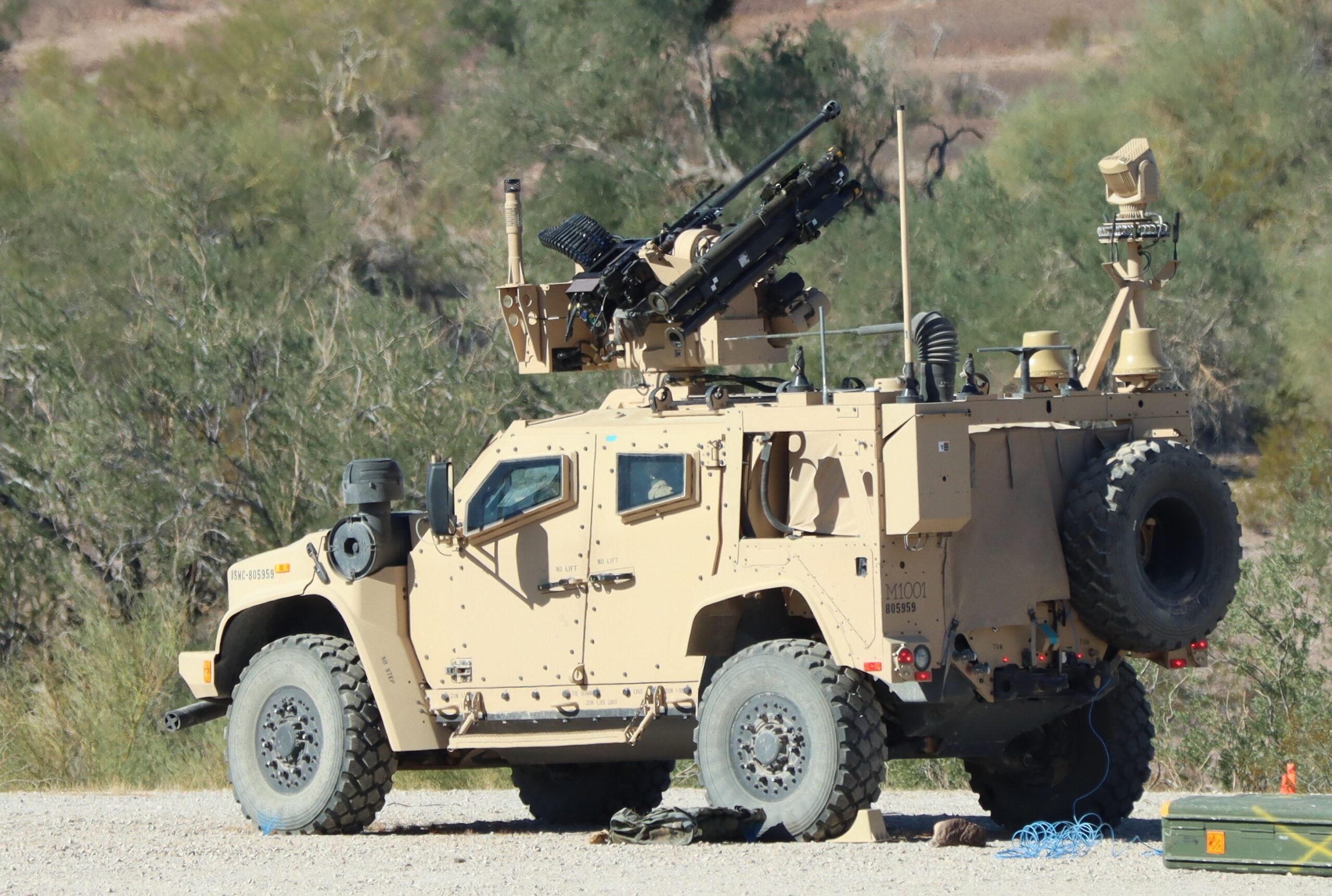
The Marine Air Defense Integrated System, known as MADIS, is the Marine Corps’ answer to a problem that has consumed military planners since the wars in Iraq, Syria, and Ukraine made clear that cheap, commercially available drones can destroy expensive military equipment and kill soldiers in ways that traditional air defense was never designed to stop. MADIS pairs two Joint Light Tactical Vehicles, each weighing roughly 6,350 kg (14,000 lb), into a maneuverable combat pair designed to detect, jam, and destroy drones and low-flying aircraft on the move, on the open ocean, in the jungle, or in the kind of distributed island-hopping scenarios the Marine Corps is building itself to fight in the Pacific.
The Mk1 vehicle handles hard-kill engagement with a 30mm automatic cannon and Stinger surface-to-air missiles to physically destroy aerial threats. The Mk2 handles electronic warfare and command-and-control, operating the RPS-42 tactical radar built by RADA Electronic Industries that detects targets with radar cross-sections as small as commercial quadcopters within a radius of approximately 30 km (19 miles) and across altitudes from near ground level to 9,144 m (30,000 ft). Together they form a layered engagement sequence: jam the drone first, destroy it if jamming fails.
The first full-rate production version of MADIS was unveiled in September 2025 following live-fire exercises at the Marine Corps Air Ground Combat Center, and in June 2026, the 12th Marine Littoral Regiment on Okinawa formally received both MADIS and NMESIS anti-ship missile systems as part of the Corps’ ongoing Force Design modernization push oriented toward China. The Overland AI contract feeds directly into that expansion, adding autonomous ground vehicles as an additional sensor and force protection layer to the MADIS architecture.
Overland AI, founded in Seattle in 2022, has built its business around solving what the company describes as the hardest problem in military robotics: getting a ground vehicle to drive itself reliably through terrain that has no roads, no GPS signal, and no pre-mapped routes, while doing it fast enough to be tactically relevant. The company’s OverDrive software, which forms the autonomy core purchased in this Marine Corps contract, grew out of DARPA’s RACER program, a multi-year initiative that specifically tested high-speed off-road autonomy in the most demanding natural environments the government could find. The resulting system uses onboard passive sensors to map terrain in real time, allowing vehicles to navigate dense forest, volcanic ridges, mud, snow, and sand without requiring a human in the loop or a satellite connection overhead. Overland AI’s OverWatch software, also included in the contract, gives a single operator the ability to task, monitor, and retask multiple autonomous vehicles simultaneously from a single command interface, integrating with existing command-and-control systems through an open application programming interface.
The vehicle most associated with Overland AI’s Marine Corps work is its ULTRA platform, an autonomous tactical ground vehicle measuring 3.94 m (12.9 ft) in length and 1.83 m (6 ft) in width, with a gross weight of 1,588 kg (3,500 lb) and a payload capacity of 454 kg (1,000 lb). It runs a 999cc engine producing 114 horsepower, achieves a top speed of 56 km/h (35 mph), and carries a cruising range of approximately 161 km (100 miles) at moderate speed, with a 100Ah 24V battery that provides two hours of idle operation with the engine shut down. The contract announcement does not specify which Overland AI platform the Marine Corps is procuring for MADIS support, and the specific vehicle type and quantities remain unconfirmed. What is confirmed is that the vehicles will carry OverWatch command software and OverDrive autonomy, the same stack the company has deployed with the 1st Cavalry Division, 173rd Airborne Brigade, 82nd Airborne Division, 2nd Marine Logistics Group, and U.S. Special Operations Command.
Marine Corps Systems Command awarded this agreement as a sole-source Other Transaction Authority purchase, a procurement mechanism that bypasses the standard competitive bidding process and allows the government to move quickly when a specific capability is urgently needed and no reasonable alternative exists. The authority used, 10 U.S. Code 4022(f), is specifically designed for follow-on prototype work, meaning the Marine Corps is converting years of Overland AI prototype testing into fielded hardware. Of the $19.7 million total agreement value, $16.9 million in fiscal year 2026 Marine Corps procurement funds will be obligated at award and will not expire at the end of the fiscal year, giving the program financial stability through the delivery window running to October 2027.
The decision to integrate unmanned ground vehicles into MADIS reflects a doctrinal evolution that goes beyond simply adding more hardware. MADIS currently requires Marines to operate in the open, maintaining sensor coverage and responding to aerial threats from exposed vehicle positions. An autonomous ground vehicle that can extend that sensor and coverage envelope outward, detecting threats at greater range and cueing the MADIS weapons system before a drone closes to engagement range, takes Marines out of the most vulnerable positions while increasing the system’s reaction time. The Marine Corps has watched Ukraine absorb tens of thousands of drone strikes and has drawn the same conclusion that most serious military analysts have reached: the side that can detect and kill incoming drones faster, with fewer humans directly exposed, consistently suffers fewer casualties and retains more tactical flexibility.
Overland AI raised $100 million in new funding in early 2026 to scale production and expand its operational footprint across the Army, Marine Corps, and Special Operations Command, with the company’s president Stephanie Bonk stating publicly that demand had moved “decisively from experimentation to operational integration.” The Marine Corps MADIS contract validates that assessment. Three years ago, autonomous ground vehicles were primarily a research curiosity in Pentagon demonstration programs. Today, the Marine Corps is writing procurement contracts for them and counting on them to protect a front-line air defense system that must function in the most contested airspace the Indo-Pacific can generate.