

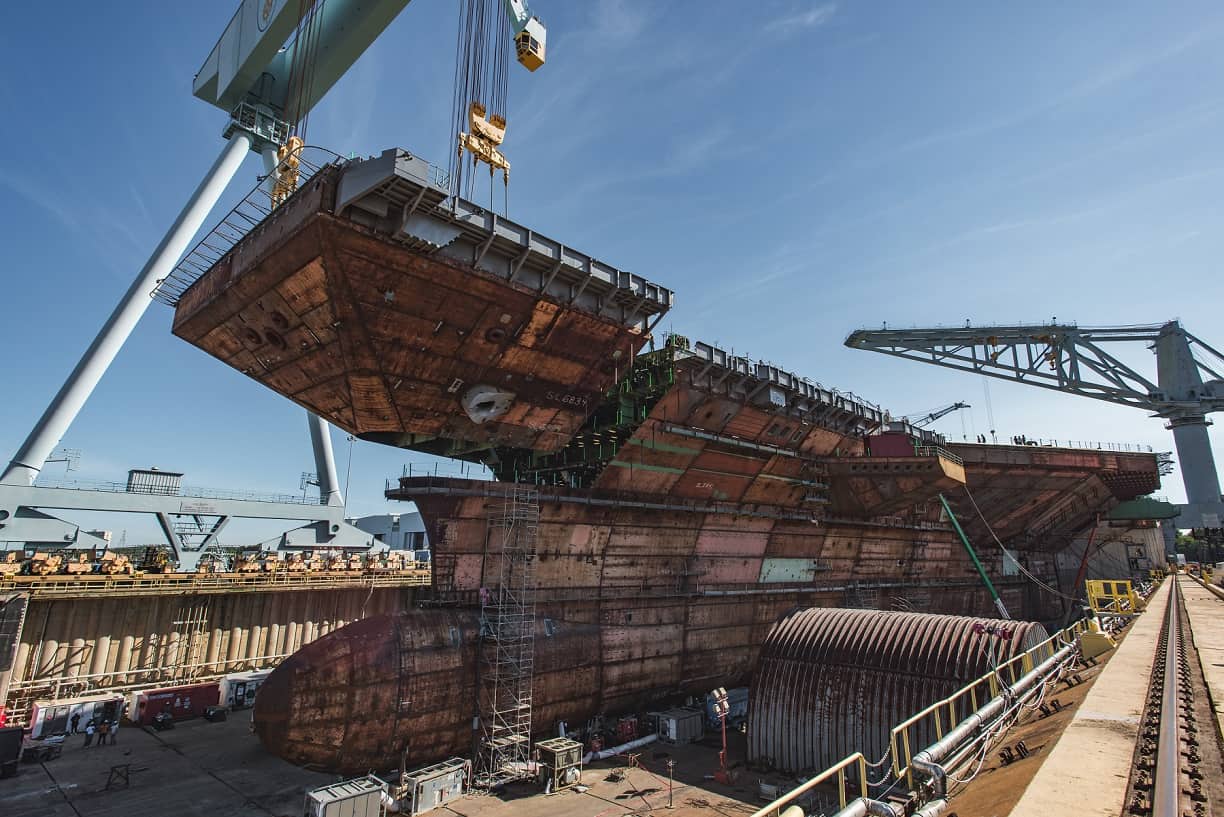
America’s next aircraft carrier, the USS John F. Kennedy, reached a major construction milestone – Huntington Ingalls Industries completed flight deck on the aircraft carrier.
U.S. largest military shipbuilding company Huntington Ingalls has lowered 780-ton upper bow unit on the nuclear-powered aircraft carrier John F. Kennedy (CVN 79), completes the primary structure of the ship.
USS John F. Kennedy (CVN-79) is the second Gerald R. Ford-class aircraft carrier being built for the United States Navy. The ship is under construction and planned to be commissioned in 2020.
The addition of the upper bow section at the company’s Newport News Shipbuilding division is one of the last steel structural units, known as a superlift, to be placed on Kennedy. It was built using digital technology, such as visual work instructions to install piping in the upper bow on the final assembly platen instead of on the ship.
“We are very pleased with the progress being made on Kennedy as we inch closer to christening the ship later this year,” said Mike Butler, Newport News’ CVN 79 program director. “The upper bow is the last superlift that completes the ship’s primary hull. This milestone is testament to the significant build strategy changes we have made—and to the men and women of Newport News Shipbuilding who do what no one else in the world can do.”
Weighing 780 tons, the superlift took 18 months to build.
Kennedy is being built with an improved build strategy that includes the increased use of digital tools to build superlifts that are much larger and more complete at ship erect than on prior carriers. Leveraging lessons learned and key build strategy changes, Kennedy is on track to be built with considerably fewer man-hours than the first ship in its class, Gerald R. Ford.
More than 3,200 shipbuilders and 2,000 suppliers from across the country are supporting the construction of Kennedy. The ship is in the early stages of its testing program and is on schedule to launch during the fourth quarter.
The christening is planned for late 2019.
Newport News Shipbuilding installed the final piece of aircraft carrier John F. Kennedy’s (#CVN79) flight deck earlier this week. Read more in the press release: https://t.co/8KtAQiNZgzhttps://t.co/ZWxz3VaoBl
— Huntington Ingalls Industries (@HIIndustries) July 11, 2019