

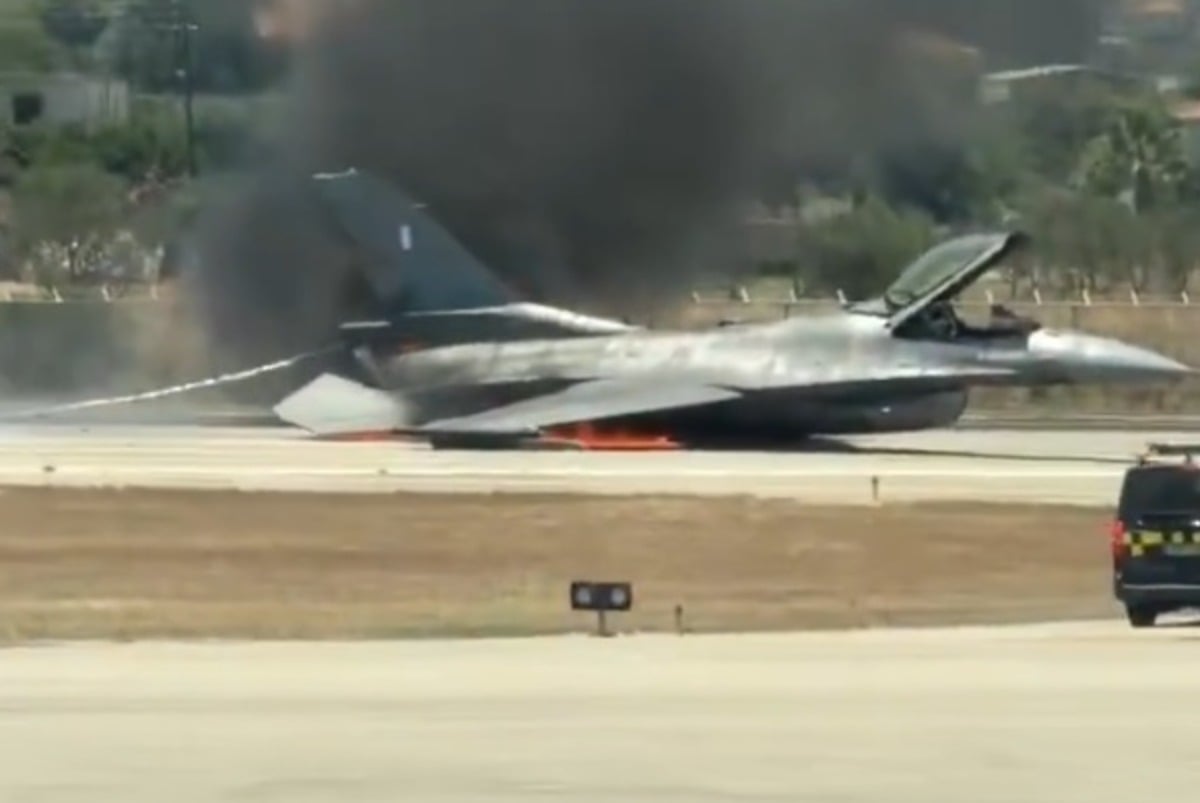
- A Hellenic Air Force F-16 from the 116th Combat Wing made an emergency landing at Zakynthos airport on July 9, 2026, after a malfunction during a training flight.
- The Hellenic Air Force confirmed the pilot is in good health while the cause of the malfunction remains under investigation.
A Greek Air Force fighter pilot pulled off a landing gear failure Thursday afternoon that could have ended very differently, bringing an F-16 down on its belly at Zakynthos airport after the jet’s wheels refused to extend during a routine training flight.
The Hellenic Air Force confirmed the emergency landing occurred around 1:45 p.m. local time, with spokesperson Lieutenant Colonel Konstantinos Gravalos telling reporters the jet suffered an unspecified malfunction, and that the pilot “is in good health.”
The aircraft belonged to the 335th Squadron of the 116th Combat Wing, based at Araxos Air Base in the northwestern Peloponnese, and had taken off for what officials described only as a training exercise before the malfunction forced the pilot to divert to Zakynthos, an island airport roughly 100 km (62 miles) south of Araxos across the Ionian Sea.
According to Greek broadcaster ERT and multiple local outlets covering the incident, the aircraft appeared to catch fire before or during the landing sequence, though the Hellenic Air Force’s own initial statement characterized the cause more cautiously, describing only an unspecified technical failure while noting the investigation into the incident’s causes remained ongoing.
Greek news outlet Newsit reported that the F-16’s landing gear failed to deploy, forcing the pilot to execute a wheels-up belly landing, a maneuver where a pilot sets an aircraft down directly on its fuselage rather than its wheels, typically cushioned by firefighting foam laid across the runway in advance to reduce friction and fire risk during the skid. The same outlet reported that the most likely cause under investigation is a fuel leak, which the pilot detected in flight before shutting down the engine and initiating the emergency landing procedure without functioning landing gear, with the resulting fire caused by friction between the aircraft’s fuselage and the runway surface during the skid itself. Firefighters extinguished the blaze quickly, according to multiple Greek outlets reporting from the scene, and Zakynthos airport remained closed following the incident until crews could remove the damaged aircraft from the runway.
A belly landing is one of the more dangerous but survivable emergency procedures a fighter pilot can execute, and it exists specifically because a jet without functioning landing gear cannot simply circle until the problem resolves itself. The maneuver requires a pilot to fly an unusually precise, low-power approach, often after burning off or dumping excess fuel to reduce both weight and fire risk, before setting the aircraft down as gently and level as possible directly on its underside, letting the airframe itself absorb the impact and subsequent friction as it slides to a stop. Ground crews typically spray a layer of firefighting foam across the runway beforehand specifically to reduce sparking and cushion the belly of the aircraft during that skid, a precaution Greek reports indicate was used during Thursday’s landing.
The F-16 Fighting Falcon has formed the backbone of the Hellenic Air Force’s combat fleet for decades, and Greece operates one of the largest F-16 fleets in Europe, having continuously modernized its jets through successive upgrade programs rather than replacing the airframe outright.