

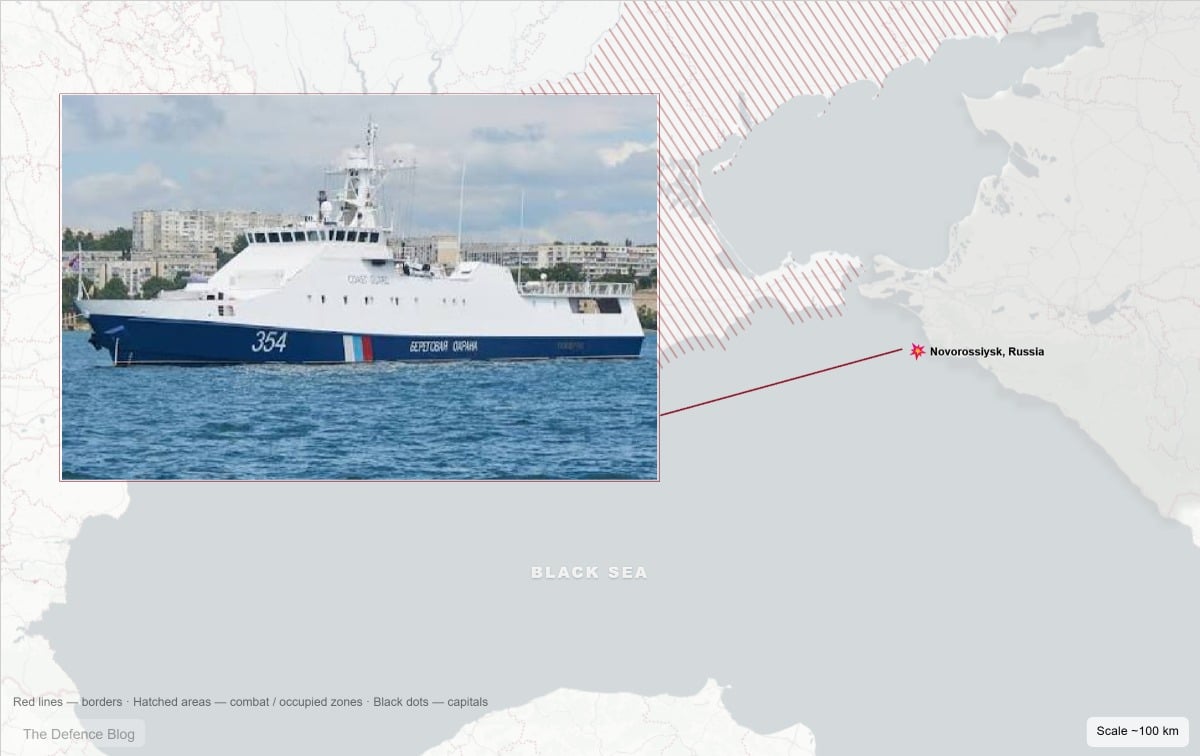
- Ukraine's Navy said it sank the Russian FSB patrol ship Izumrud near Novorossiysk on July 14, 2026, using the Sargan-3000 unmanned strike boat.
- The Ukrainian Navy said Izumrud had participated in the November 25, 2018 Kerch Strait attack on Ukrainian naval vessels.
Ukraine’s navy sank a Russian border guard ship near Novorossiysk using an unmanned strike boat. The Ukrainian Navy said its sailors sank the Rubin-class patrol ship Izumrud (354), a Russian Federal Security Service border guard vessel, using the Sargan-3000, a domestically built unmanned surface strike platform that has entered service with Ukraine’s naval forces over the past year.
“Ukrainian military sailors sank the border guard patrol ship of the 2nd rank using the Sargan-3000 maritime uncrewed complex near Novorossiysk. Among the ship’s crew there are killed and wounded,” the Ukrainian Navy said.
What gives this particular sinking its edge is the ship’s own history. Izumrud was directly involved in the November 25, 2018 incident in the Kerch Strait, when Russian forces opened fire on and seized three Ukrainian naval vessels, the gunboats Berdiansk and Nikopol and the tugboat Yany Kapu, holding their crews as prisoners for nearly a year before an eventual return under international pressure. Izumrud itself was damaged in a collision with the Russian tug Don during that same operation, and the Ukrainian Navy made clear it had not forgotten which ship played a role in one of the most brazen acts of Russian aggression against Ukrainian forces in the years before the full-scale invasion.
“It was Izumrud that took part in the attack on Ukrainian Navy ships in the Kerch Strait on November 25, 2018,” the Ukrainian Navy said, adding that “Retribution is inevitable. More to come.”
The ship itself belonged to Russia’s Project 22460 Okhotnik class, known informally as the Rubin class, a family of coast guard patrol vessels the FSB Border Service has built out steadily since the design entered production, with 14 examples commissioned as of early 2026. According to reference details the Ukrainian Navy included in its own announcement, Izumrud measured 62.5 meters (205 feet) in length, displaced somewhere between 630 and 750 tonnes (694 to 827 tons), carried a helicopter landing pad for extended patrol operations, and could reach speeds up to 27 knots (50 km/h, 31 mph), specifications that made it a capable coastal patrol asset rather than a major combatant, but still a meaningful loss for a border guard fleet that has increasingly found itself targeted as Ukraine’s naval drone campaign has expanded its reach along Russia’s Black Sea coastline.
Sister ships from the same Rubin class have taken repeated hits elsewhere in the war. Ukrainian forces struck the patrol ship Rasul Gamzatov, another Project 22460 vessel, in the Caspian Sea in December 2025 while it guarded Russian oil and gas platforms, and two more Rubin-class boats were damaged in February 2026 near Inkerman in Russian-occupied Crimea, suggesting Ukraine has identified this entire class of FSB border guard vessels as a recurring target rather than striking Izumrud as an isolated case.
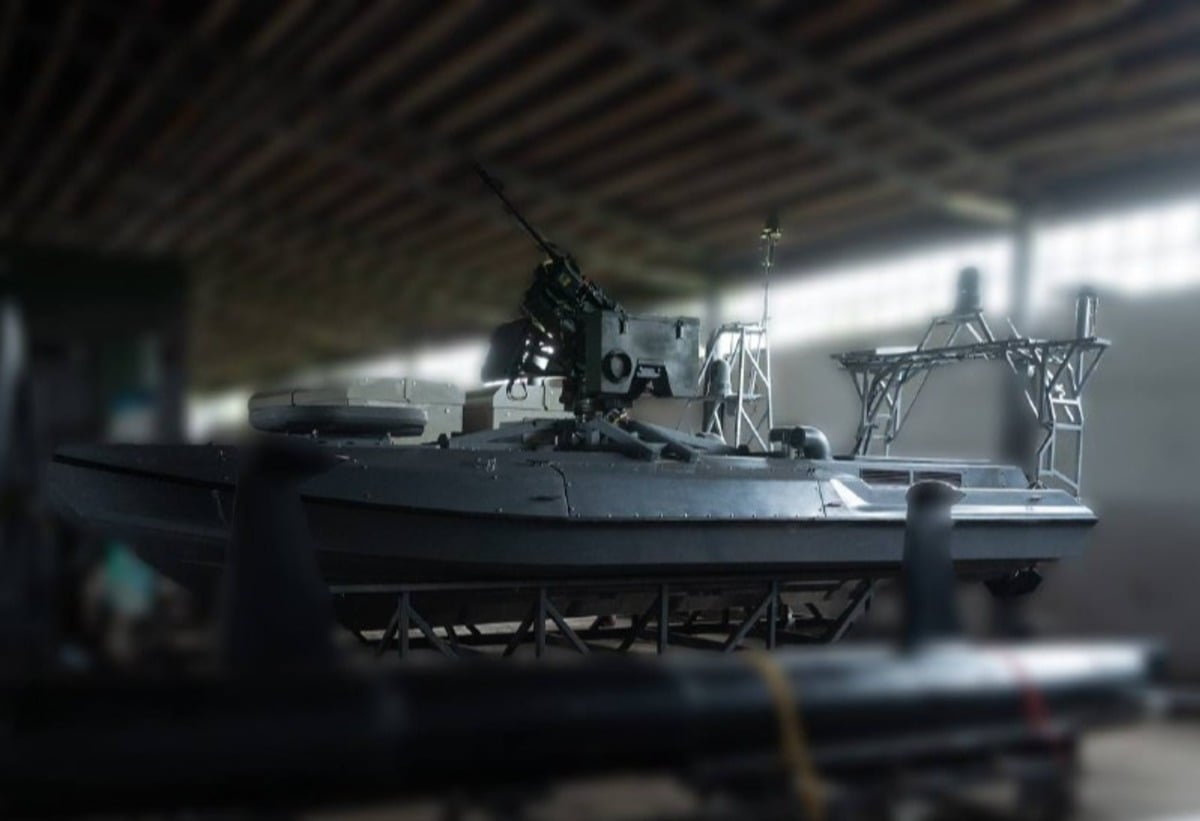
The Sargan-3000 itself represents a newer addition to Ukraine’s growing family of unmanned naval strike platforms, joining better-known systems like the Magura V5, which became the first drone in the world to sink a warship, and the Sea Baby, another Ukrainian-developed uncrewed vessel that has struck Russian targets across the Black Sea. Ukrainian President Volodymyr Zelenskyy has publicly discussed the Sargan-3000 alongside those other systems as part of the country’s expanding maritime drone arsenal, describing it as a multipurpose platform capable of high maneuverability and strike missions after it completed testing and entered formal service with the Ukrainian Navy earlier this year.
Ukraine’s Defense Ministry reported in April that roughly 30 percent of Russia’s Black Sea Fleet combat strength had been destroyed or seriously damaged since the start of the full-scale invasion, a toll that has pushed Russia to relocate much of its remaining fleet to Novorossiysk, the same port where Izumrud met its end, after repeated strikes made Sevastopol too dangerous to serve as a reliable home base.
That relocation has not made Novorossiysk safe either. Ukrainian forces have hit the port repeatedly throughout 2026, damaging or sinking vessels ranging from the frigate Admiral Essen to the minesweeper Valentin Pikul, and the Izumrud sinking extends that pattern to a smaller but symbolically loaded target, an FSB border guard ship whose own crew once took part in seizing Ukrainian sailors and holding them for the better part of a year.