


China appears set to debut a massive unmanned underwater vehicle during upcoming military parade rehearsals, with photos showing a large black torpedo-like drone being transported on a flatbed platform.
The system, which has not been named or publicly described by Chinese authorities, has sparked speculation over its potential role and design.
Observers noted that the concept strongly resembles Russia’s Poseidon project, a nuclear-powered, nuclear-armed, long-endurance torpedo also known as Status-6. That weapon was first revealed in 2019, when Russian President Vladimir Putin introduced it as one of several so-called “superweapons” in a televised address.
The South China Morning Post has previously reported that Beijing is pursuing a similar capability, citing Chinese sources who indicated that research on nuclear-powered undersea systems is underway. The paper described the weapon concept as one that would employ a disposable nuclear reactor to reach and maintain cruising speeds of more than 30 knots (about 35 miles per hour) for up to 200 hours. Once expended, the reactor would detach and sink to the seabed, after which the drone could continue operating on battery power to carry out a conventional strike.
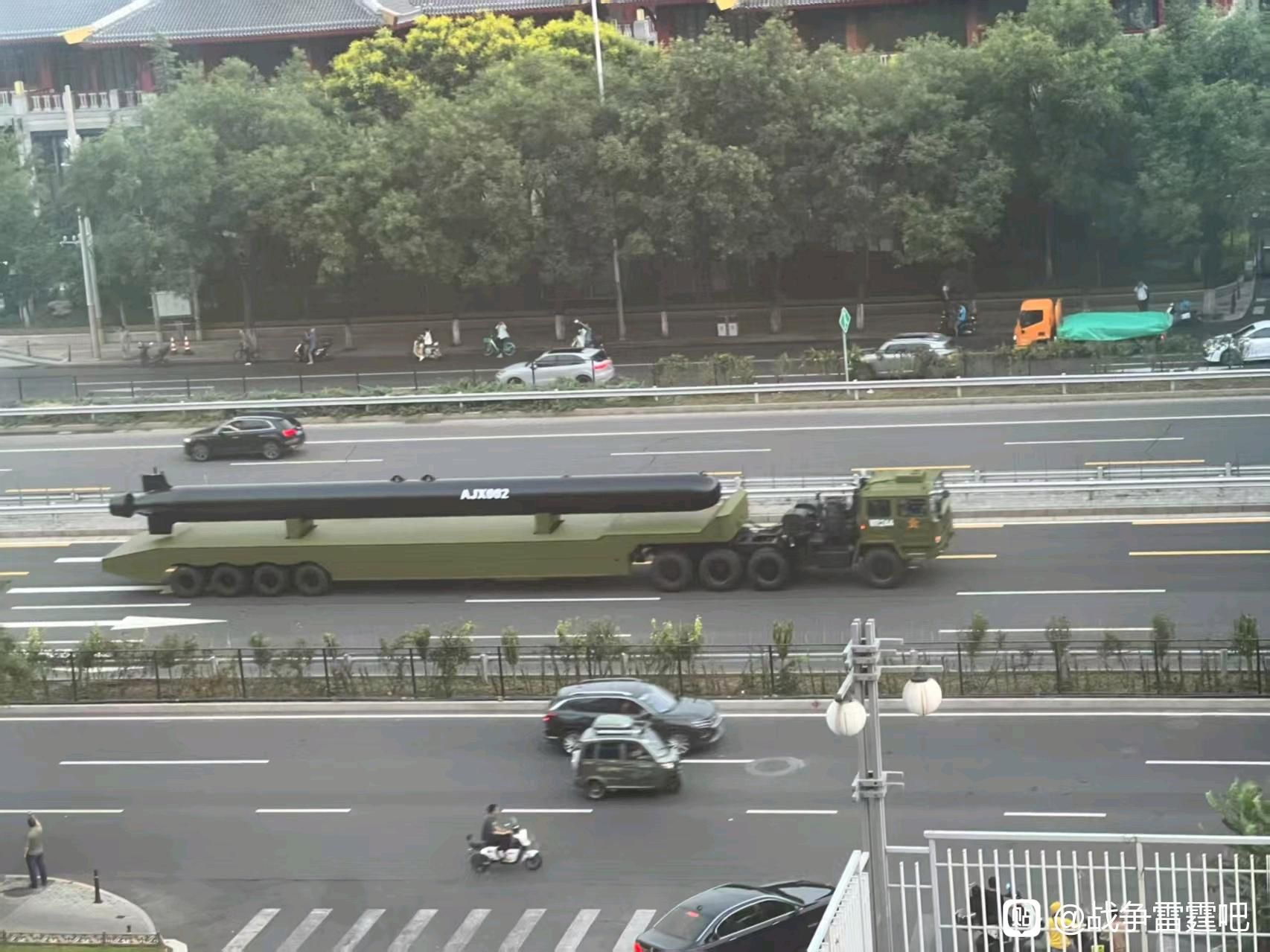
While photographs from parade preparations confirm the physical existence of the new vehicle, details on its propulsion, range, and intended mission remain unknown. It is unclear whether the drone is designed to carry conventional or nuclear payloads.
The comparison to Russia’s Poseidon has fueled debate among defense analysts. Poseidon is intended as a strategic deterrent, able to strike coastal cities or carrier groups with a nuclear warhead after traveling thousands of miles underwater. In contrast, Chinese reporting has offered little clarity on whether Beijing’s new drone is meant to replicate such a mission or serve as a different class of undersea weapon.
According to SCMP, Chinese nuclear scientist Guo Jian of the China Institute of Atomic Energy drew distinctions between the system under development and Russia’s Poseidon. Writing in the Journal of Unmanned Underwater Systems, Guo noted that there are “substantial differences” between the two projects, although he did not elaborate on the specifics of China’s design.